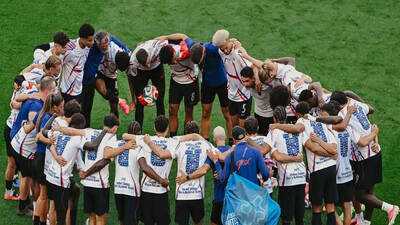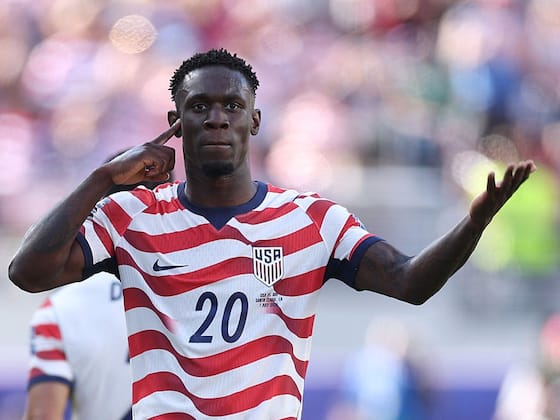
FIFA’s unexpected move to lift the suspension of U.S. striker Folarin Balogun has stirred anger in Belgium, the United States’ next World Cup rival, and ignited a global storm among football fans and political figures. The rare ruling came after a direct phone call from Donald Trump to FIFA president Gianni Infantino, prompting heated debate over political influence in football governance.
Balogun has been cleared to feature for the United States in their crucial World Cup clash against Belgium in Seattle on Monday night, following FIFA’s dismissal of Belgium’s protest over what it described as an unprecedented political interference.
A victory for the U.S. would send them into the quarterfinals — their best men’s World Cup performance since 2002.
Born in New York to Nigerian parents and raised in London, Balogun currently plays in France’s top division. His eligibility through birthright citizenship was a major boost for the U.S. team, and his inclusion has paid dividends — he leads the squad with three goals in the tournament.
However, controversy erupted on Wednesday when Balogun stepped on Tarik Muharemovic’s ankle during a 2-0 win over Bosnia-Herzegovina in the round of 32. The red card he received was widely debated — many observers felt his challenge was clumsy rather than malicious. Nevertheless, under standard procedure, a sending-off automatically results in a one-match suspension for the following game.
Had the ban stood, U.S. coach Mauricio Pochettino would have faced a major selection dilemma. While the team has several versatile attackers, few possess Balogun’s mix of physical strength and clinical finishing. Ricardo Pepi, his likely replacement, has failed to find the net in four World Cup matches.
Ordinarily, such one-match bans cannot be appealed, with reviews typically reserved for more serious offences such as violent conduct or discriminatory behaviour. Yet FIFA invoked Article 27 of its disciplinary code, which allows its judicial body to “fully or partially suspend the implementation of a disciplinary measure.” The organisation noted that Balogun could still serve a suspension if he repeats a similar offence within a year.
FIFA offered no detailed explanation for its decision, and the rule itself provides little clarity on which cases qualify for such intervention. The precedent is rare — last year Cristiano Ronaldo had two of his three-game suspension suspended, allowing him to play in Portugal’s World Cup opener while serving one match later in qualifying.
Balogun’s case appears to be the first since 1962 where a World Cup red card did not result in an automatic suspension. Back then, Chile’s president personally intervened to ensure Brazil’s Garrincha could play in the final after being sent off in the semi-final.
Infantino and Trump have maintained a well-documented relationship, with the FIFA president frequently visiting the White House as preparations for the U.S.-hosted World Cup progressed. “Thank you to FIFA for doing what was right and reversing a great injustice!” Trump wrote on social media after the ban was lifted. On Monday, he defended his call to Infantino, saying he merely asked for a review of what he believed was an incorrect decision.
Infantino previously awarded Trump a unique FIFA Peace Prize during the World Cup draw in December — an honour given to no one else before or since. Yet FIFA’s statutes clearly forbid government interference in football administration, and the body has a history of suspending national associations where political meddling occurs.
U.S. coach Mauricio Pochettino welcomed FIFA’s decision, calling the original red card “completely unfair.” But Belgium’s football federation expressed shock, with head coach Rudi Garcia describing the ruling as “something out of April Fools’ Day.” Their legal appeal was dismissed just hours before kickoff.
Later, a FIFA appeals judge ruled that Belgium “is not a party to the proceedings and, as such, has no standing to appeal the decision.” Under FIFA’s disciplinary code, suspensions of two matches or fewer are generally not open to appeal, although this clause usually applies to teams attempting to overturn bans rather than reinstate them.
It remains uncertain whether Belgium can escalate the matter to the Switzerland-based Court of Arbitration for Sport, which remains on standby for urgent World Cup disputes.
As Europe awoke to the news, Belgian Prime Minister Bart de Wever’s cat Maximus — a social media favourite — posted a cheeky message: “Red card? I’m still going to play!”
The decision has deepened tensions between FIFA and UEFA, with Europe’s governing body condemning the move as “incomprehensible and unjustifiable” and warning that “the integrity of the game is at stake.”
Norway’s coach Ståle Solbakken, whose team stunned Brazil to reach the quarterfinals, joined the chorus of criticism: “What about the next red card? Is there going to be some committee somewhere that takes that card away? It’s a bad decision that will damage the World Cup.”
Former England captain Wayne Rooney called the ruling “an absolute disgrace” during a BBC broadcast. “Infantino should be ashamed — this questions the very sportsmanship of football,” he said. However, ex-Sweden star Zlatan Ibrahimovic voiced support: “He shouldn’t have been sent off in the first place. I’m happy for the U.S. team — they’ve been fantastic, and Balo has been super-amazing.”
England manager Thomas Tuchel predicted the ruling could lead to a wave of protests over refereeing decisions. “Where do we draw the line?” he asked after England’s 3-2 win over Mexico. “Our yellow card against Declan Rice in the first minute — can we now appeal that too?”
-
Sekou Kone: Indications emerge on where ‘unplayable’ Manchester United midfielder will feature next season

-
UAE real estate proves resilient as investors seek stable, high-yield market
-
Literature review, summaries, data analysis: What are the limits of AI use in academic research?

-
Venezuela quake death toll rises to 3,535, over 16,700 injured
-
Pochettino Takes Blame for USA's World Cup Exit Against Belgium