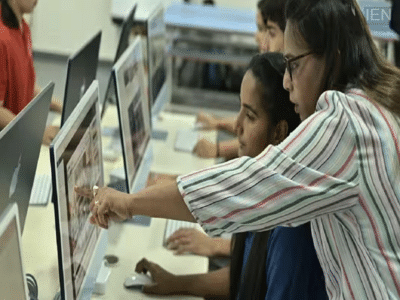
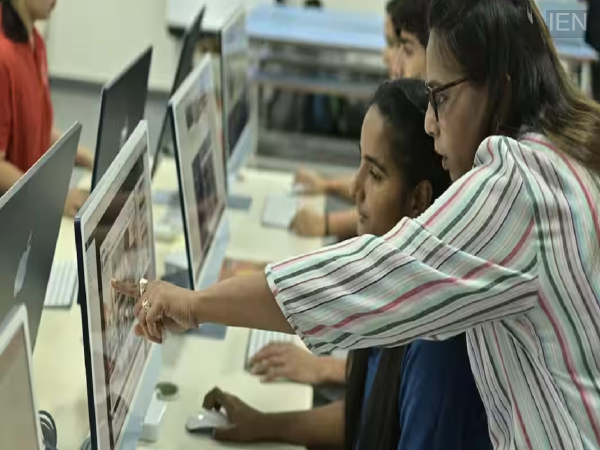
Digital Education in India: Digital technology has expanded rapidly in India over the past few years. Much like banking, entertainment, and government services, education is also swiftly shifting towards digital mediums.
Digital Education in India: The landscape of education in India is transforming rapidly; learning is no longer confined to blackboards, textbooks, and classrooms. Smartphones, the internet, AI, and digital learning platforms have begun to completely revolutionize the way we learn. Consequently, digital education and the EdTech sector are becoming integral parts of the country's education system. Experts believe that a hybrid model—combining online and offline learning—could become the norm in schools in the coming years. Let us explore whether this rising trend of digital education will fundamentally transform schooling in the near future.
Mobile and Internet Have Transformed the Learning Landscape
Digital technology has expanded rapidly in India over the past few years. Much like banking, entertainment, and government services, education is also swiftly shifting towards digital mediums. The increasing reach of smartphones and the internet has made quality education accessible not only to students in cities but also to those in small towns and rural areas. When schools closed during the COVID-19 pandemic, online learning played a crucial role in sustaining the education system. The use of digital learning platforms is steadily rising, and today, millions of students are pursuing their studies online on a regular basis.
AI is Enhancing the Learning Experience
AI is rapidly making its mark in the education sector. AI-driven learning systems now analyze students' study patterns and provide learning materials tailored to their specific needs. This offers extra support to students who are struggling, while high-performing students gain access to advanced-level content. AI has made it significantly easier to answer students' queries, analyze test results, evaluate performance, and provide personalized recommendations. As a result, education is becoming more effective and better aligned with individual student needs.
New Education Policy Emphasizes Digital Learning
The National Education Policy (NEP) 2020 places special emphasis on the use of technology in education. The government is already providing free study materials to students and teachers through digital platforms such as DIKSHA, SWAYAM, and e-Pathshala. Additionally, the government has launched several initiatives to strengthen digital infrastructure, develop a National Digital Library, and integrate modern technology into education.
AI and Computational Thinking to be Taught in Schools
Preparations are underway to introduce foundational education in Artificial Intelligence (AI) and computational thinking to students in classes 3 through 8 across schools nationwide. The objective of this initiative is to familiarize children with new technologies from an early stage and to foster logical thinking and problem-solving skills. New teaching materials are being developed, and teachers will receive specialized training to enable them to impart knowledge on these subjects to students in an accessible manner.
Will Education Undergo a Complete Transformation in the Coming Years?
Education experts believe that a hybrid model—combining online and offline learning—will prove more effective in the future than relying solely on one or the other. Alongside classroom instruction, students will be able to access supplementary study materials, recorded lectures, online tests, and personalized guidance via digital platforms. Furthermore, technologies such as Virtual Reality (VR), Augmented Reality (AR), gamification, and micro-credentials are gradually becoming part of the educational landscape, potentially making learning more interactive and practical. However, despite the expansion of digital education, several challenges persist. Internet connectivity remains inadequate in many rural areas of the country, and not all students have access to devices like smartphones, tablets, or laptops.
-
Spain Edge Portugal 1-0

-
Take a break from poha-paratha for breakfast, make delicious vegetable uttapam; You will get South Indian taste at home with easy recipe

-
Nothing’s cheapest 5G phone Nothing Phone 4b will be launched in India today

-
Cristiano Ronaldo exits his final World Cup as Portugal falls 1-0 to Spain

-
Grand Chess tour: Pragg ends tied third – Tezzbuzz