
Many parents might have experienced an instance where their child insists on hearing the exact same bedtime story every night before going to sleep. While for some adults, this might be a cause for worry to some adults as repeating the same book or story is monotonous and limits a child’s hearing, psychological research indicates the opposite case. Research suggests that repeated storybook reading helps children build vocabulary, improve language comprehension, and strengthen literacy skills.
in the Journal of Educational Psychology found that repetition allows children to become more familiar with words, concepts, and ideas, making it easier for them to retain their vocabulary over time. Thus, psychologists say that rather than reflecting a lack of creativity, rereading the same book or story appears to be an effective learning strategy for young minds.
Why children ask for their favourite story repeatedly
Developmental psychologists believe that children thrive on predictability; therefore, hearing the same story over and over reduces the mental effort that is required to follow the plot, allowing children to focus on other details that they might have missed earlier. This shifted focus often included learning new words, sentence structures, and emotions experienced by the characters. The study titled Individual Differences in 4-Year-Old Children’s Acquisition of Vocabulary During Storybook Reading found that four-year-olds learned more vocabulary when they actively engaged with repeated storybook readings than when they listened to them just once.
The benefits of hearing the same story extend beyond simply hearing words more often. by developmental psychologist Monique Senechal, named The Differential Effect of Storybook Reading on Preschoolers’ Acquisition of Expressive and Receptive Vocabulary, published in the Journal of Child Language, included three storybook reading conditions: single-reading, repeated-reading, and questioning. In both repeated-reading and questioning, the story-book was read three times. The researchers found that repetitive reading improved both receptive vocabulary and expressive vocabulary, particularly when they were encouraged by adults to participate by answering questions or naming objects from the story.
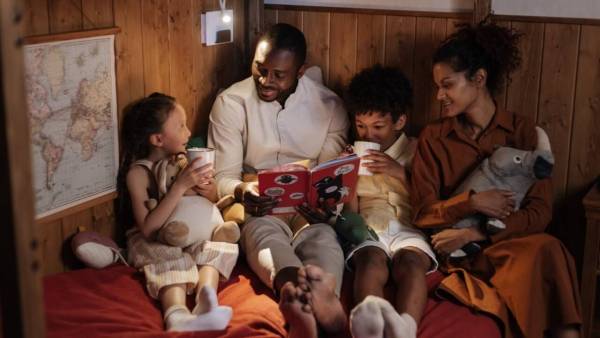
Researchers believe that repeated exposure to familiar stories strengthens children’s memory for new words, helping them to associate vocabulary with context, making future recall easier. Notably, repetition also supports how a child’s memory system develops. A review published in Frontiers in Psychology concluded that hearing the same plot repeatedly helps a child to encounter unfamiliar words in meaningful context multiple times. Additionally, the review highlighted that repeated readings consistently outperform single readings for vocabulary learning, as in former cases children devote less attention to understanding the storyline and more attention to learning language.
Conversations play an important role as well
Experts have repeatedly emphasised that reading becomes even more impactful when parents pause to talk with children about the book or the plot. A 2018 meta-analysis published in Developmental Psychology observed 38 studies involving more than 2,400 children, where they found that shared reading consistently improves a child’s world learning. This includes interactive techniques such as asking questions and encouraging discussions regarding the book, producing some of the strongest language gains.
Many say that children repeatedly request the same book because they lack imagination; that is not the case, as familiar books provide comfort while allowing young minds to practise their vocabulary skills with increasing confidence. It has been noted that as children become more and more familiar with one story, they often begin to predict sentences, recognise patterns, and eventually begin joining their parents in saying repeated phrases. And for parents wondering whether it is acceptable to read the same story for the tenth consecutive night, psychological research suggests that the answer is yes, as it might help their child to develop a lifelong skill at an early age.
-
Wife held for murdering abusive husband in Telangana’s Jagtial

-
Double elimination in Lock Upp 2, two popular names out

-
Shah Rukh Khan’s son Aryan Khan gets mobbed, video viral

-
IPL Matches In Australia? BCCI And Cricket Australia Discuss Historic Move

-
Heavy Rain Triggers School Closure In Himachal's Paonta As Sirmaur Faces Downpour