For a moment, let us set aside the multi-crore wedding industry that fuels the Indian economy in more ways than one. The Indian wedding market is estimated to be worth around ₹10 lakh crore annually, making it one of the country's largest consumption-driven sectors. Every year, nearly 1 crore weddings take place across India, supporting the livelihoods of jewellers, traditional weavers and designers to florists, photographers, caterers and homegrown artisans.
Yet, beyond these mind-boggling statistics lies something unique that cannot be measured - the emotion. An Indian wedding is as synonymous with gold, diamonds, polki, kundan and a richly embroidered zardozi joda, as it is with glass bangles, kumkum and repurposed ancestral saris. It is ultimately about emotions, about the family, tradition, belonging, and the stories that are lovingly passed from one generation to the next.
At any Indian wedding, you see soft pastel hues, heirloom textiles, uncut diamonds, polki jewellery, a gold chain that belonged to your mother or maybe the retro wristwatch that once belonged to your great grandfather, guests dressed in their best, and the unmissable smiles of the couple and their families.
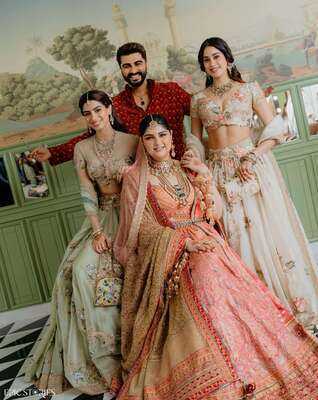
Anshula Kapoor's wedding was a reminder of why Indian weddings are as much about emotion as they are about tradition. For one of her celebrations, Anshula wore her late mother Mona Kapoor's beautifully restored 42-year-old gold tissue and zardozi dupatta. It was a piece around which she built her bridal ensemble. Paired with a handcrafted Tarun Tahiliani lehenga, heritage-inspired polki and emerald jewellery, and traditional kaleeras, the look was deeply personal rather than performative. It was not merely a thoughtfully curated bridal trousseau; it carried her mother’s blessings and memories, woven into every thread. That is what made the moment unforgettable.
Also read:
The same sentiment echoed at Aamir Khan and Gauri Spratt’s intimate wedding. Instead of a spectacle, the couple chose to exchange personal vows, sitting casually in the middle of their living room, in the presence of close family and friends. Gauri’s understated ivory bridal ensemble was complemented by layered polki jewellery, a choker, statement earrings and delicate necklaces that celebrated quiet elegance. Aamir kept his look minimal, accessorising his traditional attire with a distinctive brooch and a silver anklet that became an unexpected talking point. Their celebration proved that intimacy leaves a far lasting and deeper impression than opulence.
Indian families hold on to celebrations that are unique to regions and family traditions. The remarkable diversity woven together with emotion speaks volumes and sets desi shaadis apart from any part of the world. It is a tapestry of emotions tied together with immense love.
So even if a shaadi has London thumakda playing in the background, there will be an emotional bidaai wrapped in that perfect sentiment. Simply put, an Indian wedding is never just a ceremony. It is an emotion.
-
Mira Sethi’s divorce story grabs attention
-
Why is World Population Day celebrated? Know its history and importance

-
Why is World Population Day celebrated? Know its history and importance

-
Be careful of dampness of house during monsoon, easy and effective ways to avoid dampness, smell and mold of walls…
-
The Cancer New Moon’s Special Meaning For Your Zodiac Sign This Week, July 13 – 19, 2026