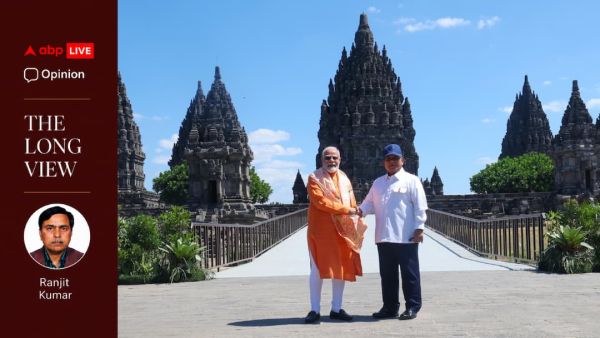
The geostrategic games — “string of pearls” and “necklace of diamonds” — being played by two Asian giants in their adversary’s region are garnering the attention of strategic community.
The strategic landscape in Asia is currently characterized by intense maneuvering among regional powers, particularly highlighted by the recent diplomatic engagements of Indian Prime Minister Narendra Modi and Chinese President Xi Jinping. Modi's visit to Indonesia from July 6 to 8, alongside Bangla Desh PM Tarique Rahman's trip to Beijing from June 22 to 26, underscores the strategic competition between the two Asian giants as they seek to assert their influence in maritime domains traditionally dominated by their adversaries.
This dynamic is particularly evident in the context of China's "string of pearls" strategy, which aims to encircle India through a network of strategic partnerships and infrastructure projects in South Asia. In response, India has initiated its own counter-strategy, termed the "necklace of diamonds," in strategic circles, which focuses on strengthening ties with China's maritime neighbours to deter aggressive actions from Beijing.
Sabang Port And Defence Cooperation
The recent defence cooperation agreements forged during Modi's visit to Indonesia are of considerable significance, marking a substantial shift in the regional balance of power. The memorandum of understanding to jointly develop the strategically vital Sabang port, located near the entrance to the Malacca Strait, represents a significant advancement in India’s maritime strategy.
This collaboration is further bolstered by Indonesia's decision to procure advanced weapon systems from India, including the BrahMos supersonic cruise missiles and Astra air-to-air missiles. Such developments not only enhance Indonesia's defence capabilities but also serve to deepen the strategic partnership between the two largest democracies in Asia, thereby creating a formidable counterweight to China's expanding influence in the region.
Shifting Regional Alignments
The geopolitical implications of these developments are profound, particularly in light of Bangladesh's recent decision to transfer control of the Mongla port to China for modernization and operational purposes, a move that has raised concerns among Indian strategists.
In contrast, Indonesia's proactive stance in collaborating with India on the Sabang port and its acquisition of advanced weaponry signals a shift in regional alliances that could unsettle Chinese strategic calculations. India's previous transfers of BrahMos missiles to the Philippines and its agreements with Vietnam further illustrate its commitment to challenging China's dominance in Southeast Asia.
As countries like Vietnam, the Philippines, and Indonesia increasingly turn to India for defence procurement, the Indian Navy's ongoing interactions with other Southeast Asian nations such as Singapore, Malaysia, Brunei, and Thailand reinforce the emerging security architecture aimed at countering Chinese assertiveness in the region.
India and its ASEAN partners have been enhancing defence cooperation through joint exercises, port visits, military delegations, and coordinated maritime patrols. The Indian Navy is actively involved in ensuring maritime security, focusing on maintaining an open, transparent, and rules-based Indo-Pacific region. This collaborative effort aims to promote interoperability among the nations involved, fostering a peaceful and prosperous maritime environment.
China's Presence In South Asia
In contrast, India's neighbouring countries, such as Pakistan, Bangladesh, and Sri Lanka, have increasingly turned to China by offering their ports, including Gwadar, Mongla, and Hambantota.
On the other hand, Chinese maritime neighbours in the South China Sea are now looking to India for development contracts and access to advanced weapon systems. Notably, the proposed Indian management of Sabang port represents a significant development in this context, highlighting India's growing influence in the region.
While terms like "String of Pearls" and "Necklace of Diamonds" are not officially defined strategies, they reflect a clear intent by both India and China to secure their respective spheres of influence.
India’s recent move to supply advanced weapon systems to ASEAN nations contrasts sharply with China's long-standing defence relationships in the South Asian region, where it has provided submarines, ballistic missiles and other advanced weaponry to Pakistan and Bangladesh. The ongoing construction of a submarine base in Bangladesh further underscores China's commitment to strengthening its military presence in the Indian Ocean.
The Pekua base will facilitate the monitoring of Indian military activities in the Bay of Bengal, while the Sabang port will enhance capabilities to obstruct China's maritime traffic through the Malacca Strait. This strategic positioning underscores the importance of regional security and the need for vigilance against potential threats.
ASEAN, UNCLOS And Indo-Pacific Strategy
In discussions with ASEAN members, there is a consistent emphasis on the principles of sovereignty, territorial integrity, and adherence to international law of the sea , particularly the 1982 UNCLOS, not recognised by China. The revival of the Memorandum of Understanding on maritime safety and security cooperation with Indonesia marks a crucial advancement in fostering dialogue and collaboration among nations, while ensuring freedom of navigation and over flight.
India actively engages ASEAN partners in a unified stance against terrorism, advocating for a zero-tolerance approach. In light of the diminished commitments from the United States regarding the four nation QUAD, it is essential for the littoral states of the South and East China Seas to collaborate in countering China's provocative actions.
This cooperation is also vital for India, as a significant portion of its maritime trade traverses these critical sea lanes, reinforcing the need for a collective strategy to uphold regional stability and sovereignty.
A recalibration of the Indo-Pacific strategy is essential for fostering collaboration among key partners such as Japan and Australia, with the aim of bolstering the resolve of ASEAN member states to counteract China's attempts to assert dominance over the South and East China Seas.
To effectively achieve this, it is crucial for the Indian security establishment to take proactive measures that enhance the military capabilities of ASEAN nations. By doing so, these countries will be better equipped to neutralize any aggressive maneuvers by China that seek to undermine the sovereignty of the littoral states in these strategically significant maritime regions.
Critical Minerals And The 'Necklace Of Diamonds'
During Prime Minister Modi's recent visit to Jakarta, a significant highlight of the comprehensive outcome document was the agreement to enhance cooperation in the production of critical minerals and rare earth magnets.
The manner in which China has strategically weaponized selective export licenses for components derived from critical minerals has sent shockwaves through emerging economies like India, as well as the broader industrialized world, which has found itself increasingly reliant on Chinese monopoly on supplies. This situation underscores the urgent need for nations to diversify their sources and strengthen their own production capabilities in order to mitigate vulnerabilities associated with over-dependence on a single nation.
In this context, the development of India's undeclared "necklace of diamonds" strategy is garnering considerable attention within Indo-Pacific strategic circles. Indonesia, in particular, possesses significant potential for both economic and strategic collaboration with India, which could serve to fortify the Indo-Pacific alliance.
Therefore, Prime Minister Modi's visit to Jakarta is poised to be a landmark event, potentially paving the way for deeper ties and cooperative initiatives that will enhance regional stability and security in the face of growing Chinese assertiveness and other geopolitical challenges.
-
Breel Embolo breaks down after mistaken VAR red card in Switzerland’s World Cup 2026 quarter-final against Argentina

-
England Rewrite Record Books! 6 Massive Milestones From India's 4-0 T20I Nightmare

-
CJP Protest Day 23: Wangchuk's Health Worsens As Fast Enters 15th Day

-
Erling Haaland’s father criticises referee after Norway’s World Cup loss to England

-
Mumbai: NCLT Orders Liquidation Of Rao Edusolutions After Resolution Process Fails