12 July 2026
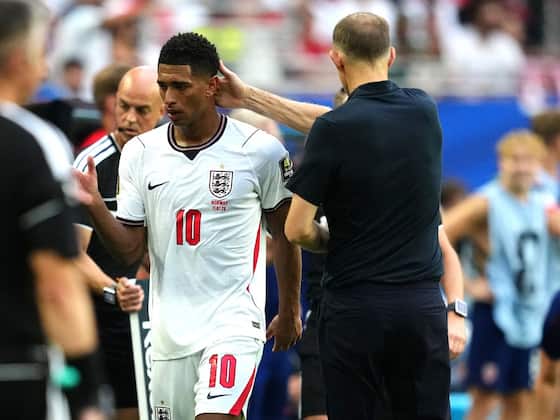
After two contrasting interpretations of England’s match against Norway, the ongoing discussion around Thomas Tuchel and Jude Bellingham’s working relationship offers another split in perspective.
On one side, Bellingham’s post-match remarks could not have come at a worse time, especially ahead of an emotionally charged World Cup encounter with Argentina. England need complete unity, and the blunt tone of their match-winner’s interviews may unnecessarily risk that cohesion.
Yet, depending on his temperament, Tuchel might view the moment as a sign of productive tension rather than discord.
Given the emotional weight of the situation, it’s worth examining the details closely.
Tuchel praised his players’ mentality in their hard-fought 2-1 comeback win over Norway but offered a sharp technical critique during his brief interview.
“It’s amazing but I’m not happy with the performance,” the German coach admitted. “In every sense. The commitment is there but we made life very difficult for ourselves with how we played: sloppy, too many technical mistakes, not quick enough, not repetitive enough. We were lucky today.”
When these comments were relayed to Bellingham moments later, England’s star midfielder gave a terse response, his body language revealing even more than his words.
“Maybe... but maybe he doesn’t know what it’s like to play in those kinds of conditions against Erling Haaland, Martin Odegaard, Antonio Nusa, Alexander Sorloth.”
In another appearance, Bellingham shrugged off the criticism: “Yeah, well, whatever. Whatever. It’s difficult out there. It’s a tough shift.”
He then redirected attention towards his teammates, saying, “All the players put in a tough shift, so my thoughts and appreciation go to the players who were out there and gave everything again.”
The visible disagreement, mainly highlighted through ITV’s Gabriel Clarke, sparked surprise and concern within the team environment. Several individuals described themselves as “shocked.”
Many felt Bellingham’s reaction was unnecessary, and some even interpreted it as a subtle dismissal of Tuchel’s playing career — a sensitive topic for certain managers. Tuchel has faced similar tensions before, particularly during his time managing key figures at Bayern Munich.
The controversy has raised questions about whether England’s much-celebrated “brotherhood” remains intact or if divisions are forming at the top.
And hovering over it all is the daunting challenge of facing Argentina.
Some observers, however, argue that this friction is actually part of Tuchel’s deliberate dynamic with Bellingham — a push-and-pull relationship that has steadily elevated the young midfielder’s performances.
While Bellingham’s brilliance now rightly earns widespread praise, Tuchel’s emotional intelligence deserves credit too. At Paris Saint-Germain, he managed Neymar in a similar way, coaxing the Brazilian into his best form since 2015 during the 2019–20 season.
Back in October, Tuchel’s decision to drop Bellingham was viewed as a turning point. It forced the player to confront his approach and understand what was required of him within the England setup.
Since then, Bellingham has been seen as “matured,” showing a more composed persona than during Euro 2024.
The controversial omissions of Cole Palmer, Morgan Gibbs-White and Phil Foden were also part of the same plan — reinforcing Bellingham’s status as the central figure in England’s system. It’s striking to recall that, not long ago, there had been debate over whether Real Madrid’s star or the promising Morgan Rogers would start.
Tuchel had already made up his mind before the World Cup. Rogers’s form last autumn was impressive, and Tuchel appreciated how his inclusion aided the team’s flow. But his long-term objective remained clear: to refine Bellingham, smooth out his rough edges, and ensure England harnessed his full potential — just as he did with Neymar.
This is why the perceived regression in their rapport has taken many by surprise.
Perhaps it’s the confidence that comes naturally to elite competitors after a standout performance like Bellingham’s against Norway. The reality remains that England desperately need him.
Tuchel faces mounting challenges despite overcoming numerous hurdles. Harry Kane, once England’s most influential figure, looked sluggish for the first time. Declan Rice’s fitness is a growing concern, given his vital role in maintaining the team’s structure — as this match exposed England’s lack of alternatives in his position.
Tuchel still appears reluctant to fully trust Kobbie Mainoo. Reece James remains short of match sharpness. Across the backline, Marc Guehi and John Stones both seemed below peak condition.
Bukayo Saka’s inconsistent season, meanwhile, limits him to sporadic bursts of form.
All this makes England a somewhat unbalanced side for a team considered among the world’s top four. Yet, they remain in the semi-finals largely because of one man: Bellingham.
Tuchel may secretly appreciate that as much as the goals themselves. Known for his candour, the German coach often speaks his mind freely — including about Bellingham — so it’s entirely possible his feelings mirror the player’s intensity.
Tuchel favours dressing rooms with strong personalities, where players engage him directly. But this exchange didn’t occur behind closed doors. It happened publicly — something that would typically challenge authority, especially in a tactically unsettled team.
In the end, only one opinion truly matters: Tuchel’s. Yet, right now, there’s also little doubt that only one player truly defines England — Jude Bellingham.
-
Akansha Ranjan Kapoor Appoints BFF Alia Bhatt For Kaleera Duty Before Marrying Sharan Sharma

-
From Earnings To Inflation Data: Key Factors To Drive D-Street

-
Sinner beats Zverev to retain Wimbledon title

-
Tragic Fire Claims Lives at Bangkok Entertainment Venue

-
Countryfile presenter admits 'breaking rule' as guest forced to step in