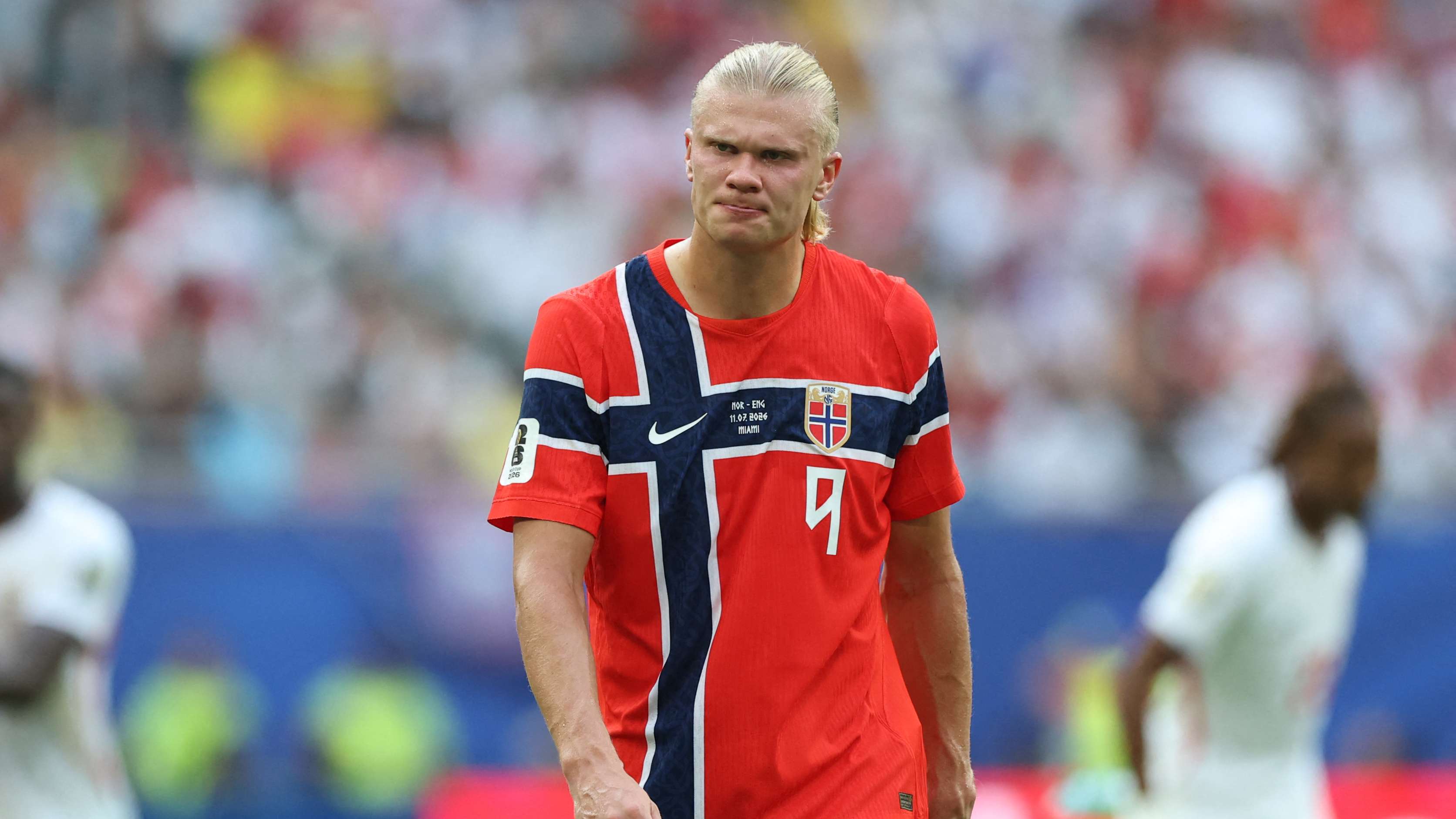
Erling Haaland’s unusually quiet showing during Norway’s World Cup quarter-final defeat to England has been traced back to a sickness bug that affected several members of the Norwegian squad. The Manchester City striker looked far from his energetic best before being substituted in extra time as England clinched a 2-1 win to progress to the semi-finals.
Illness affects Norway’s key man
Before the match, much of the anticipation revolved around the clash between Harry Kane and Haaland. However, the Norwegian forward struggled to impose himself in the game. Former Premier League striker Tony Cascarino revealed that Haaland had been battling a physical issue similar to the illness that plagued England’s Declan Rice earlier in the week.
Cascarino explained that he received information about Haaland’s condition during the interval of the intense knockout fixture. “No, I was told last night, I got a message at half-time that apparently Erling Haaland wasn’t well,” Cascarino told the World Cup Weekender on talkSPORT. “He was another one who was suffering from a sickness. So, obviously the manager has alluded to it saying fitness issues, and he clearly didn’t look right. Whatever we say, he didn’t look right physically. He’s come off, and he didn’t say an injury. So I presume it was exactly what I just said. He suffered from not being well.”
Energy levels drop below usual standards
Statistics supported what was visible to the fans — Haaland was not his usual dominant self against England defenders John Stones and Marc Guehi. Although teammate Alexander Sorloth missed an opportunity to set him up when Norway were 1-0 ahead, Haaland’s reduced movement and stamina were the main concerns among supporters in Miami. The forward was also involved in the game’s biggest controversy, when Torbjorn Lysaker Heggem’s goal was ruled out by VAR after officials determined that Haaland had fouled his future Manchester City colleague Elliot Anderson in the build-up.
Cascarino further highlighted how the illness impacted Haaland’s usual intensity. “He was unwell, yeah. He was unwell prior to the game,” Cascarino added. “He doesn’t touch the ball a lot anyway but I was surprised about how much energy he lacked as well. Him and Sorloth both looked like they didn’t have that drive, and he looked absolutely… I just looked at him afterwards and thought, well, what I’d heard at half-time — I’m saying I know it from somebody who would know that — he was meant to be [sick], he wasn’t well.”
Solbakken clarifies the substitution
Norway’s head coach Stale Solbakken later explained that substituting Haaland was an easy call given his physical condition. Haaland, who had been Norway’s standout performer with seven goals in the tournament, finally appeared to run out of energy during the quarter-final.
Speaking after the match, Solbakken said: “It was not a tough decision to take him out, because he was finished. Maybe I should have taken him out ten minutes before. Obviously, he has had a tremendous World Cup, he used all his energy and power game after game after game. I think that he also got a dead leg in the second half, so that combined with the fatigue. But he did everything that he could, I think he was a bit unlucky in a couple of situations. But he scored seven goals in five games for us, he had a fantastic World Cup.”
Similar struggles for Declan Rice
The illness problem wasn’t limited to Norway’s camp. England midfielder Declan Rice was also reported to have battled a similar condition in the days leading up to the match. The Arsenal player had been confined to bed for several days before manager Thomas Tuchel decided he could only feature for 45 minutes in the quarter-final. As the World Cup approaches its concluding stages, the growing fatigue among top players has become a major topic of discussion.
-
Taurus Tarot Horoscope Today, July 13, 2026: Physical energy will rise, boosting activity
-
Aquarius Daily Horoscope Today (Jan 20 - Feb 18), July 13, 2026: Expect Gains and Stronger Bonds Ahead
-
Cancer Daily Horoscope Today (Jun 21 - Jul 22), July 13, 2026: Stay Sensitive and Value Your Friendships
-
Virgo Daily Horoscope Today (Aug 23 - Sep 22), July 13, 2026: Confidence Will Soar, Charm Will Shine
-
'This One Means A Lot': Jannik Sinner Opens Up After Historic Wimbledon Triumph