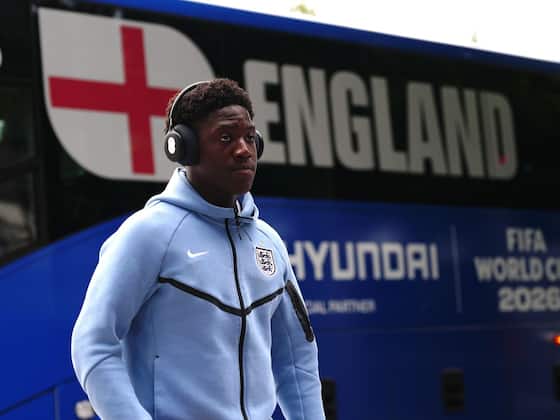
England have reached the semi-finals of the World Cup, though expectations of them lifting the trophy remain modest. But one question continues to puzzle fans — why did Thomas Tuchel decide to bring Kobbie Mainoo along?
None of us outside the England camp have access to what happens in training sessions, tactical briefings, or within team meetings, so our insights pale in comparison to the manager’s. Still, when a situation arises where your central midfielder needs to come off, do you:
a) Bring on the fresh midfielder waiting on the bench — who has yet to play a minute but was a vital part of the Premier League side that earned the most points since Christmas, OR
b) Introduce an attacker, disrupt your team by shifting your best player out of position, and end up in chaos — so much so that you’re forced to change things again after conceding a goal to Norway and being thoroughly dominated?
Then, when your initial plan falls apart, do you:
a) Bring on that same fresh central midfielder, or
b) Introduce a right-back, further destabilising the midfield and shifting players out of their natural roles?
England may have scraped through, but one has to wonder — why even take Mainoo? Ryan, Bermuda (Madueke remains a signpost reading ‘no threat from this flank until substitutes arrive’).
Let’s save everyone some time ahead of Wednesday’s match...
... England will take a 1-0 lead right after the hydration break or a Tuchel tactical adjustment (yes, that rhymed unintentionally) with Bukayo Saka channelling his inner Arjen Robben, cutting inside from the right and curling a shot into the top corner.
... Around the 60th minute, Jude Bellingham, after being targeted all game, will lose his composure and receive a red card. Shortly after, Argentina will score a disputed goal while an English defender lies on the turf.
... England will hold on to force extra time, but another defensive injury will compel Tuchel to bring on Phil Neville (or any scapegoat of your choosing), who will lose track of Lionel Messi — allowing the Argentine star to score the decisive goal with about 10 minutes left.
... England will respond by introducing Harry Maguire (or another big target man) and resort to lofted long balls into the Argentina box, resembling soldiers tossing grenades.
... The match will conclude with Emiliano Martinez clearing the ball off the line.
Just as FIFA would have scripted it. Adidasmufc
(Is it just me, or does anyone actually enjoy watching England play? I feel like I need a defibrillator beside me every time.)
Like their campaigns in 1986 and 1990, England have once again assembled a decent, albeit exhausted squad.
Marc Guehi and John Stones, with Ezri Konsa, Reece James, and Ryan O’Reilly followed by Djed Spence, will make life difficult for Argentina.
If Declan Rice cannot last 90 minutes, Morgan Rogers — with his long-range shooting ability — could be a useful alternative.
It will likely be tense but close, with a place in the final against either France or Spain at stake. Peter, Andalucia
After skimming through this morning’s mailbox, I’m shocked by the negativity. Didn’t you lot just win a World Cup quarter-final? Robert, Irishman in Birmingham
I didn’t catch the post-match interviews because we were too busy singing ‘Three Lions’ and ‘We’ve Got Bellingham’ (so glad my son is finally hooked on football!). But what I’ve read here today echoes my own thoughts.
Perhaps this is our level, and maybe that’s fine. For most of my life, England couldn’t cross the finish line — whether in brave defeats or complete collapses. Now, we regularly edge through tough moments, even if not yet to ultimate glory. Performances may not always dazzle, but the grit and desire to win — qualities we always accused them of lacking — are finally there.
Since 2018 (the year my son was born — lucky lad), we’ve had several unforgettable tournament moments: Tunisia’s last-minute winner, Panama for sheer fun, Colombia for the penalty shootout triumph, Sweden for breezing through, Croatia for taking the lead in a semi-final, Germany for the tense win, Ukraine for a calm victory, Denmark for finally winning a big match, Italy for leading in a final, Iran for free-flowing football, Wales for thrashing a neighbour, Senegal for overcoming a tricky test, and France for a performance worthy of pride despite defeat. Then came Slovakia, Switzerland, the Netherlands, and Spain in 2024 — each providing drama, resilience, and unforgettable moments. This year, victories against Croatia, Panama, DR Congo, Mexico, and Norway have all added to a thrilling run.
That’s an incredible amount of joy. Critics might ask, ‘what have we actually won?’ But looking back over the last eight years, we’ve had more memorable moments than in the previous two decades combined. You’d have to go back to the early 2000s for anything comparable — and even then, those campaigns ended prematurely due to mental fragility.
No grand conclusion here — just enjoy it. For once, we’re living through an England team that delivers the drama and determination we always wanted.
I originally intended to write about Bellingham’s remarkable balance after scoring the winner — the way he glided through the air and celebrated without falling — pure athleticism. Most of us would have crashed to the ground in that situation. Incredible stuff. Paul
I absolutely loved how Tuchel handled that reporter. This obsession with turning football into soap opera storylines deserves pushback. To raise questions about ‘mentality’ given the relentless media scrutiny since Tuchel’s appointment was bound to trigger that fiery response — and it was glorious to watch.
Reintroducing Tuchel’s reaction during Bellingham’s interview, purely to provoke a response, was a cheap move. Manufactured conflict at its worst.
The English media environment feels toxic. It’s hard to believe some journalists actually want England to win — clicks seem to matter more. I’d love a media panel where players and managers could ask why the press so often act like antagonists. Semi-final next — bring it on. Alexander Tovey
...and thank you, Matt Stead — seemingly the only level-headed sports writer in the country today. Rob
Tuchel handled his post-match comments perfectly — they’ll motivate Bellingham and the rest of the squad ahead of Wednesday’s clash. Now’s not the time for overpraise if we truly believe in bringing it home. Woz
It takes quite a poor article to make me write in, but you’ve managed it. ‘Jude Bellingham needs to shut up and play football?’ It was an innocent answer to a loaded question. I get that you’re being deliberately provocative for clicks, but that kind of journalism doesn’t foster loyal readership. You got my click once — congratulations — but I won’t be back. You used the word ‘embarrassment’ in your piece; on that, I’ll agree — since it fits the author perfectly. Bob Sacamano
I also want to highlight Switzerland’s performance against Argentina. Here’s a quick recap:
– Switzerland slightly outplayed Argentina until conceding from a corner.
– Conceding from a set piece against Argentina is frustrating and costly for underdogs.
– They responded well to equalise and looked the stronger side before the red card.
– The match was well-balanced, and the red card turned the tide.
– Breel Embolo’s dismissal — due to mistaken VAR identity — was harsh and unfortunate.
– Switzerland defended superbly for 110 minutes, and it took a world-class strike to beat them.
– Missing key attackers like Vargas and Manzambi left them unable to chase an equaliser.
– Had this been a primetime European kickoff, perhaps the performance would have earned more respect from the media.
Just as Swiss public transport is known for punctuality, you can always count on Switzerland to reach the quarter-finals of a World Cup or Euros — maybe soon they’ll go even further. Oliver Dziggel, Geneva, Switzerland
As accurate as the Champions League forecasts were, so too have the World Cup predictions proven. The data highlighted five genuine contenders — Argentina, Spain, France, England, and the Netherlands — with a 66.66% probability that one would win.
The absence of a dark-horse semi-finalist for only the second time in 40 years when the tournament is held outside Europe may signal a trend. With advanced data analytics and scouting, smaller teams find it harder to surprise elite opposition. Just as the Champions League no longer sees clubs like Porto or Monaco gate-crash the latter stages, neither will we see future World Cups produce new Moroccos, Turkeys, or Bulgarias. The fact that all top four seeds reached the semi-finals confirms this shift.
As for the likely winner, statistics suggest it often depends on which team enjoys more rest before the final. Reviewing the last 10 World Cups, teams that played their semi-final first have had a slight edge — especially in recent decades, as sports science has improved.
Among the last five tournaments, four winners came from Day 1 semi-finalists, indicating that even a single day’s extra rest can prove decisive when margins are razor-thin.
That spells trouble for England, the Day 2 semi-finalists, who already endured extra time in their quarter-final, and even more so for Argentina, who faced extended matches earlier in the knockout rounds. Their best route to success now? Win the semi-final in regulation time and hope Spain or France go the distance.
-
Dubai Housing Sales Drop 16% to AED 225.7 Billion in H1 2026 Amid West Asia Conflict

-
Stop Wasting Time! 12 Everyday Habits That Make Life Easier! Click here to know about it

-
WhatsApp: If you want to hide your WhatsApp profile photo from certain contacts, then follow these easy steps

-
Ayushman Bharat Yojana: How Eligible Families Can Get Healthcare Support Without Financial Stress

-
Man Plants a “Magic” Tree in His Garden — Then Gets Shocked by What Grows on It!