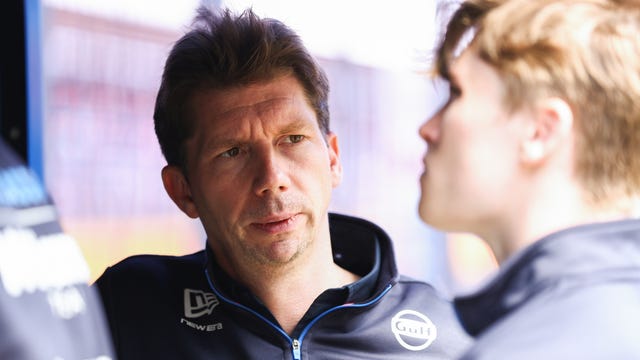
When James Vowles took charge as the Williams F1 Team Principal in January 2023, the once-dominant outfit was struggling, having finished 10th in the Constructors’ Championship for the fourth time in five years. The former Mercedes strategist faced a monumental challenge; turning the team’s fortunes around was like steering an oil tanker—it was bound to take time and patience.
Vowles began laying the groundwork for transformation, reshaping the team’s structure and bringing in key personnel. A major breakthrough came in the summer of 2024 when he convinced Carlos Sainz to join Williams, successfully selling his long-term vision to the Spanish driver. Their collaboration paid off handsomely as the team climbed to fifth in the Championship the following year, with Sainz exceeding expectations by securing a couple of podium finishes.
However, progress in 2026 has stalled. The FW48 car was delayed and missed the first pre-season test in Barcelona, besides being significantly overweight. Even that didn’t fully account for its lacklustre performance in the opening races. Although the car gradually improved, occasionally allowing Sainz and teammate Alex Albon to collect points in high-attrition races, it remained fundamentally flawed.
To address this, Williams has chosen a comprehensive redesign—similar to what Aston Martin has undertaken—introducing a major upgrade package that Vowles refers to as a “B-spec” version, due for debut at the Azerbaijan Grand Prix in September. Assuming the two Middle Eastern races remain on the schedule, Sainz and Albon will have eight rounds to secure stronger results and lift the team from its current eighth position in the standings. Such a mid-season reset is a massive undertaking and signals that the original car concept missed the mark.
Vowles considers the situation a test of the team’s resilience. “In terms of our direction, we need to prove to ourselves as a business that we can deliver engineering excellence and build a car to the right quality level during the season,” he explained. “It’s essentially like flying a plane and rebuilding it at the same time. But we must demonstrate that we’ve evolved from where we were three years ago and that we now have that capability. At present, we’re on track to achieve that.”
He draws parallels with Aston Martin’s current efforts, where Adrian Newey is also striving to overhaul the team’s performance with a substantially revised car mid-season. “We lacked proper process systems and structural foundations,” Vowles admitted. “I know what efficient organisations look like, and even today we’re struggling to match what other teams can achieve. It’s on us to fix that. The challenge is doing so while still progressing on track.”
The situation at Williams highlights the inherent difficulty of Formula 1, particularly for midfield teams trying to close the gap to the established front-runners—Mercedes, Ferrari, Red Bull, and McLaren. Although Williams had made strides in recent years, overhauling its operational methods takes time. Doing so while simultaneously developing a new car under revised regulations has been a formidable challenge.
It’s no surprise that the top four teams have extended their advantage in 2026 after the field had gradually evened out under the previous set of technical rules. Entering this season, those leading teams were fully prepared to channel resources into maximising performance, while teams like Williams were still refining the processes required to build a competitive car. Vowles knew 2026 would be tough, but the reality has proven even more demanding. “I thought we could produce a car that, while slightly overweight, would still be roughly on schedule,” he said. “We never claimed to be the benchmark this year. It just needed to work. Unfortunately, we didn’t meet that expectation—we underperformed relative to our own targets.”
Williams’s biggest setback over the winter was falling behind schedule. Designing and building a new F1 car is an enormous project that depends on thousands of components being designed, manufactured, and integrated in a coordinated manner. Doing this while simultaneously refining the processes that support it is like playing three-dimensional chess—when one piece goes wrong, the entire plan collapses.
“The first time the data flagged an issue, it was already too late to make corrections,” Vowles revealed. “It sounds strange, and it took me some time to understand, but when you fall three weeks behind—as we did—it becomes unrecoverable. There’s simply no way to catch up. Everything else in the production chain is scheduled based on those dates, so when one part slips, everything else does too. The effort required to recover is enormous, and the only option left is to compromise—which is exactly what you’re seeing now.”
Despite the challenges, Vowles sees valuable lessons emerging from the 2026 season as the team continues to bridge the gap to the frontrunners, including his former employer. “Understanding the capacity of your operations is data Mercedes accumulated over at least a decade—from around 2010 to 2026,” he explained. “We built that knowledge in just one year, during this winter. It’s not just about systems and processes; it’s about the working culture and expertise that come with it.”
Vowles remains optimistic about the future. “Never let a good crisis go to waste,” he said. “The changes we’ve implemented have put us in a strong position going forward, and honestly, we wouldn’t have made them if we’d had partial success over the winter. As painful as this experience has been, I believe it was necessary for our growth.”
-
Only 39 pc government school teachers qualify TET in Telangana
-
SC ready for hearing in Bhojshala dispute, urges patience

-
India, UK trade pact to come into force from July 15: An Explainer

-
Five years after deadly floods, a German valley prepares for the next one

-
Patan's Rani Ki Vav 3D Projection Show Wins Gold at WOW Awards Asia 2026