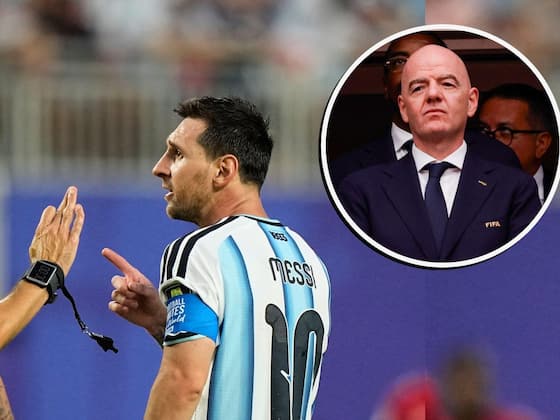
If you have spent any time scrolling through social media over the past few weeks, you would have seen the uproar surrounding the idea that Argentina have been favoured by referees during the 2026 World Cup.
Take a breather, step outside, and it becomes clear that this is pure mass hysteria. It’s like watching the Dancing Plague of 1518 from a safe distance and wondering if everyone is alright.
Once you step out of the monetised, engagement-driven echo chamber—complete with bizarre invocations of Benjamin Netanyahu and Israel that are as illogical as they are offensive—you’ll realise how far this conspiracy theory has spread beyond its origins.
The BBC even brought in their rules expert, Dale Johnson, to examine the question: ‘Are Argentina being treated favourably at the World Cup?’
This is hardly the kind of coverage FIFA would have wanted for its marquee tournament, but the organisation has only itself to blame for the way suspicion and speculation have taken root.
By blurring the lines of its own disciplinary processes, FIFA have created an environment where every controversial refereeing call is now viewed with suspicion.
However, the noise surrounding Argentina ignores the reality that their campaign has not benefited from any major officiating errors. Nothing that would have prompted the PGMOL to issue an apology had it happened in the Premier League.
There’s been nothing as baffling as Kylian Mbappe’s denied penalty against Senegal or Ghana’s unawarded spot-kick versus England. Imagine the uproar if those incidents had involved an Argentine player.
This is what happens when people try to weave separate incidents into a single narrative. FIFA are supposedly pro-England? They like Senegal but dislike Ghana? They’re anti-France as well? Conveniently ignoring that France received two penalties in the last World Cup final.
Start connecting the dots and you’ll quickly see how absurd it all becomes.
The reality is that referee errors, including those involving VAR, are far more plausible than any secret instructions from Gianni Infantino.
Yes, Lionel Messi could have been sent off in the opening match for a studs-up challenge, but replays showed minimal force. It was more of an orange-card situation.
We’ve seen similar fouls go unpunished before — even worse challenges against Argentina in this very tournament.
Leaving aside the chaos surrounding Folarin Balogun’s red card for the moment, the fact that the decision was so hotly debated — not just by uninformed spectators like Donald Trump — shows that such calls are rarely straightforward.
What else is there to support the conspiracy?
Egypt had a goal ruled out after a clear foul on Lisandro Martinez.
They also had two penalty appeals dismissed right before Argentina’s late winner, both of which were clearly baseless upon review.
Switzerland’s Breel Embolo was sent off due to a strange VAR interpretation previously used to caution Miguel Almiron. Poor Almiron then fell foul of another new rule in the following game.
So what, exactly, are we left with?
Messi escaped a booking against Algeria.
Argentina, like Paraguay against France, have benefited from relatively lenient officiating. They could easily have collected a few more yellow cards, as even the BBC noted.
So, Argentina might have received a few fewer bookings. That’s it? Call Oliver Stone — there’s your next JFK script.
Back on planet Earth — among people not losing their minds on Elon Musk’s X — this supposed Argentina scandal has been met with the indifference it deserves.
Spain manager Luis de la Fuente said, “I honestly don’t understand why you ask me about the controversy surrounding the referee in the Argentina vs. Egypt match. Where did that even come from? I watched the game and thought the referee got everything right. I’d actually like to congratulate him because every decision he made was spot on.”
France manager Didier Deschamps agreed, saying, “We have to deal with it. I trust the referees. Our opponent is Morocco, not the referee. Let’s hope ours are as good as Monsieur Letexier was.”
There was some noise about an Argentinian officiating team handling France’s quarter-final, but the match went by without incident. Clearly no grand plot there.
However, broadcaster Richard Keys remains suspicious: “Is no one else going to say it? I have been since its introduction – the best & easiest way to fix a football match is with VAR. It goes on in plain sight – ask Egypt.”
He followed up later: “Pierluigi Collina insists no one is trying to get Argentina into another final. Ok. That’s it then. We have to believe him. Evertonians remember Collina’s last ever game very well. Did we ever find out why he disallowed Ferguson’s goal?”
Keys may think he’s making a valid point, but he’s missing the real issue.
FIFA refereeing chief Pierluigi Collina stated in a press briefing, “Of course, constructive discussion about decisions will always be part of football, but unfounded allegations have no place in our sport. Nobody can question the integrity of the FIFA World Cup match officials. When this happens, it may provoke reactions that lead to threats against them and their families. This is not right.”
He’s correct. If you truly believe referees are compromised, there’s little reason to watch or care about the competition.
Ultimately, there is no evidence to support claims of corruption. No official at this World Cup has done anything to justify accusations of bias, however disputed some decisions may be.
Still, FIFA now face a credibility crisis of their own making. Their interference in disciplinary matters — such as the handling of Folarin Balogun and Cristiano Ronaldo’s suspensions — has eroded trust.
When FIFA appear willing to intervene to ensure a superstar or host nation’s player can participate, it’s not a big leap for fans to suspect they might influence referees too.
That line of thinking is dangerous — and deeply corrosive.
Gianni Infantino must be pleased that the four seeded nations, the top-ranked sides, have reached the semi-finals. It makes for marketable matchups: Kylian Mbappe versus Lamine Yamal, Harry Kane versus Lionel Messi.
But if FIFA wanted to silence talk of a scripted tournament, this was not the way to achieve it. Cue the X-Files theme music.
-
Telangana govt clarifies on Revanth’s duplicate voter list entry

-
Hyderabad: Nizamia Unani students protest after only 5 pass exam

-
Only 38% Of Consumers Trust The Purity Of Ghee They Buy, Survey Finds

-
Singapore HC Rejects Byju Raveendran's Plea To Halt Six-Month Jail Sentence

-
Now painting your house will also be expensive. Asian Paints has increased the price of paint by 12%. What is the reason behind this?