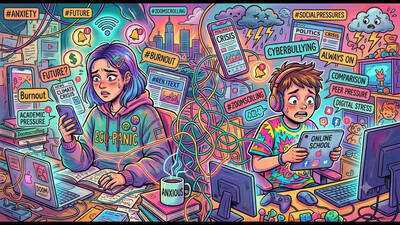
To say we live in an anxiety-ridden world would be a huge cliche. But we must, everyday. Because things are getting worse. Anxiety has become the defining emotional condition of young adulthood. From climate change and economic uncertainty to AI disrupting careers, relentless social media comparisons and an always-on news cycle, Generation Z and Gen Alpha are growing up in a world that feels permanently unstable. Mental health experts have spent years teaching people how to cope after stress strikes, but psychologists are now drawing attention to a different approach: proactive coping .
What is proactive coping?Rather than waiting for problems to arrive and then scrambling to manage them, proactive coping is about preparing yourself long before the crisis appears. It is a subtle but powerful shift in mindset, replacing the exhausting question, "What if everything goes wrong?" with a far more useful one: "What can I do today to make tomorrow easier?"
Most of us are familiar with reactive coping because it is how we naturally deal with life's setbacks. You lose your job and update your résumé. You fall ill and begin taking care of your health. You panic before an examination and start cramming the night before. The response comes after the stress has already arrived. Proactive coping works on an entirely different timeline. It assumes that challenges are an inevitable part of life and asks individuals to build their resources before they are urgently needed.
That may mean developing new professional skills while still comfortably employed, maintaining physical fitness before health problems emerge, creating financial savings during stable periods or nurturing strong friendships long before emotional support becomes necessary.
Psychologists argue that the motivation for both proactive and reactive coping is also different. Reactive coping is driven by the need to minimise harm, whereas proactive coping is driven by the desire to grow. Future demands are viewed as challenges that can be prepared for and eventually mastered rather than a looming threat. That thought process immediately reduces anxiety by several notches.
We have to understand that anxiety itself is largely future-oriented. It convinces people to mentally rehearse everything that could go wrong without giving them a sense of control over any of it. Proactive coping also focuses on the future, but instead of encouraging endless prediction, it encourages deliberate preparation. The emphasis shifts away from imagining worst-case scenarios and towards steadily strengthening resources that make those scenarios less overwhelming.
 How proactive coping reduces anxietyEvery new skill acquired, every healthy habit established, every meaningful relationship nurtured and every financial cushion built becomes psychological evidence that the future is not entirely outside one's control. This growing sense of preparedness gradually weakens one of anxiety's strongest drivers: helplessness.
Psychological research suggests that this restoration of personal agency is one of proactive coping's greatest strengths. Individuals who practise it consistently tend to report higher levels of optimism, stronger self-esteem and lower levels of trait anxiety because they develop confidence in their own ability to influence future outcomes.
Another reason proactive coping resonates with today's generation is that it changes the meaning of stress. Traditional coping methods often begin only after stress has become unavoidable, making pressure something to escape. Proactive coping reframes stress as a signal for growth. Preparing for an interview weeks in advance, building a professional network before looking for a new role or developing disciplined study habits from the beginning of a semester transforms future pressure into manageable challenges. Psychologists describe this as turning distress into ‘eustress’: a productive form of stress that energises rather than paralyses.
The challenge remains real, but it no longer feels overwhelming. The benefits extend beyond anxiety management . It builds emotional resilience in people. Research says that proactive coping can act as a buffer against depression because it encourages purposeful goal-setting and helps individuals build stronger support systems before emotional crises emerge.
Instead of becoming trapped in cycles of rumination and avoidance, proactive individuals generate momentum through small, meaningful actions that reinforce a sense of competence.
But none of this means proactive coping is about controlling every aspect of life. In fact, psychologists warn against confusing preparation with perfectionism. It can be exhausting, and have the opposite effect. Healthy proactive coping therefore requires flexibility alongside preparation. The objective is not to predict the future perfectly but to build enough psychological, social and practical reserves that unexpected changes become easier to navigate.
For a generation living through constant disruption, this may be one of the most useful psychological skills to cultivate. The future is unlikely to become more predictable anytime soon. Artificial intelligence will continue to reshape careers, economic cycles will fluctuate, technology will keep accelerating and global crises will continue to emerge without warning. What proactive coping offers is a more sustainable alternative: investing in resilience before it is urgently required.
-
Hyderabad: Task force busts gambling den in Attapur, 7 arrested

-
SC orders policy on early release of old, terminally ill inmates

-
Kudankulam nuclear power plant data breached, says Reliance

-
Rohit Sharma To Retire After IND vs ENG 3rd ODI? Report Makes Explosive Claim

-
No Cap With Megha Prasad | Who Is Really Benefiting From Sonam Wangchuk's Hunger Strike?