In Argentina’s far north, where rugged mountains fold into narrow valleys and small adobe settlements cling to the landscape, a new railway journey is connecting travellers with a much older story. he Quebrada Solar Train , which began operating in 2024, follows part of a historic route through the Quebrada de Humahuaca in Jujuy Province, a region recognised by UNESCO for its cultural significance. While the train itself represents a modern step towards lower-emission transport, the landscape outside its windows carries traces of thousands of years of human movement, trade, belief and settlement. The journey links villages where Indigenous traditions remain visible in daily life, offering visitors a slower way to experience one of South America’s longest-inhabited cultural corridors.
The ancient history behind Argentina’s Quebrada solar train route
The Quebrada de Humahuaca has served as a route for people long before railways appeared in the Andes. Archaeological evidence indicates that communities were moving through the valley around 9000BC, making it one of the continent’s oldest continuously used corridors.
According to the BBC, the modern train covers roughly 42 kilometres between several historic villages, including Volcán, Tumbaya, Purmamarca, Maimará and Tilcara. Yet the significance of the route extends beyond distance. For centuries, Indigenous traders crossed the valley carrying goods between settlements. The route later became connected to the extensive Inca road system known as the Qhapaq Ñan, which linked communities across large parts of western South America.
Spanish colonial authorities also relied on the same passage after arriving in the region. Over time, different cultures, economies and belief systems moved along the valley, leaving traces that remain visible today.
How the Quebrada solar train combines sustainable travel and culture
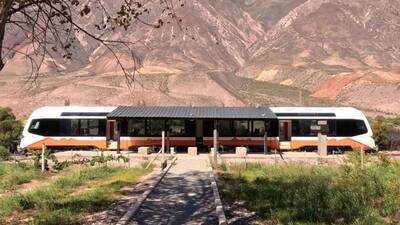
The train itself stands out against the surrounding mountains. Designed with large panoramic windows and powered by solar energy, it operates in a region that receives abundant sunshine throughout the year.
Reportedly, the service travels at a relatively slow pace, allowing passengers to take in the changing scenery rather than simply move between destinations. The landscape shifts from green stretches of vegetation to dry hills coloured by iron-rich rock formations. Villages appear intermittently, often marked by churches, small plazas and traditional adobe construction techniques that have been passed down through generations.
Officials behind the project hope the railway will support local economies by encouraging visitors to spend time in communities along the route. The intention is not simply to transport tourists through the valley but to create opportunities that help residents remain connected to ancestral lands while preserving cultural practices that continue to shape everyday life.
Tumbaya and Purmamarca: Exploring culture along Argentina’s solar train route
One of the stops highlighted by BBC is Tumbaya, a quiet settlement where traditional architecture still dominates the streetscape. Buildings constructed from sun-dried clay bricks remain common, reflecting techniques that have endured for centuries.
Religious traditions also remain deeply embedded in community life. During major pilgrimage periods, thousands of worshippers pass through villages that can appear almost deserted at other times of the year. The contrast reflects the rhythm of local life, where annual celebrations continue to hold significance alongside modern developments.
Further along the route lies Purmamarca, perhaps best known for the Cerro de los Siete Colores, or Hill of Seven Colours. The mountain’s bands of red, pink, purple and ochre rise behind the village, creating one of Argentina’s most recognisable landscapes. Local markets sell woven textiles made from llama wool, handcrafted pottery and other products tied to regional traditions.
According to the BBC, visitors may also encounter small stone cairns known as apachetas. Offerings left at these sites form part of long-standing Andean customs associated with Pachamama, often translated as Mother Earth. Such practices remain visible across the region and continue to hold cultural importance for many local communities.
Ancient roads, Inca heritage and colonial landmarks along the solar train route
The historical layers of the valley become particularly apparent at Hornillos, where a former colonial staging post now functions as a museum. As per the BBC, the site once provided accommodation for merchants and couriers travelling between major centres during the colonial period.
Inside, exhibits trace a much longer timeline. Long before Spanish rule, Indigenous communities used the valley to move goods such as salt and pottery. Later, the Inca Empire incorporated the route into its transport network, strengthening connections across the Andes. Colonial authorities subsequently adapted the corridor for their own commercial and administrative purposes.
As the train continues towards Maimará, evidence of centuries of agricultural activity becomes visible. Terraced fields, some dating back around 1,500 years, still shape the landscape. Crops including quinoa have been cultivated here for generations, while local markets continue to sell regional produce and traditional herbs.
The result is a journey that moves through more than scenery. According to the BBC, the solar-powered railway offers a way of experiencing a valley where ancient roads, Indigenous customs, colonial history and contemporary community life remain closely intertwined. For travellers, the route provides a rare opportunity to witness thousands of years of human history unfolding across a single stretch of the Andes.
-
Jude Bellingham Expresses Gratitude to Fans After World Cup Exit

-
Amit Shah's Upcoming Three-Day Visit to West Bengal: Key Meetings and Initiatives

-
NALCO Releases Admit Card for Non-Executive Exam 2026

-
Messi has a message for World Cup critics of Argentina: ''Nothing was handed to us''

-
Kali Kumar Tongchangya Elected Unopposed as CADC Chairman in Mizoram