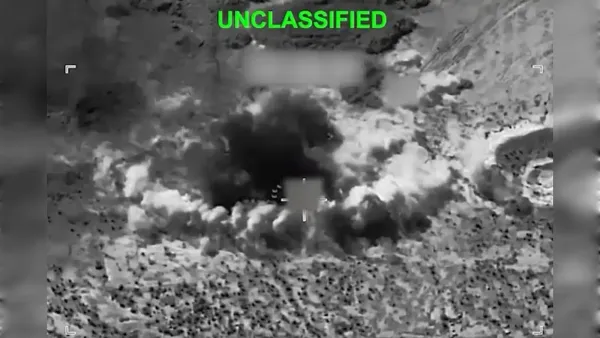
The United States launched a fresh wave of strikes against Iran on Wednesday, July 15, saying the operation targeted military capabilities Tehran has used to attack commercial shipping in the Strait of Hormuz.
US Central Command (CENTCOM) said the operation began at 6 a.m. ET, describing the strikes as part of efforts to weaken Iran’s ability to threaten maritime traffic through one of the world’s busiest energy corridors.
“The strikes are designed to further degrade military capabilities Iranian forces have used to attack commercial shipping in the Strait of Hormuz,” CENTCOM said in a post on X.

The latest operation came hours after Washington reinstated a naval blockade on Iranian ports, further escalating military tensions in the region.
CENTCOM details latest strike operation
US Central Command (CENTCOM) said it completed a morning round of strikes against Iran at 7:30 am ET on Wednesday, July 15.
According to CENTCOM, the 90-minute operation targeted coastal defence systems, as well as cruise missile storage and launch sites on Greater Tunb Island.
The command said the strikes were intended to further degrade Iran’s ability to attack commercial shipping in the Strait of Hormuz.
Explosion reported in Shiraz
An explosion was reported in the southern Iranian city of Shiraz on Wednesday, Iranian media said.
Authorities did not immediately disclose the cause of the blast, its exact location or whether there were any casualties.
Europe warns airlines over Middle East airspace
The European Union Aviation Safety Agency (EASA) has raised the threat level for airlines operating in the Middle East, Bloomberg reported, urging carriers to avoid flying through the region amid the growing risk of missile and drone attacks.
EASA said unexpected military developments, along with the potential use of missiles, drones, fighter jets and air defence systems, pose a significant risk to civilian aircraft operating at all altitudes across the affected airspace.
IMO warns against Hormuz transit
The International Maritime Organisation (IMO) said the Strait of Hormuz remains too dangerous for commercial vessels to transit.
Speaking to Bloomberg Radio, IMO Secretary-General Arsenio Dominguez said the strategic waterway remains unsafe because of the ongoing conflict.
“I will maintain the message of upholding international law, for countries to do the same thing, and for companies — at this stage, particularly with the volatility — not to take risks to transit through the Strait of Hormuz,” he said.
-
Indian Athletes Gear Up for Competitive Commonwealth Games Ahead of Asian Games

-
India's Junior Pickleball Team Set for Asian Championship

-
Central Cabinet Approves Major Initiatives for Infrastructure and Semiconductor Development

-
Anuradha Paudwal Addresses Controversy Over Ram Mandir Remarks and India's Global Aspirations

-
Nagpur Cyber Police Files FIR Against Social Media Creators for Defaming Minister Gadkari