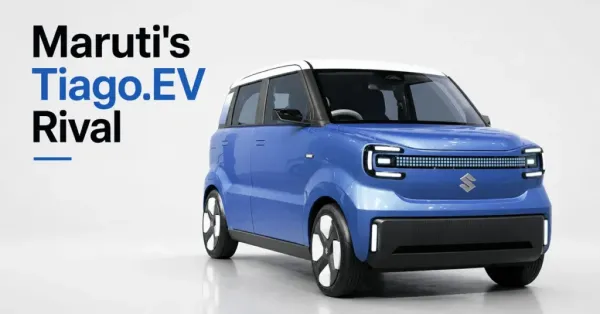
The eVitara, Maruti Suzuki’s first EV, is slowly picking up momentum in the Indian market. News of the company’s third all-electric product has now emerged. It will likely be the production form of the Vision e-Sky concept. An electric hatchback that will compete with the Tata Tiago.EV when launched. The global launch is expected in the financial year 2026-27 and India entry could happen later.
First, let’s make one thing clear. The production-spec Vision e-Sky is expected to be smaller than the Tiago.EV in dimensions, but larger than the MG Comet. The concept had a length, width and height of 3,395mm, 1,475mm, and 1,625mm respectively. These make it smaller than the S-Presso, Maruti’s smallest car currently on sale. As for the rivals, the Tiago.EV measures 3,825 mm in length, 1,684 mm in width, and 1,562 mm in height. The Comet, on the other hand, is 2974 mm long, 1505 mm wide, and 1640 mm tall.
You will also notice that the e-Sky concept has a tall, narrow stance like the Comet EV. Think if it as an electric Kei car. Considering these and the expected range of 270km per charge, it is safe to consider the production version a Tiago.EV rival.
This will be a global product, although a heavily localised version is likely to be sold in India. Suzuki UK boss David Kateley, recently confirmed the company’s plans to launch the e-hatchback in the United Kingdom. He also confirmed that it will be an A-segment BEV that will compete with the likes of Honda’s Super-N..
In the Indian context, the Vision e-Sky-based EV can be a big success if executed properly. Manufacturers like Tata Motors and JSW MG Motor India have already proved it that there is money in the entry level electric vehicle segment. Maruti Suzuki continues to bet big on small cars, in the internal combustion engine-powered space. So, it won’t be a surprise to see them introduce a small electric hatchback in the coming years. Afterall, Maruti understands Indian customer demands well.
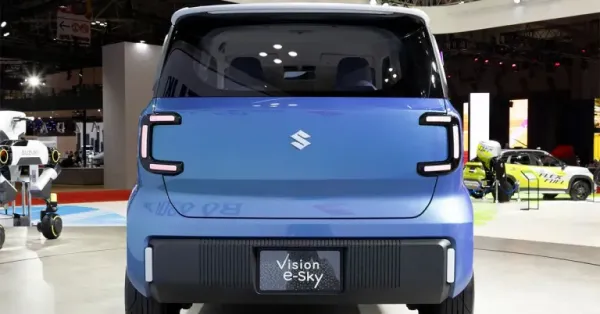
The Vision e-Sky-based electric car will be heavily localised for the Indian market, and will become the most affordable EV from the manufacturer when it launches here.
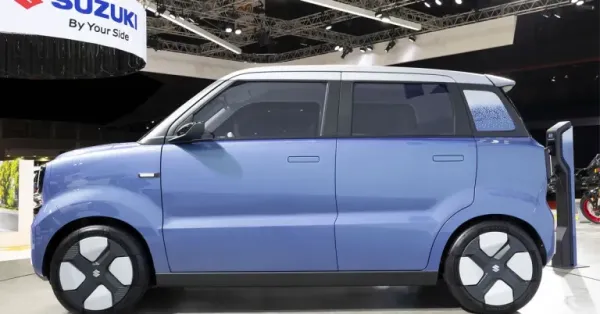
This concept previews the company’s next-generation urban electric car and was first shown at the Japan Mobility Show 2025. It is based on the design philosophy ‘Unique, Smart, Positive’. It is a good-looking concept with a youthful front fascia.
It gets a matrix-style LED light bar, LED headlamps and C-shaped LED DRLs at the front. The nose and front bumper feature clean designs. Chunky wheel arches are also part of this design. The overall stance is upright, with a flat nose and tail. Both the overhangs are short.
The vehicle gets flush-type door handles, a subtle roof spoiler, aero-friendly wheels, and aerodynamically shaped wing mirrors. The design approach can be described as minimalistic to some extent. The show car had a two-tone paint scheme with the roof finished in White.
Despite the compact proportions, there will be a good amount of cabin room. The tall-boy design will ensure this. The production model is likely to be based on Maruti Suzuki’s upcoming K-EV platform. This will be a heavily localised architecture, and will also help in maximising interior space.
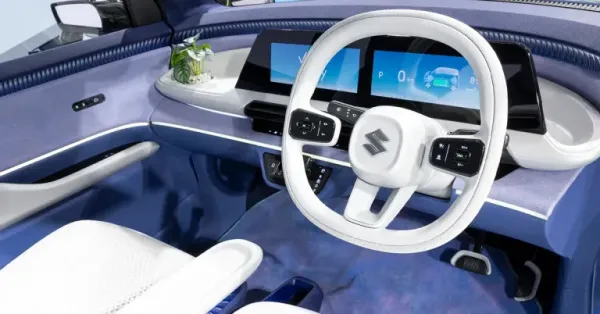
Inside, the Vision e-Sky gets a clean and tech-focused layout. One of the standout features is the squircle-shaped steering wheel. It gets integrated controls set on gloss-black panels.
The dashboard houses dual digital displays. The driver’s screen shows important information such as battery charge, driving range, vehicle speed, and lighting status. The second screen is likely for infotainment duties.
The cabin has a wraparound layout and the floating dashboard design gels in well. The concept has ambient lighting neatly integrated into the cabin design. The drive selector is placed on the dashboard. We are likely to see changes in the position of some controls (for example, wing mirror controls) on the production version. On the show car, the cabin had a Blue-purple-Beige colour scheme.
Details on the mechanical front remain sparse. Suzuki has, however, confirmed that this EV will have a claimed range of over 270km per charge. That’s comparable to the Tiago.EV’s numbers. While the battery size hasn’t been disclosed officially, a 29kWh is likely. Upcoming small EVs from Maruti will all be based on the K-EV platform.
-
Why Does the World Cup Have a Third-Place Match? England to Face France in the 'Bronze Final'

-
US introduces fixed-term for student, exchange visas

-
UP: APTC commandant's follower dies by suicide, family claims torture; 3 cops booked

-
Ex-bureaucrat's son arrested for fraud worth lakhs by posing as govt official in Dehradun

-
Panel probing ‘theft’ of Badrinath offerings suggests dress code for counting, CCTV surveillance