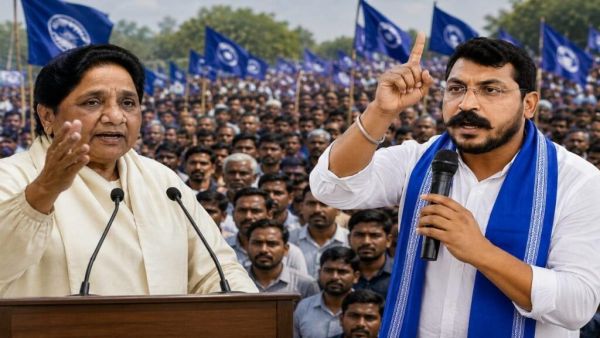
With the sound of Uttar Pradesh Assembly elections 2027, Dalit politics is again becoming the biggest center of the politics of the state. On one hand, Bahujan Samaj Party (BSP) supremo Mayawati is busy appointing in-charges across the state, organizational reshuffle and activating the cadre up to the booth level to re-establish the organization. On the other hand, National President of Azad Samaj Party (Kanshi Ram) and Nagina MP Chandrashekhar Azad is running a campaign to connect the Dalit community, youth and local leadership by touring from district to district. The strategies of both the leaders are different but the goal is one – to have the strongest claim on Dalit votes in 2027.
The Scheduled Caste population in Uttar Pradesh is considered to be about 21 percent. This is the reason why almost every big political party of the state tries to win Dalit votes in its favor. The Jatav community is considered to be the most influential within the Dalit society, whose share is estimated at around 10 to 11 percent. This class has been the strongest social base of BSP and Mayawati for a long time. Apart from this, Pasi, Valmiki, Kori, Dhobi, Khatik and other Dalit communities also play an important role in the election results.
Dalit vote decides elections in these districts
According to political analysts, including Agra, Aligarh, Hathras, Firozabad, Mainpuri, Etah, Kasganj, Meerut, Saharanpur, Muzaffarnagar, Bijnor, Bulandshahr, Bareilly, Shahjahanpur, Hardoi, Sitapur, Unnao, Rae Bareli, Fatehpur, Prayagraj, Kaushambi, Jalaun, Jhansi, Banda, Chitrakoot, Sonbhadra and Mirzapur. Dalit voters have the ability to decide the equation of victory and defeat in a large number of assembly seats in many districts. Their political role is considered to be most influential in Western Uttar Pradesh and Bundelkhand.
After the disappointing performance in the 2022 Assembly elections and 2024 Lok Sabha elections, Mayawati is now busy in strengthening the organization. In various districts of the state, work is being done on the strategy of appointing new in-charges, fixing accountability of old officials and activating the cadre up to the booth level. BSP is also trying to reunite other Dalit communities with its traditional Jatav vote bank.
Chandrashekhar’s mission—to prepare new land district by district
On the other hand, Chandrashekhar Azad is continuously seen in the field. In recent weeks he visited Meerut, Saharanpur, Muzaffarnagar, Bijnor, Nagina, Hapur and many surrounding areas. During these tours, he interacted with the youth, gave responsibilities to local leaders and openly raised his voice against the government on social issues. Azad Samaj Party’s effort is to convert the politics of the movement into electoral strength.
The famous Lalita Gautam murder case of Meerut also brought out the difference in the working style of the two leaders in Dalit politics. Through social media, Mayawati demanded an impartial investigation from the government and justice to the victim’s family. Chandrashekhar Azad himself reached Meerut, met the victim’s family, joined the protest and assured to fight for justice. Sharp political rhetoric was also seen between the two leaders on this issue.
Can Mayawati’s Jatav vote bank slip?
This question remains the most discussed topic in the politics of Uttar Pradesh at present. Political experts believe that a large section of the Jatav community still appears to be standing strongly with Mayawati. However, Chandrashekhar Azad’s acceptance has increased among a section of Dalit youth. If this support turns into organizational strength in the coming months, a new challenge may arise before the BSP. However, it is too early to say that the Jatav vote bank will completely shift from BSP. Social and political circumstances may affect this equation in the run up to the elections.
Political analysts believe that if Dalit votes are divided between BSP and Azad Samaj Party, then BJP, Samajwadi Party and to some extent Congress can also benefit from it. On the other hand, if Mayawati is successful in reuniting her traditional vote bank, then BSP can return strongly to the contest. On the other hand, if Chandrashekhar’s district-to-district campaign garners widespread support among Dalit youth and non-Jatav communities, then the equation of Dalit politics in Uttar Pradesh can change.
The real test of Dalit leadership will be in 2027
At present, Dalit politics in Uttar Pradesh seems to be moving forward on two different paths. On one hand, Mayawati is trying to make a comeback with the help of organisation, disciplined cadre and her traditional social base, while on the other hand, Chandrashekhar Azad is trying to establish himself as the leader of the new generation through streets, movements and continuous ground presence. The 2027 elections will decide whether BSP will again become the center of Dalit politics or Chandrashekhar Azad will be successful in creating a new and decisive place in this politics.
-
BRS meets CEO, seeks probe into Revanth Reddy’s ‘multiple votes’
-
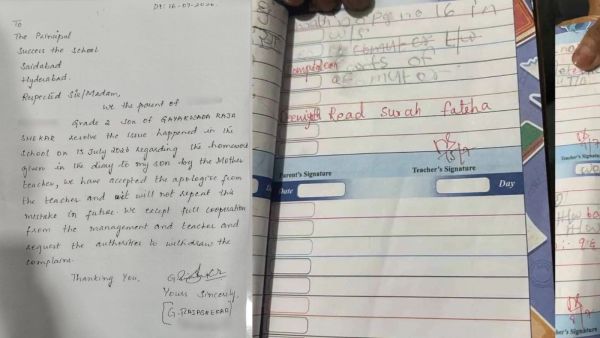
Hyderabad school’s kalma homework row: Parents withdraw complaint
-
NEET-UG retest results declared, 11.21 lakh candidates qualify
-
OnePlus begins exiting US, Europe; India could follow in 2027

-
Faridabad NEET Aspirant Dies By Suicide After Checking Score With NTA Answer Key