Every now and then, I like to attend a racing event purely as a regular fan—no media credentials, no special access, no professional perks. It’s a refreshing change of pace from my usual role as an automotive journalist.
My friend Luther Abel, through his media connections at Spire Motorsports, managed to get me a complimentary ticket to NASCAR’s Anduril 250 held on Coronado Island, just across the bay from San Diego. While he was busy interviewing driver Michael McDowell and creating content for his platform, I found myself seated in the front stretch grandstands. I even scored a free hat. It was the closest I’ve come to a true fan experience since my early days of visiting the Ventura Raceway dirt track on Friday nights, back when I first began writing about cars in 1990.
The Coronado event was an unusual one. It appeared to be a one-off race set on the access roads and aprons of Naval Air Station North Island, part of Naval Base Coronado, located just across the water from downtown San Diego. The civilian part of Coronado functions as its own city and is among San Diego’s most upscale suburbs, while the military side houses aircraft carriers. North Island is famously the base where Capt. Pete “Maverick” Mitchell is stationed in the fictional Top Gun sequel.
For an in-depth race recap and driver reactions, Fred Smith’s report covers it well. From my position in the stands, though, visibility was limited. The 3.4-mile, 16-turn circuit offered me only a half-mile glimpse—from the exit of Turn 16 until the cars disappeared before Turn 1. Because the track was set within an active military installation, the infield was filled with operational buildings that not only obstructed views but also muffled much of the noise. The atmosphere turned almost silent whenever the pack disappeared to the far side of the course.
It reminded me of my first major race experience back in September 1975, when I was 14. I had convinced my father to take me to the inaugural Long Beach Grand Prix, an SCCA Formula 5000 event that served as a proof-of-concept for street racing in Long Beach, California. What stands out most in my memory is how little I could actually see. Just catching a fleeting glimpse of Vern Schuppan’s light-blue No. 48 Jorgenson Eagle thrilled me. Knowing that Mario Andretti and Al Unser were racing nearby in their Viceroy-sponsored Lola T332s made me feel close to greatness. But I couldn’t tell who led or who crossed the finish line first on Ocean Boulevard—not that I fully understood what kind of theatre that area was known for back then.
That’s often the challenge with temporary circuits—spectators rarely see much of the action. The racing itself tends to suffer too, since narrow barriers restrict overtaking. It’s been true for nearly a century at the Monaco Grand Prix and was similar when Formula One raced through Detroit, Phoenix, and other improvised venues, including today’s Las Vegas Grand Prix. One exception was the Caesar’s Palace Grand Prix held in 1981 and 1982 in the resort’s parking lot. I attended the 1982 event and had a decent view, but the desert heat was brutal, the lack of shade unbearable, and the portable toilets overwhelming. The track layout itself was hardly more complex than a Malibu Grand Prix course.
I assume others remember Malibu Grand Prix as well?
My main goal at the Anduril 250 was to witness firsthand what makes Shane van Gisbergen (SVG) so extraordinary on road courses. From what I can tell, his mind calculates the perfect balance of braking, clutch, and throttle inputs needed to maintain momentum with stunning precision—almost like human traction control. Combined with his fearless approach and ability to seize even the smallest passing opportunity, it’s no surprise he qualified on pole. I fully expected him to dominate.
However, SVG didn’t simply run away with the race. He was fighting for the lead on lap 32 when he got caught in one of those inevitable multi-car pileups that happen on tight temporary circuits. The incident was triggered by a dive-bomb move that would have been inconsequential on a more spacious track such as Sonoma, Circuit of the Americas, or Watkins Glen. But on Coronado’s narrow layout, it caused a complete blockage. Part of the wall itself was damaged, prompting NASCAR to throw a red flag and halt the race. SVG eventually finished 38th.
A similar multi-car crash in Saturday’s O'Reilly Auto Parts Series race took more than 40 minutes to clear and repair the barriers.
Although the Anduril 250 lasted only 75 laps, the entire event stretched to four hours and 36 minutes. Thankfully, the coastal weather was ideal, with a cool ocean breeze that offset the afternoon sun.
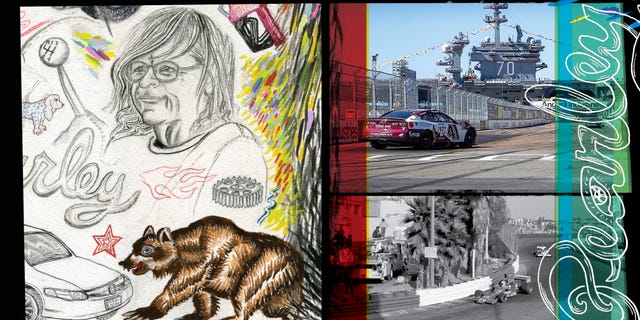
There was plenty to appreciate about the Coronado venue. The U.S. Navy welcomed the event enthusiastically, and the sailors looked sharp in their dress whites. The corner adjacent to the docked USS Carl Vinson aircraft carrier made for an impressive backdrop—even if I only caught it on the video screen. The pre-race flyover—featuring two F-35s, two F/A-18s, and an E2 Hawkeye in formation—was spectacular. The vendor area had ample space, food queues moved quickly, and attendees could get an up-close look at equipment such as the V-22 Osprey and various drones built by Anduril Industries.
Before this event, I hadn’t even heard of Anduril.
Motorsports have a long tradition of collaborating with the military, even though this was NASCAR’s first race held on an active base. One of my favourite archival images appeared in the January 1960 issue of Road & Track, showing General Curtis LeMay—architect of World War II bombing strategy and head of the Strategic Air Command—zipping around a SAC base in a go-kart, cigar in mouth and flight helmet on. The October 1953 cover of the same magazine featured sports cars lined up beside Navy aircraft at Moffett Field in Northern California. The connection between racing and the armed forces runs deep.
Ben Kennedy, NASCAR’s Chief Operating Officer, seems open to feedback. So here are my thoughts for a potential return to Coronado: first, shorten the track layout so fans can see and hear more of the action. Second, make it a timed race rather than a fixed lap count—something like “The Three Hours of Coronado” would create better pacing and strategic intrigue. Third, ensure a more uniform racing surface. And finally, if possible, widen the track to allow more overtaking.
There’s too much potential in the Coronado event to not refine it further. The Long Beach Grand Prix has thrived for five decades, with the city evolving around it to create one of Southern California’s most iconic festivities. Visibility is still limited, but it’s vastly improved—and the old adult theatres have long since given way to banks and condominiums.
For the record, Corey Heim took the victory at Coronado.
This weekend, NASCAR heads north to Sonoma, another road course. I expect Shane van Gisbergen to bounce back and dominate there.
-
‘We always knew we were stronger than England’ – Lionel Messi admits fearing ‘foolish’ backlash if Argentina had fallen short in World Cup semi-final

-
Why America's hospitals keep looking to India for nurses

-
SC refuses to hear contempt pleas alleging violation of 2024 'bulldozer' guidelines
-
Third language should be introduced in Class 6, not Class 9, says Supreme Court on CBSE policy

-
Why ISRO's reported scientist exodus is about more than just numbers