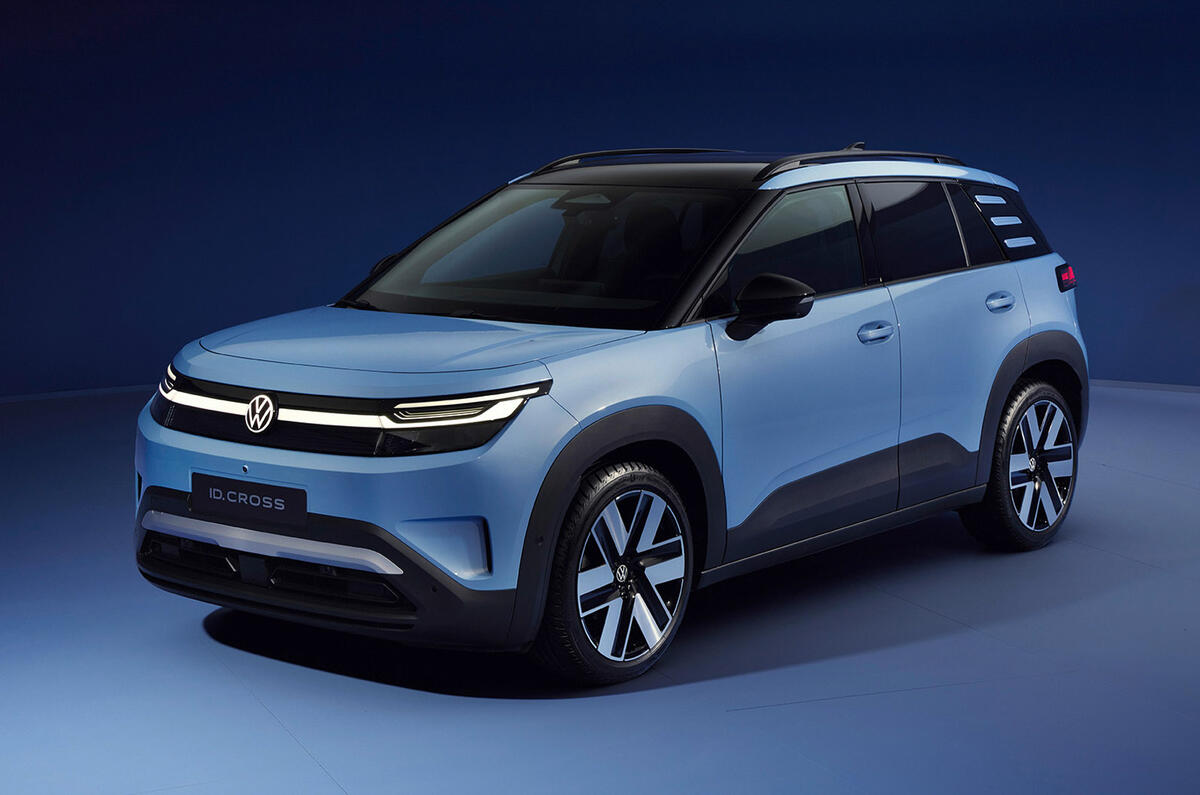
Volkswagen has officially introduced the ID Cross, an all-electric alternative to the T-Cross, positioned to compete directly with the Renault 4 and Ford Puma Gen-E in one of the most competitive segments of the automotive market.
The ID Cross joins the ID Polo, Cupra Raval, and Skoda Epiq as the fourth model built on the Volkswagen Group’s new MEB+ platform. This is a simplified version of the modular electric architecture used in larger models such as the ID 3 and ID 4.
In terms of dimensions, the ID Cross is slightly larger than the petrol-powered T-Cross. However, Volkswagen claims that the electric design allows for a much more spacious interior. The car offers 475 litres of boot space — 20 litres more than the T-Cross — along with an additional 22-litre front compartment to store the charging cable.
According to Volkswagen's design head Andreas Mindt, the cabin of the ID Cross has been crafted to “feel like a friend.” The interior features fabric on the centre console, dashboard, and door panels, paired with ambient lighting to create a relaxing, lounge-like environment.
Ergonomics have received particular attention in the new design. Just like the ID Polo, the ID Cross reintroduces physical buttons on both the steering wheel and dashboard, providing a more tactile user experience compared to the touch-sensitive controls used in previous Volkswagen EVs.
A rotary-style knob is located on the centre console, allowing users to adjust infotainment volume or skip tracks easily, and it is positioned for convenient access by both the driver and front passenger.
Mindt explained that the inclusion of buttons adds a sense of “stability” to the interior. He previously acknowledged that eliminating physical buttons in earlier designs was a “mistake,” and this new crossover is part of his commitment to reintroducing them across future Volkswagen models.
The ID Cross will come with three front-mounted motor options producing 114bhp, 133bhp, and 208bhp. Customers can choose between two battery packs — a 37kWh lithium-iron-phosphate unit offering a 196-mile range, and a 52kWh nickel-manganese-cobalt battery capable of 271 miles on a full charge.
The smaller battery supports charging speeds of up to 90kW, while the larger pack can charge at up to 105kW. Both can replenish from 10% to 80% in under 30 minutes, ensuring quick turnaround during long journeys.
These specifications put the ID Cross on par with its sibling, the Skoda Epiq, and ahead of the Renault 4, although the latter is expected to receive an update soon that will improve both its range and power output through a new motor.
Deliveries for the Volkswagen ID Cross are scheduled to commence later this year, with starting prices expected to be around £25,000.
It remains uncertain whether the model will qualify for the UK government’s Electric Car Grant, which offers discounts of £1,500 or £3,750 depending on a vehicle’s production and transport emissions. The ID Polo, Cupra Raval, and Skoda Epiq all fall under the lower grant category, and the ID Cross is anticipated to follow suit, as it will be produced in Pamplona, Spain, using European-sourced batteries.
-
‘We always knew we were stronger than England’ – Lionel Messi admits fearing ‘foolish’ backlash if Argentina had fallen short in World Cup semi-final

-
Why America's hospitals keep looking to India for nurses

-
SC refuses to hear contempt pleas alleging violation of 2024 'bulldozer' guidelines

-
Third language should be introduced in Class 6, not Class 9, says Supreme Court on CBSE policy

-
Why ISRO's reported scientist exodus is about more than just numbers