When you venture into the most remote and demanding terrains on Earth, it becomes clear that the Toyota Land Cruiser still reigns supreme in the wild. Its unmatched durability and dependability have earned it a legendary reputation in regions where vehicle failure can have fatal consequences—from the vast Australian Outback to the scorching Sahara Desert. This dominance was evident when Road & Track recently visited Morocco to test the Polestar 5 and came across numerous trail-ready Land Cruisers spanning several generations.
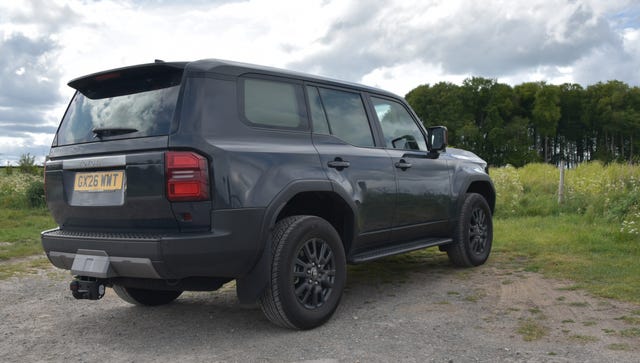
However, the version discussed here is an unusual branch of the Land Cruiser lineage—a van variant. Known as the Land Cruiser Commercial, this model is a cargo-oriented adaptation of the "J250" platform, available in select European markets. It replaces the second and third seating rows with a large cargo bay. Interestingly, this configuration doesn't originate from Toyota’s Japanese factory; instead, the vehicle arrives in the United Kingdom as a standard passenger Land Cruiser and is then modified at Toyota’s Derbyshire facility—the same plant that produces the U.S.-spec GR Corolla. The Commercial version is sold in the U.K., Ireland, and other European nations where tax benefits are offered for van conversions.
While the Land Cruiser Commercial offers greater capacity for bulky or irregularly shaped goods compared to the standard SUV, its modifications primarily cater to tax advantages rather than practical improvements. In the U.K., employees who use a company-provided van for personal purposes face significantly lower tax rates than those using cars, and vans also attract reduced purchase taxes. For instance, the Land Cruiser Commercial incurs a £345 Vehicle Excise Duty (approximately $460), while the regular Land Cruiser owner must pay £5490 (around $7340). This tax disparity has spurred a growing market for van conversions of SUVs, with Land Rover and Ineos offering similar versions of the Defender and Grenadier, respectively.
Up close, it’s clear that the Land Cruiser Commercial wasn’t originally designed as a cargo hauler. It retains the glass panels in the rear doors, but these are now fixed and non-functional, with hard panels behind them to shield against shifting loads. The door interiors still house the window motors, yet the switches are covered with blanking plates to disable operation. Likewise, the rear window switches on the driver’s door are concealed under a plastic cover. Inside the rear compartment, seatbelts and grab handles are removed, but curiously, the cupholders from the former third-row seating remain in place within the side panels.
To discourage buyers from illegally converting the van back into a passenger vehicle, Toyota has removed the rear seat mounting points entirely, replacing them with a reinforced flat load floor. The cargo area includes multiple lashing points for securing loads safely and a full-height mesh partition separating the cargo bay from the driver and passenger seats.
Since it’s derived from the well-equipped European Land Cruiser, the Commercial version carries over several premium features. It retains a power-operated tailgate with a separately opening upper glass window. However, its higher load floor reduces the practicality of this split design. The Commercial also keeps the power-adjustable, heated, and cooled front seats, along with the premium audio system and adaptive cruise control from the standard Land Cruiser. It’s certainly one of the most luxurious vans available.
Driving the European-spec Land Cruiser Commercial also provides access to a powertrain unavailable in the U.S.—a turbocharged 2.8-litre inline-four diesel engine, favored by adventurers and overlanders worldwide. This engine produces 202 hp and 369 lb-ft of torque, aided slightly by a 48-volt mild-hybrid system. Although these figures may seem modest against the van’s 5200-pound unladen weight, the ample low-end torque available from 1600 rpm and the responsive eight-speed automatic gearbox ensure that performance never feels lacking.
The diesel motor is not the most refined, especially when compared to the six-cylinder diesels found in the European Defender and Grenadier. The Land Cruiser exhibits noticeable vibration at idle and considerable noise under heavy throttle, along with a reluctance to rev. Even under hard acceleration, the automatic transmission upshifts at around 3800 rpm, and only in manual mode can the tachometer reach its 4400-rpm redline.
At cruising speeds, however, refinement improves considerably—far superior to that of a typical panel van. Toyota claims a 0–62 mph time of 10.2 seconds, though few owners are likely to test it, given that the van tends to squat under acceleration and lift its nose. It’s not engineered for high-speed stability; on highways, it exhibits minor lane wander on its Dunlop AT23 Grandtrek tires, and the wipers struggle to keep up past 75 mph.
Like most utility vehicles, the Land Cruiser Commercial performs better when carrying weight. When unladen, the suspension feels underdamped over uneven roads, becoming choppy on rough terrain. However, once loaded with a 220-pound vintage fire pump—borrowed for a future magazine feature—the vehicle displayed improved composure and ride stability. Although off-road testing was limited due to dry conditions, the van handled deep ruts and sunbaked dirt tracks with ease. It retains the same off-road hardware as the standard Land Cruiser, including a two-speed transfer case, a manually lockable center differential, and an advanced traction management system.
The main drawback of the Land Cruiser Commercial is that it’s not an especially practical van. Its cargo bay measures 66.4 inches in length, 50.6 inches in width, and 42.9 inches in height, with the elevated floor making heavy cargo difficult to load or unload. The large top-hinged tailgate also limits usability, requiring significant rear clearance to open fully—less convenient than side-hinged alternatives.
Of course, buyers aren’t likely to cross-shop the Land Cruiser Commercial with traditional panel vans like the Ford Transit. It does, however, offer greater payload capacity than a standard Land Cruiser with its seats folded. Toyota rates it to carry up to 1780 pounds of cargo and tow up to 7700 pounds, the maximum allowable for its class under European regulations.
Personally, I found the Land Cruiser Commercial to be an endearing oddity within one of my favorite vehicle lineups. Despite its shortcomings—and the obvious inconvenience of only two seats—it remains significantly cheaper than the regular Land Cruiser in the U.K. With a pre-tax price of £50,640 (around $67,800), it undercuts the entry-level Land Cruiser Invincible by nearly £9000 (approximately $12,000). That’s a meaningful saving for a rugged and capable Land Cruiser, even if it can only carry two occupants at a time.
-
Manchester United plan move for French midfielder, but player prefers to stay in La Liga

-
‘No One Wants to Play’: Thomas Tuchel Defends England’s Semi-Final Feat While Criticising World Cup Third-Place Play-Off Against France

-
MP trip plan at low cost? You will get complete fun of traveling in IRCTC’s 9 days tour package, know the complete details of the package.

-
Kitchen Utensils Expiry Date: Kitchen utensils can be dangerous for health! If you want to avoid diseases, recognize these signs in time

-
Is OnePlus Going To Shut Down In India? What Is For The Users Ahead