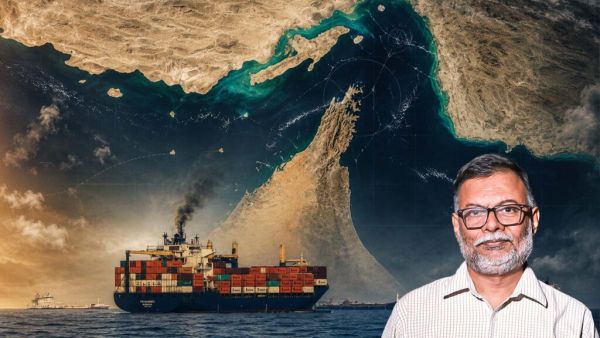
Both the United States and Iran are to blame for the mounting deaths of innocent civilian seafarers caught in the crossfire of the West Asian war, and New Delhi remains practically powerless to halt the maritime bloodshed, a veteran foreign policy analyst has warned.
While diplomatic channels remain open, the complete collapse of the regional maritime truce has put India’s energy security under immense strain, forcing it to pivot heavily to Russian crude.
Also read: Strait of Hormuz reopens after US-Iran deal, offering relief to global energy markets
The Federal spoke with Consulting Editor K S Dakshina Murthy, a specialist in global geopolitics and West Asian affairs, to unpack the severe ramifications of the blockaded Strait of Hormuz on global trade, India’s foreign policy dilemma, and whether the regional escalation is spiralling into an unending war of attrition.
How does the death of Indian seafarers in the Strait of Hormuz complicate India’s diplomatic balancing act?
This is a question where there are really no straight answers, in the sense that India cannot do anything as far as preventing this from happening unless the war ends. New Delhi cannot really blame the US or Iran individually when it is the combination of both of them that has caused this.
There are Indian citizens working across global shipping companies all around the world. In fact, according to one estimate, there are 300,000 Indian seafarers working on various ships globally, making India the third-largest supplier of seafarers in the world. Naturally, many of these Indians are stuck on ships in the Strait of Hormuz right now. Some estimates say 500, while others say around 200—it is not exactly clear and likely ranges between those numbers.
Also read: Centre advises against deploying Indian sailors through Hormuz amid West Asia crisis
Unfortunately, about seven Indians have died so far. Initially, the first three seafarers who got caught in the crossfire were hit by a missile fired by the US, and the latest casualty was from a strike by Iran. Both sides are to blame, and the war itself is the direct cause of the deaths of these innocent civilians.
India cannot play a major role in preventing this because we do not know what kind of control the government has over international shipping companies. Obviously, India cannot control every private shipping firm. The Indian government did put out an advisory some time ago, advising oil and shipping companies not to employ Indians on vessels sailing through the Strait of Hormuz. While it is an advisory, we do not know to what extent it can be fully complied with.
Meanwhile, the danger remains highly active for those still stuck there. According to reports, between 200 and 500 seafarers are still stranded on various vessels inside the strait. Diplomatically, India has protested. New Delhi raised protests against the US after its attack killed three sailors, and earlier this week, India lodged a protest with Iran over the killing of another sailor. Beyond these diplomatic protests, there is very little India can do directly.
Indirectly, of course, India can join in global mediation and negotiation efforts. It can add to the existing international pressure on Iran and the US to halt this entire conflict and restart peace talks. That is the only real path. There was certainly an element of disappointment that the US—a close ally of India—and Iran—another close partner—did not prioritise the safety of Indian seafarers. But practically speaking, they were targeting hostile vessels, and Indian crew members simply happened to be on board. It is an odd situation where you can neither blame them nor excuse them. Ultimately, the conflict has to end for the killings to stop.
With vessels and crew stranded at the blockade, how can India keep its oil supply secure?
Alongside the safety of our sailors, India’s energy security is the other critical aspect. If you go back to the start of the war on February 28, India was importing 40 per cent of its crude oil requirements, 60 per cent of its liquefied natural gas (LNG) imports, and 90 per cent of its liquefied petroleum gas (LPG) imports directly through the Strait of Hormuz. It was a massive volume of energy passing through a single choke point.
Once the war commenced with military strikes by Israel and the US on Iran, the oil flows and essential fuel supplies through the Strait of Hormuz were completely disrupted. Over the past few months, the Indian government has had to naturally look at diversifying and finding alternative sources of fuel.
Russia has emerged as a key savior in this regard. Crude oil imports from Russia have surged dramatically. In June, India was importing 2.58 million barrels per day from Russia, which accounted for nearly half of India’s monthly crude requirements. Russia has also been supplying this oil at favourable discounted prices. This flow was further facilitated by a brief waiver of sanctions by US President Donald Trump.
Also read: Iran-US MoU: Band-aid solution not working, surgery required
In July, these Russian imports have gone up even higher than they were in June. Russia has firmly become a vital supplier. Beyond Russia, India is also securing LNG and LPG from other countries, including the US itself. However, these shipments have to travel much longer distances, which increases transit times, but India has no choice but to look for alternative suppliers.
Additionally, India is modifying its receiving terminals. At the Mundra port, India is expanding and modifying its Very Large Crude Carrier (VLCC) terminal to receive larger fuel shipments from non-Hormuz sources.
There are, however, geopolitical risks to this strategy. A bill is currently pending in the US Congress proposing that Washington impose a 100 per cent tariff on five countries, including India and China, alongside Hungary and Slovakia, for continuing to purchase Russian oil. While it is still in the proposal stage, with Donald Trump, it is highly possible that it could be enacted. But until that happens, the energy crisis is so critical that India has very few options but to rely on Russia as a key supplier.
Does Trump targeting civilian infrastructure signal a shift toward total war?
If you look at how the conflict has flared up over the last week, the big question is: what is the actual status of the memorandum of understanding (MoU) signed between Iran and the US? The irony is that neither the US nor Iran is bluntly declaring that the MoU is dead and that they are back to full-scale war. Neither country is saying that.
Instead, they are continuing this battle of attrition because the Strait of Hormuz has evolved into a massive obstacle, overshadowing traditional disputes like Iran’s nuclear program or US demands for regime change. Both countries are unable to move forward with peace negotiations without resolving the Hormuz deadlock first.
This impasse dilutes the provisions of the MoU, which stipulated that both nations must stop attacking each other. There were significant grey areas, particularly over who would control the shipping lanes. Trump stated that the US would withdraw its blockade if Iran relinquished its control over the Strait of Hormuz. However, Iran realised that giving up control over the strait meant losing its most critical leverage in the negotiations, giving the US the upper hand. So, they held on to Hormuz.
Because Iran held on, the US reinstated the naval blockade. Now, the US has gone a step further by targeting the coastal military infrastructure that allows Iran to control the strait. Over the past week, several U.S. strikes have hit the southern coast of Iran. Realising this has not fully yielded the desired results, Trump is expanding targets to the north of Iran, potentially aiming at arms dumps and nuclear storage facilities.
Yet, when Trump was recently asked if negotiations were over, he said no. He stated that the US and Iran are still in touch. When asked when he last spoke to an Iranian negotiator, Trump replied that while he hadn’t spoken to them personally, his team had been in contact with someone in Iran just an hour prior. This means communication lines remain open even as active military strikes continue.
Many geopolitical analysts now warn that this US-Iran conflict is turning into a protracted, never-ending war, similar to what the US got embroiled in in Iraq and Afghanistan. Following the September 11 attacks, the US spent 20 years in Afghanistan and remains indirectly involved in Iraq to this day. If this conflict becomes a permanent war of attrition, it will cause massive economic problems globally.
Is a diplomatic breakthrough realistic right now, given the rising anger in Tehran?
The intense anti-US and anti-Trump banners that appeared during Ayatollah Ali Khamenei’s funeral highlight the shift in the domestic mood inside Iran. The diplomatic mediation was temporarily paused to allow the Iranian leadership to focus on the funeral.
Khamenei was assassinated shortly after the war began in early March, and as the conflict expanded, his death had briefly receded into the background of daily military operations. The massive public funeral brought the tragedy back to the forefront, highly arousing public anger and sorrow, with widespread chants of “death to Trump” and “death to the US.”
Also read: US reinstates naval blockade on Iran, imposes 20 pc cargo toll on Strait of Hormuz
This public outrage is what prompted the Iranian establishment to declare they would absolutely not yield control of the Strait of Hormuz, triggering the subsequent US military retaliation. We must not forget that although they are negotiating, it was the US that assassinated Khamenei.
The only hope is that both sides will allow a few days for the emotional domestic outrage to subside so that quiet negotiations can take over. There is immense backchannel pressure on the US from its own Gulf allies, who are being targeted by Iranian retaliatory strikes on US military bases in their territories. While these Gulf nations do not want Iran to control the Strait of Hormuz, they are suffering heavy collateral damage to their own oil, gas, and civilian infrastructure, forcing them to push Washington toward a ceasefire.
Furthermore, Donald Trump is highly conscious of the upcoming US midterm elections. He knows he needs to resolve this conflict to avoid a disastrous showing at the polls.
There is also a silver lining elsewhere in the region. Israel and Lebanon have entered serious negotiations, the fighting in southern Lebanon has largely stopped, and there are reports that Israel may pull out its troops. This regional development shows that diplomatic solutions are possible. The current situation is a mixed bag, but we must hope that diplomatic pragmatism eventually overrides military attrition.
-
Jude Bellingham Expresses Gratitude to Fans After World Cup Exit

-
Amit Shah's Upcoming Three-Day Visit to West Bengal: Key Meetings and Initiatives
-
NALCO Releases Admit Card for Non-Executive Exam 2026

-
Messi has a message for World Cup critics of Argentina: ''Nothing was handed to us''

-
Kali Kumar Tongchangya Elected Unopposed as CADC Chairman in Mizoram