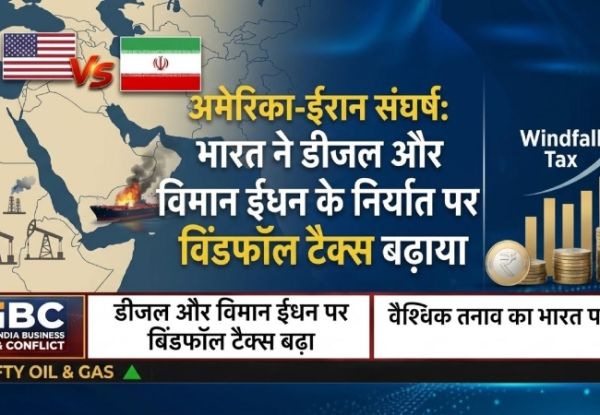
New Delhi. The effect of increasing military tension and blockade between America and Iran is now visible on the Indian economy and energy market. In view of the huge rise in crude oil prices in the international market, the Indian government has taken a big initiative. The government has drastically increased the windfall tax on the export of diesel and jet fuel (Aviation Turbine Fuel) sent out of the country. These new rates have become effective from today i.e. 16th July 2026.
Read :- Nitin Gadkari’s big statement on E20 controversy, will have to pay more price for 100% pure petrol
Big change in export tax
According to the information given by the Finance Ministry, amendments have been made in tax rates to control the unexpected profits of domestic companies amid the skyrocketing prices of crude oil in the global market. In which the export tax on diesel has been directly increased from ₹ 8.5 per liter to ₹ 15.5 per liter. Apart from this, the export tax on jet fuel (ATF) has been increased from ₹ 7.5 per liter to ₹ 14.5 per liter. If we talk about petrol, the tax has been reduced from ₹4 per liter to ₹2.5 per liter, giving very little relief to the exporters.
Why was this decision taken?
According to experts, due to the US-Iran conflict, the crisis on major maritime oil routes like the Gulf of Oman and the Strait of Hormuz has increased. Due to this, the prices of crude oil in the international market have crossed $85 per barrel. When global prices rise, private sector companies find it more profitable to sell fuel abroad rather than in the Indian market. The government has discouraged exports through this tax so that there is no problem of fuel within the country.
Read :- Iran launches missile attack on UAE oil tankers, 1 Indian sailor killed, 8 others injured
What will be the impact on the general public and consumers?
This decision of the government will not have a direct impact on the pockets of common people. There has been no change in the retail prices of petrol and diesel available at petrol pumps within the country. By ensuring adequate supply of diesel within the country, the cost of freight and transportation and material management will remain under control, due to which the prices of essential commodities will not increase.
Air travel can be expensive
Even though there will be no shortage of ATF in the country, under the pressure of rising crude oil prices globally, airlines may increase the prices of air tickets in the coming days. Apart from this, the government reviews international oil prices every 15 days, on the basis of which these tax rates are increased or decreased. If the tension in the Gulf countries does not reduce in the coming days, then more stringent measures may be seen in the energy sector.
Read:- Iran shocked by American attacks, Tehran opened fire on commercial ships in Hormuz.
-
Jude Bellingham clarifies what he said to Lionel Messi during England’s World Cup semi-final loss to Argentina

-
'I feel cheated and betrayed!' – Former France and Barcelona forward Christophe Dugarry lashes out at Didier Deschamps and team after 'humiliating' loss to Spain

-
AC Milan eye Manchester United’s Amad Diallo amid potential transfer twist

-
Bihar CM Samrat Choudhary Launches Live Classes For Schools, Free JEE-NEET Coaching Programme

-
Political Controversy Surrounds Gordie Howe International Bridge Opening