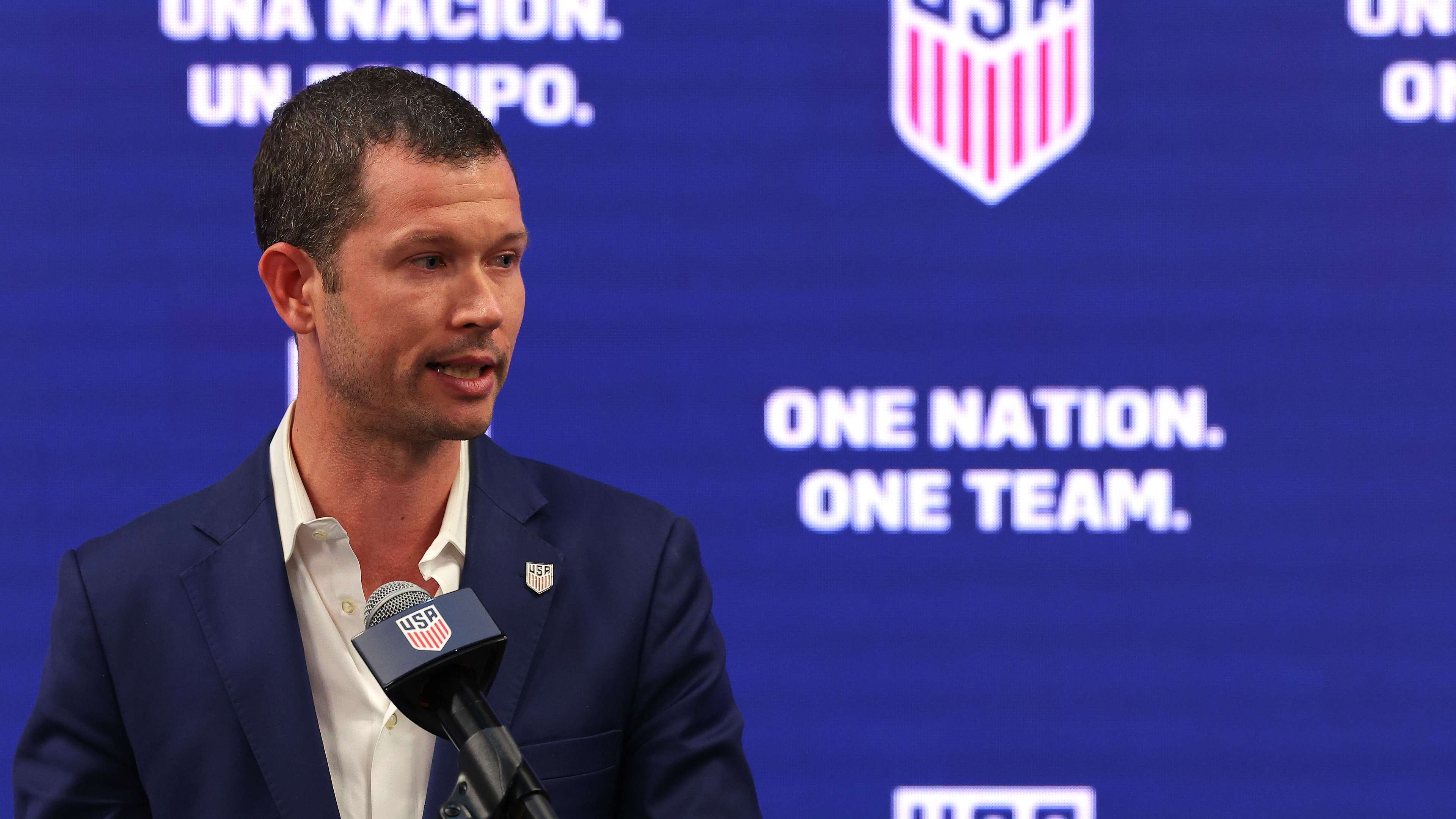
ATLANTA – U.S. Soccer CEO J.T. Batson has spoken about the White House’s involvement in the controversy surrounding Folarin Balogun’s World Cup suspension, stating that President Donald Trump “is able to do what the President wants to do.” Trump’s phone call to FIFA President Gianni Infantino, which preceded the suspension of Balogun’s one-match ban, has drawn widespread criticism. FIFA, however, has maintained that its disciplinary procedures remained independent.
Batson, alongside FIFA’s Chief of Global Football Development Arsène Wenger and U.S. Soccer COO Dan Helfrich, addressed the media in Atlanta on Thursday to discuss the next phase for American football after the World Cup. During the press conference, Batson was asked about the sequence of events that led to Balogun’s ban being lifted prior to the USMNT’s match against Belgium.
In the build-up to that fixture, which ended in a 4-1 defeat for the U.S. team, Trump and other government officials had publicly acknowledged their involvement, including the President’s direct call to Infantino. The move was criticised both domestically and abroad, with Belgium particularly dissatisfied with FIFA’s ruling.
When asked whether the White House’s intervention was excessive, Batson responded, “The President is able to do what the President wants to do. The President is the President of the United States. We’re extremely grateful for the support of fans across the country, wherever they may be, and we’re genuinely excited about that. We know this kind of engagement will benefit us in the long term.”
He continued, “The level of support was remarkable. My phone would constantly light up whenever fans felt we had been wronged or saw opportunities for improvement. To me, that shows our soccer culture is evolving. People care deeply, and the fact that these topics are now being discussed on sports talk radio—where football was rarely featured before—shows how far we’ve come as a soccer nation.”
Folarin Balogun, speaking to CBS earlier this week, admitted that the decision unsettled the squad as they dealt with the external attention surrounding the White House’s involvement. “My first reaction was happiness to be back in the team,” Balogun said, “but as I reflected, I realised it would stir controversy. I could sense some nerves among my teammates because it was an unusual situation.”
He added, “As we approached the match, I tried to focus as best as I could, but there was a lot of outside noise, and that’s hard to ignore.”
Reflecting on the broader picture, Batson discussed what U.S. Soccer had learned from the tournament and its ambitions moving forward. He said the federation was committed to strengthening its foundation, starting with reforms in youth development designed to enhance player education. Wenger spoke at length about the importance of structured learning and the pathway required for the U.S. men’s team to reach elite status.
Batson described this summer’s campaign as a step forward rather than a conclusion. “There are several factors that must align for us to continue winning World Cups on the women’s side and to become serious contenders on the men’s side,” he explained. “Our goal is to position ourselves to achieve that. Our senior team’s performance matters, but so does the health of our youth teams, our development pathways, talent identification, and coaching quality.”
He added, “One of our aims is to better educate our fans and stakeholders about what truly drives success. We want to be like Argentina and Spain—competing in a World Cup final.”
As for the team’s leadership, Batson said future decisions were still pending. Following the World Cup, both head coach Mauricio Pochettino and U.S. Soccer agreed to a period of reflection before deciding their next steps. “As we mentioned earlier, we wanted to take a short break to rest and regroup,” Batson said. “I didn’t get much rest myself, but the discussions have been ongoing and focused on long-term planning. For instance, we’re actively involved in talks with Steve Cherundolo regarding the U-23 team role, and we’re pleased with the progress so far.”
Looking back on the World Cup, Batson described it as a success for U.S. Soccer, calling it a milestone on a continuing journey of growth. “From our perspective, the 2026 World Cup has been incredibly successful and has fundamentally changed the sport’s trajectory in the United States,” he said. “When we think of 1994, 1996, and 1999, that five-year stretch ushered in a new era for football here. Now, we see this summer as the beginning of another five-year period leading up to the 2028 Los Angeles Olympics and the 2031 Women’s World Cup. Our goal is to ensure that the U.S. becomes one of the world’s top football nations.”
This summer’s World Cup will conclude on Sunday with the final between Argentina and Spain in New Jersey. The USMNT will regroup in September for their first matches after the tournament.
-
Cancer Tarot Horoscope Today, July 18, 2026: Stay calm and trust your instincts for success

-
Love Horoscope for Saturday, July 18, 2026: Pisces Relationships Strengthen, Insights for All Zodiac Signs

-
Financial Horoscope Today, July 18, 2026: Sagittarius Encouraged to Take Bold Financial Steps, See What’s in Store for Other Signs

-
7.3 Earthquake strikes Mexico-Guatemala border; no damage yet

-
US hits Iran for seventh straight night,bridges targeted