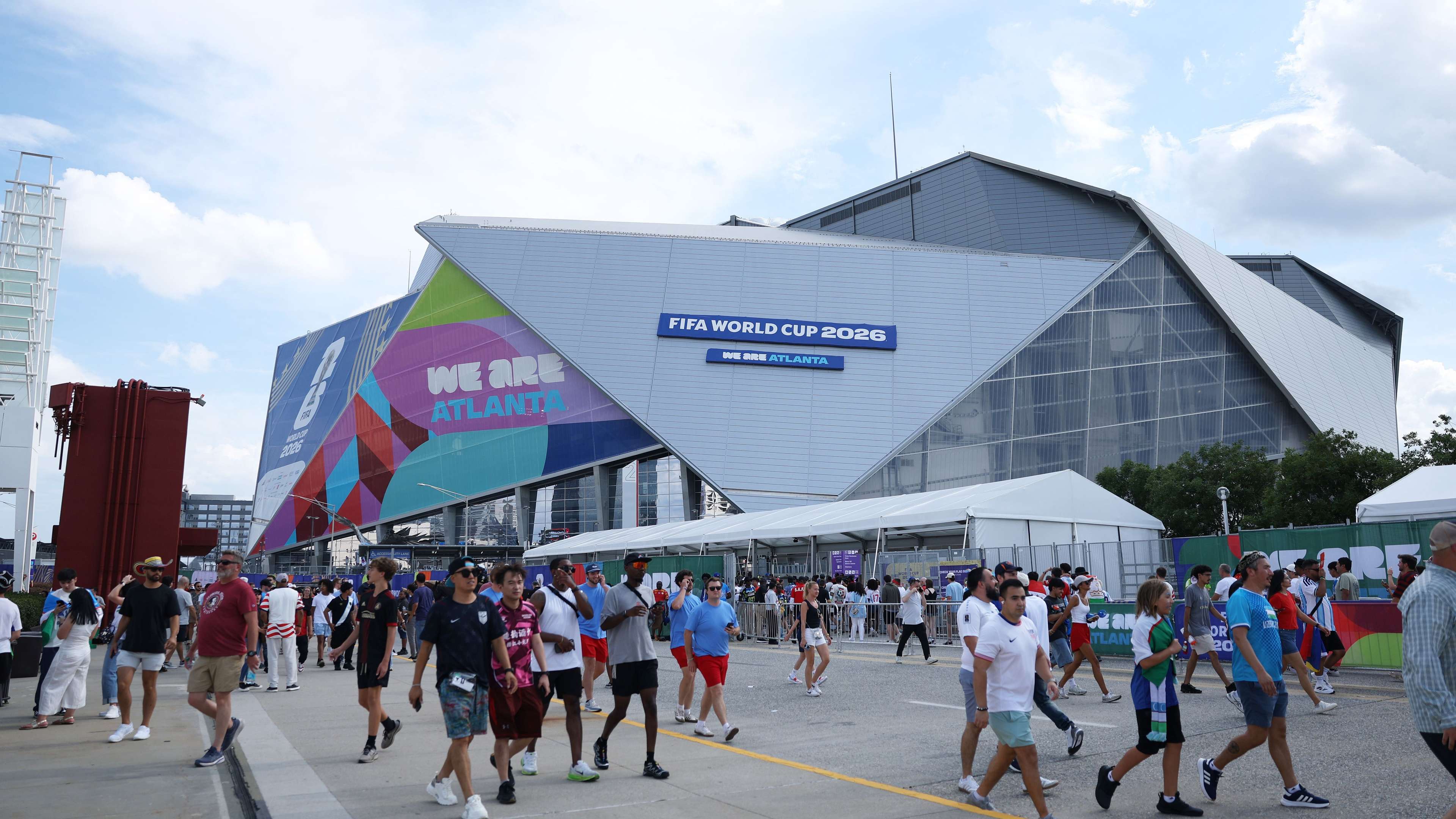
Atlanta didn’t require the FIFA World Cup to build a football identity. Hosting eight matches and welcoming over half a million visitors to its fan festival merely confirmed what the city had spent nearly six decades shaping — a deep-rooted love for the game.
ATLANTA — Three hours before kick-off, a vendor waved bottles of water through the humid air. Atlanta Stadium was nearly empty, yet the man’s voice echoed across the concourse, calling out his $3 deal to the few early spectators wandering in. It was a fitting snapshot of a stadium placed at the heart of a genuine football city. While many North American cities appeared to be temporarily adopting the sport this summer, Atlanta felt different — as though the game had always belonged to it.
Atlanta had been waiting for this moment, and it delivered in style.
“Atlanta doesn’t pretend to be something it’s not,” said Jason Longshore, a veteran commentator who has covered the city’s football scene for three decades. “There’s a popular phrase here — ‘Atlanta influences everything.’ You see it in music, fashion, and lifestyle. The way Atlanta has embraced football is uniquely American, but also uniquely Atlanta.”
The city’s football culture was built from the grassroots. Long before the World Cup arrived, generations of players, coaches, and fans had cultivated the sport. While major investment eventually followed, the culture remained proudly local and accessible. American football is often criticized for being elitist or commercialized, but Atlanta has always embraced its authenticity — imperfect yet unapologetically its own.
The roots of that culture stretch back to the 1960s. The Atlanta Chiefs were founded in 1967 by Dick Cecil, then an executive with the Atlanta Braves. Among their standout players was Kaizer Motaung, who later returned to South Africa to form Kaizer Chiefs, directly inspired by his Atlanta experience. Cecil, motivated by the 1966 World Cup, believed professional football could thrive in his city.
His vision was deliberate and inclusive. At a time when Atlanta wasn’t particularly immigrant-heavy, Cecil built a multicultural team, signing players from 14 different countries. They played professionally for six months and spent the remaining six months coaching youth players. That approach both developed a fan base and introduced thousands to the sport. The Chiefs even played — and twice defeated — Manchester City in friendlies, and in 1968 they won the first NASL Championship.
“They signed players from everywhere,” Longshore recalled. “Each spoke English, and their 12-month contracts required them to play for half the year and teach for the other half. They introduced football to tens of thousands across the region between 1967 and 1972.”
Estimates suggest that only about 150 people played organized football in Atlanta in 1966. By mid-1968, that number had grown to 16,000. Those children became lifelong fans. Longshore himself belonged to that second generation, watching the 1986 World Cup in awe as Diego Maradona’s brilliance left him spellbound.
It was that same generation that would later rally behind Atlanta United. The club’s formation wasn’t simple. Though there were early ambitions for a Major League Soccer franchise, the 1996 Olympics slowed progress. The Chiefs’ old stadium had been torn down in 1997, leaving the city without a football venue.
When Arthur Blank acquired the Atlanta Falcons in 2001, he envisioned bringing MLS to the city. By then, Atlanta’s population was growing more diverse, and football was regaining popularity. Although the mid-2000s trend was to build smaller, 20,000-seater stadiums, Blank had grander ideas. He chose the Mercedes-Benz Arena — renamed Atlanta Stadium for the World Cup — as the home for both the Falcons and Atlanta United.
“When Blank declared that both the Falcons and United would share the big stadium, it changed everything,” said Longshore. “It gave football the mainstream credibility it lacked elsewhere.”
Winning, of course, accelerated its popularity. Atlanta United signed Josef Martinez and Miguel Almiron before their debut season, shattered attendance records, and won the MLS Cup in just their second year.
That success shaped a culture admired worldwide. Former West Ham midfielder Jack Collison, who moved to Atlanta in 2019 to work in the club’s youth academy, said, “Arthur Blank wanted to build a super club in one of the most diverse cities in America. Football unites people of every background, and Atlanta reflects that perfectly.”
When West Ham visited for a preseason friendly last year, Collison said his old teammates were amazed. “Speaking to Mark Noble and a few players, they couldn’t believe the energy. They’ve played in world-class stadiums, but to experience that atmosphere here for a preseason match—it was breathtaking.”
Fafa Picault, who joined Atlanta United after winning the MLS Cup with Inter Miami, echoed that sentiment. “The city’s Latin culture has grown so much. Compared to when I first visited, it’s transformed completely,” he said.
The football spirit has even influenced the NFL’s Atlanta Falcons, who share the stadium. “It’s only going to get so much bigger,” said Falcons running back Bijan Robinson. “Seeing people travel from around the world to support their teams—that’s what this is all about.”
Atlanta’s growing football ecosystem also attracted U.S. Soccer, which recently built a state-of-the-art training facility 20 miles south of downtown, funded by Blank. “The facilities are incredible,” said Tyler Adams during the USMNT’s World Cup camp. “It’s exactly what the national team has needed for a long time. It’ll help us grow for sure.”
Atlanta’s World Cup hosting experience was a triumph. The city staged eight matches and drew 500,000 fans to its festival. Keeping true to its fan-first ethos, it offered affordable food and drinks — $2 for hot dogs and sodas, $5 for cheeseburgers — a sharp contrast to the commercial excess elsewhere.
“From the start of the bid in 2018, we knew Atlanta had all the ingredients to host an exceptional World Cup,” said Dan Corso, President of the Atlanta Sports Council and World Cup Host Committee. “Our community, volunteers, and partners made it a collective success, proving Atlanta is one of the world’s premier sporting cities.”
The semifinal in Atlanta was unforgettable. The stadium’s enclosed roof amplified every sound, transforming it into a cauldron of passion — a dream stage for Argentina fans. When England and Argentina lined up for the anthems, “God Save the King” was drowned out by a wall of whistles, while Argentina’s anthem echoed triumphantly.
The match itself was intense and physical — a fierce rivalry reborn. Every Argentine tackle ignited roars, every English challenge provoked jeers. Jude Bellingham’s reaction drew boos, and when Elliot Anderson fouled Lionel Messi, the arena erupted. Argentina’s two late goals to overturn a 1-0 deficit created one of the tournament’s defining moments. As England manager Thomas Tuchel admitted afterward, it “felt like an away game.”
Despite the high stakes, the night ended in camaraderie. Outside the stadium, supporters from both sides mingled in bars. In one Irish pub, six Argentine fans shared drinks and laughter as two England fans approached to shake hands. “I hate España,” joked one, prompting laughter all around. They parted amicably, disappearing into the lively Atlanta night.
There may be no better city in America to lose a football match in.
-
Japan: Superstitions make some homes hard to sell or rent
-
India's first hydrogen-powered train hits the tracks
-
Job opportunity with the country's largest examination agency; salary up to ₹2 lakh..

-
Former Badrinath Temple Official Arrested in Alleged Donation Theft Case

-
New Bundesliga broadcasting deal in the US: Reach over money