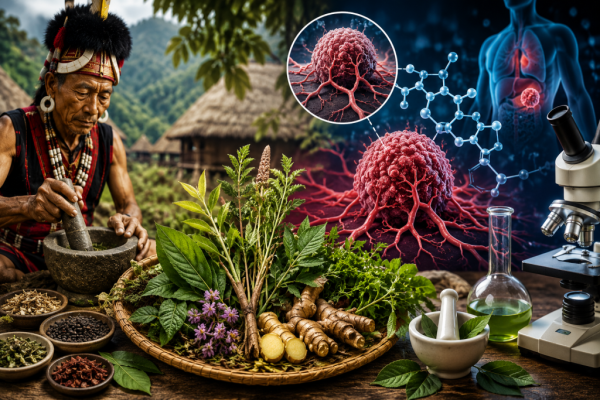
Can age-old tribal herbal knowledge become the basis for future treatment of serious diseases like cancer? A new scientific study on a mixture of five medicinal plants traditionally used by the Konyak tribe of Nagaland has given new direction to this possibility. Researchers have claimed that natural bioactive compounds have been found in this herbal formula, which have the ability to influence the process that plays an important role in the growth of cancer cells.
Scientists have clarified that this study is still in its initial stage and its findings are based on computational analysis. Any clinical confirmation would require laboratory (in-vitro), animal models, and clinical trials in humans.
Journey from tribal knowledge to modern science
This study has been done by a joint team of scientists from Nagaland University, Berhampur University and Savita Medical College and Hospital. The objective of the research was to scientifically evaluate the traditional medicinal knowledge systems that tribal communities have been using for generations to treat various diseases.
Researchers analyzed a traditional polyherbal (multi-medicinal) remedy from the Konyak tribe with the help of modern scientific techniques. For this, advanced techniques like Gas Chromatography–Mass Spectrometry (GC-MS) and computer-based molecular modeling were used.
How might these natural compounds work?
The study found that certain natural compounds present in the herbal mixture displayed strong binding to a protein called **VEGFR2 (Vascular Endothelial Growth Factor Receptor-2)**.
This protein plays an important role in the formation of new blood vessels (angiogenesis) within tumors. Cancer cells receive oxygen and nutrients through these new blood vessels, making it easier for them to grow and spread to other parts of the body.
If this process can be effectively stopped, tumor growth can be slowed down. For this reason, VEGFR2 is considered an important therapeutic target in modern cancer research.
Medicines likely to have fewer side effects
According to the research, the identified natural compounds target VEGFR2 with relatively greater precision. Scientists believe that if drugs based on these compounds are developed in the future, they may have fewer side effects than some existing anti-cancer treatments.
In preliminary analysis, the toxicity levels of these compounds were found to be relatively low and their absorption and distribution properties in the body were also satisfactory. However, these findings can be confirmed only by further experimental studies.
Scientists took precautions
Head of the research team, Dr. G. According to Bupesh, this is the first time that this special five-plant traditional herbal mixture of the Konyak tribe has been studied in detail with the help of modern scientific equipment. Scientists have clarified that this study does not prove the effectiveness of any new drug, nor is it a proven option for cancer treatment. At present this is only preliminary scientific analysis of the identification of potentially bioactive compounds and their potential effects.
Research published in international scientific journal
This study has been published in the international peer-reviewed scientific journal Microchemical Journal. Researchers say that the next phase will require laboratory-based testing, animal studies and then clinical trials to scientifically evaluate the effectiveness and safety of these compounds.
Traditional knowledge got scientific basis
Vice Chancellor of Nagaland University, Prof. Jagdish K. Patnaik said that this study acts as an important bridge between traditional knowledge and modern science. According to him, the tribal communities of India have vast experience of medicinal plants, which can be tested on scientific criteria and made useful in future medicine.
Experts believe that if such research is pursued systematically, significant progress toward developing low-cost, nature-based, and potentially safe treatments is possible.
the way forward
Cancer remains one of the world’s most serious health challenges. In such a situation, discovery of new medicinal compounds from natural sources remains an important area of medical science. This study, based on the traditional knowledge of the Konyak tribe of Nagaland, is being considered as an initial but important step in this direction. However, experts are of the clear opinion that until comprehensive scientific trials are completed, this herbal mixture cannot be considered as a cancer treatment or medicine. Nevertheless, this research provides a strong indication that India’s traditional knowledge traditions hold significant potential for modern medical science, which needs to be scientifically understood and developed.
-
'Absolute disgrace': Chelsea delete Enzo Fernandez post amid England's World Cup defeat to Argentina

-
Bengaluru businessman gets lifer for murder in Attapur

-
SS Rajamouli Drops Priyanka Chopra's First 'Mandakini' Look From 'Varanasi' On Her Birthday

-
Diesel prices rise; government hikes Roadways bus fares by 10%—find out the new rates.

-
Gold Rate Today: Gold prices drop for the second consecutive day; 22-carat gold stands at ₹1,30,790 in Delhi; silver also falls..