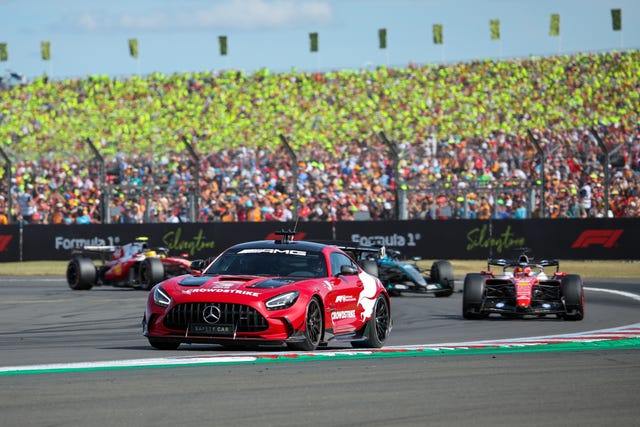
The recent British Grand Prix reignited a recurring topic in Formula 1 – the disappointment that arises when a race concludes under safety car conditions, with competitors merely accelerating through the final corner to cross the finish line.
At Silverstone, everything seemed set for an exciting showdown after Max Verstappen’s late spin brought out a safety car. Race leader Charles Leclerc held a sufficient lead to pit for fresh tyres and maintain his position. Lewis Hamilton, running second, also opted for new rubber, while George Russell, behind him, chose not to change tyres, gaining track position over Hamilton. The stage was perfectly set for a dramatic restart, potentially showcasing Hamilton on fresher tyres attempting to overtake Russell on older ones—a reversal of the 2021 Abu Dhabi Grand Prix finale, where Hamilton lost the race and the World Championship to Verstappen.
However, the delay in clearing Verstappen’s stranded Red Bull prolonged the safety car period, with more laps consumed by the unlapping and wave-by procedures. Regulations also require an additional lap before racing can resume. A premature message indicating that the safety car would return to the pits was issued in error, and when the restart didn’t happen, the race ended under the safety car, leading to a major anticlimax. The anticipated battle never occurred, and Hamilton’s sacrifice of second place to Russell went unrewarded.
Beyond the Hamilton–Russell situation, other drivers down the field were also frustrated, believing they could have gained positions. Pierre Gasly, in particular, was so displeased that he sarcastically applauded race control as he crossed the line.
“I’m a racer,” said the Alpine driver during the Spa weekend. “It’s never enjoyable for anyone, either on or off the track, to finish behind a safety car. I was a bit frustrated at the time because I didn’t have all the information. Later, I understood why it happened that way, but ideally, nobody wants a race to end like that. It just doesn’t look good for us.”
Gasly added that Formula 1 needs to explore a better approach: “I’m sure we’ll discuss ways to make decisions faster or give the race director more efficient options to restart the race to avoid such situations. From a racer’s perspective, if I can get one more lap to fight for positions, I’d always want that. That’s what racing is about.”
Oscar Piastri, meanwhile, emphasised that at least the rules were followed correctly, unlike the controversy in Abu Dhabi 2021.
“It was just unfortunate timing,” said the McLaren driver about the Silverstone finish. “I heard it was only three or four seconds too late to allow for a full lap. The rules are there for a reason. Once you start making exceptions, it becomes messy. Of course, in the future, things should be handled more efficiently because we all want to finish under green flag conditions. But I’m at least glad that the regulations were properly followed. The execution, however, can be improved.”
Piastri’s comments referred to expediting the unlapping process so that races can resume sooner. While other racing series sometimes add laps to ensure a green flag finish, Formula 1 cannot do so due to strict fuel and race distance regulations.
Another possible solution is to issue a red flag and halt the race until the track is cleared, ensuring a proper racing finish.
There have been precedents for this approach. During the 2011 Monaco Grand Prix, Vitaly Petrov’s crash at the chicane in the closing stages led then FIA race director Charlie Whiting to red-flag the event after 72 of 78 laps. The race later resumed with a short sprint to the finish. Whiting explained that he made the call because fans deserved a proper conclusion, which wouldn’t have happened under prolonged safety car laps.
More recently, similar late restarts occurred in Baku in 2021 and Australia in 2023. Many argue that the 2021 Abu Dhabi Grand Prix should have been red-flagged while Nicholas Latifi’s damaged car was being recovered, which might have set up a fairer duel between Hamilton and Verstappen with both on fresh tyres.
Hamilton, who lost out in both Abu Dhabi 2021 and again at Silverstone, believes stopping the race to ensure a full racing finish should be an available option.
“Yes, definitely,” he told Road & Track. “It happened in Australia once, and it was one of the best races. It’s not ideal if you’re leading, but it gives fans the best experience. Officials have the authority to do it, and they’ve done it before. Finishing under a safety car is always disappointing, both as a driver and as an athlete. I can only imagine how the fans feel.”
However, GPDA director George Russell expressed reservations about using red flags too liberally.
“I have mixed feelings,” he said. “If a driver has a 20-second lead and a red flag neutralises the race with just three laps left, is that fair? Maybe if 25% or 30% of the race remains, you can accept it. But with only a few laps to go, like in Melbourne 2023, it feels questionable. At the same time, no one likes finishing behind a safety car. We all want that thrilling conclusion, but if no incident occurs, there wouldn’t be a dramatic ending anyway.”
In previous official discussions, teams have generally opposed late red flags and grid restarts, viewing them as prioritising entertainment over sporting integrity. There’s also concern about manipulation, recalling incidents like “Crashgate,” where a driver’s deliberate crash affected race outcomes.
Consequently, race directors in recent years have been discouraged from deploying red flags solely to ensure a racing finish. Perhaps, given the recurring controversies, it is time to revisit that policy debate.
-
Make Fasting Special Jaggery-Peanut Ladoo in 15 Minutes for Ashadhi Ekadashi Fasting! Note down the quick recipe

-
The new trend in wellness food, from Botox Cupcakes to Collagen Wontons, have you tried it?

-
Lava will make a big explosion! Two new smartphones to be launched on July 24; Disclosure of Specifications and Features

-
Elon Musk’s Neuralink behind! China implants first commercial brain chip in human brain

-
Charith Asalanka and Eshan Malinga lead Galle Gallants to victory over Jaffna Kings in LPL 2026. Read