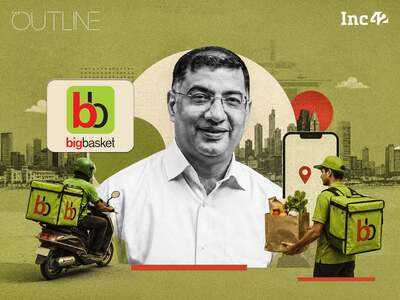
“I was in denial of the idea of quick commerce. Back then, if you had asked 100 people whether they wanted groceries in 10 minutes, most of them would’ve said no,” Hari Menon, the cofounder of BigBasket, wrote on LinkedIn last month, as he announced his departure after leading the Tata-backed online grocery marketplace for 15 years.
When Menon wrote this post, the online delivery giant was already undergoing a strategic overhaul — one that it had not seen before. Within weeks of Menon’s exit, reports emerged that Tata Digital wanted BigBasket to nearly halve its operating footprint, from 76 cities to around 40 profitable markets, to move towards sustainable profitability.
The company has denied claims of scaling down. “The city count figures are drawn from a speculative report that BigBasket never confirmed or commented on. This has already been refuted, and it doesn’t reflect the current on-ground reality,” the company responded to our email query.
However, sources maintained that the company is recalibrating parts of its operations, and added that such a move would not be unusual given its current strategic priorities. “What’s happening at BigBasket is not just a regular cost-cutting exercise… the company is rethinking its model,” an industry expert said.
Long before Indians got accustomed to the 10-minute convenience economy, BigBasket was busy building the country’s organised online grocery market around scheduled deliveries, large weekly baskets and a highly integrated supply chain spanning warehouses, farmers and private labels.
But the rise of quick commerce changed the playing field.
According to experts, by the time it planned its foray into quick delivery via BB Now, rivals had already spent billions building dense fulfilment infrastructure, acquiring customers through deep discounts and shaping consumer habits. As a result, many younger users today instinctively open Blinkit or Zepto before considering BigBasket, making customer acquisition significantly harder despite the company’s strong brand recall.
Furthermore, the model’s economics only made things worse for BigBasket. Unlike its rivals, which infused large amounts of capital to expand infrastructure and subsidise demand, BigBasket was constrained by Tata Group’s financial discipline. Even as the company expanded to around 700 dark stores, its ability to match the pace of competitors was constrained by the need to rein in losses. On the other hand, rivals were burning cash like there was no tomorrow.
“Due to its inability to compete with its rivals, the scale down of its footprint makes sense,” an expert said.
Amit Nanda’s Uphill BattleBigBasket’s new CEO, Amit Nanda, has inherited a business at a very different stage of its evolution. After years of prioritising scale and expanding its presence across India, the company’s immediate challenge is to restore financial discipline in an increasingly unforgiving market.
Tata Digital has directed the former Amazon executive, Nanda, to reduce BigBasket’s operational footprint to 40 markets. Rather than pursuing nationwide expansion, the company is expected to concentrate investments in densely populated urban clusters that offer stronger order density and healthier unit economics.
It is to be noted that parent Supermarket Grocery Supplies reported a 42% jump in consolidated net loss to ₹2,006.8 Cr in FY25. Operating revenue declined 2% to ₹9,866.7 Cr. The deterioration was driven largely by its consumer business, where losses widened nearly 47% to ₹1,851 Cr.
The ongoing restructuring at BigBasket also reflects a broader shift within the Tata Group. Over the past few years, Tata Digital has received significant funding from the Tata Group to build its consumer businesses. It now wants the bang for its buck.
According to a recent Mint report, Tata Sons infused nearly ₹3,000 Cr into Tata Digital in April at a valuation of about $10.3 Bn. However, the investment came at a 5.5% lower valuation than the previous funding round.
This is because Tata Digital’s portfolio, comprising BigBasket, Tata Cliq and other consumer businesses, is expected to remain loss-making for at least the next three years, with cumulative losses projected to reach around ₹9,000 Cr.
Hence, the group is said to be reassessing where fresh capital can generate the strongest long-term returns.
Nanda’s appointment reflects this changing priority. Unlike Menon, whose focus was on building India’s online grocery market from the ground up, Nanda has been tasked with improving operational efficiency, sharpening execution and moving the business closer to sustainable profitability. His arrival marks BigBasket’s transition from a founder-led company to a professionally managed business where capital discipline is likely to carry as much weight as expansion.
Whether that strategy is enough remains an open question, as pulling back from smaller markets may improve profitability, but it also risks ceding ground to rivals.
For more than a decade, BigBasket built its business around planned weekly shopping. Large basket sizes of ₹1,200-1,300, scheduled deliveries and an integrated supply chain allowed the company to optimise for inventory efficiency rather than delivery speed.
In the past few years, however, consumers increasingly shifted from planned weekly purchases to multiple smaller orders throughout the week, using instant delivery platforms for everything from fresh vegetables and snacks to forgotten household essentials. With average order values declining to nearly half, profitability became increasingly dependent on order density, dark store utilisation and high purchase frequency.
Unlike Blinkit, Zepto and Swiggy Instamart, which were designed around this behaviour from inception, BigBasket had to transform an existing business while continuing to serve millions of customers accustomed to scheduled grocery deliveries.
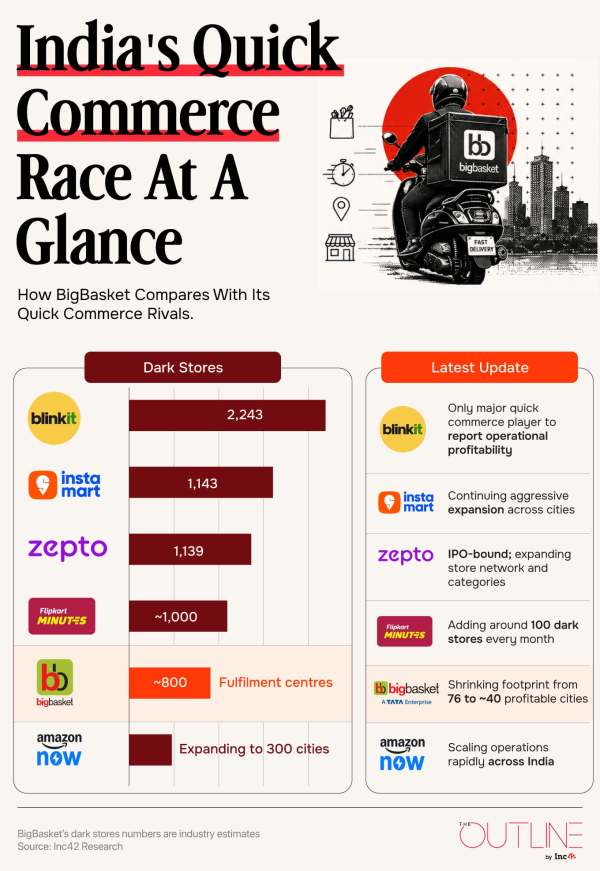
The company responded by aggressively expanding BB Now, growing its dark store network from just 56 locations under its legacy model to nearly 1,000 stores today. It broadened its assortment well beyond groceries, adding electronics through Croma with deliveries in under 45 minutes, while expanding categories such as toys, stationery, sports equipment and organic produce. This was to increase order frequency and improve margins.
As of today, Blinkit operates more than 2,200 dark stores, nearly twice BigBasket’s network, accounting for 46.5% of all quick commerce orders and processing over 2.5 Mn orders every day. Zepto and Swiggy Instamart together account for another 53% of the market, while Amazon Now and Flipkart Minutes are rapidly expanding their own networks.
Rather than matching rivals store for store or discount for discount, BigBasket appears to be pursuing a different playbook.
The company is increasingly leaning on its strengths: private labels such as Fresho and BB Royal, Tata Consumer brands, a wider grocery assortment and value-led bulk purchases, to differentiate itself in categories where consumers remain more price-sensitive.
But as rivals continue to deploy capital aggressively to expand their networks and acquire customers, will BigBasket’s big retreat help it become profitable without losing relevance?
[Edited by Shishir Parasher]
The post BigBasket’s Retreat appeared first on Inc42 Media.
-
WATCH: Shadab Khan Explains Why Match Against India Hurt Pakistan In World Cup
-
Spain Battles Massive Wildfires As Blaze Near Madrid Spreads Rapidly, Thousands Evacuated

-
Ben Duckett Smashes Century At Lord's, Becomes First Batter To Score Hundred In India Vs England ODI Series 2026

-
PV Sindhu Responds To PM Modi's Congratulatory Post After Japan Open Title Win, Says 'Your Wishes Mean The World To Me'
-
Panama Foreign Minister Javier Martinez-Acha Arrives In India For Five-Day Visit