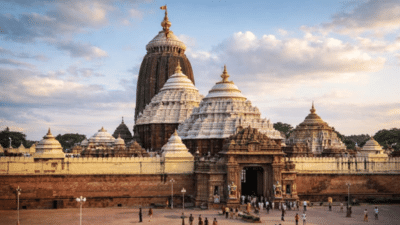
New Delhi: As lakhs of devotees gather in Odisha for the grand Jagannath Rath Yatra 2026, one mystery continues to capture as much attention as the sacred chariots themselves. High above the 12th-century Jagannath Temple in Puri, the temple’s iconic Patitapabana Bana (sacred flag) appears to flutter in the direction opposite to the wind – a phenomenon that has intrigued pilgrims, tourists, scientists and historians for decades.
While devotees see it as a symbol of Lord Jagannath’s divine presence, researchers have attempted to explain the spectacle through the principles of aerodynamics. Yet, despite numerous theories, no universally accepted scientific explanation has conclusively settled the debate, making it one of India’s most enduring temple mysteries.
Does the flag really fly against the windEvery year, as the annual Rath Yatra begins, videos and photographs of the Jagannath Temple’s fluttering flag flood social media, reviving discussions about whether it truly flies against the wind.
The belief is deeply rooted in local tradition. Devotees claim that regardless of the prevailing breeze, the flag atop the temple’s towering Shikhara seems to stream in the opposite direction. For many, it is yet another miracle associated with Lord Jagannath and the sacred shrine, one of the four revered Char Dham pilgrimage sites in Hinduism.
While no definitive explanation exists, scientists and researchers have proposed several theories.
One widely discussed hypothesis involves Kármán vortex shedding, a fluid dynamics phenomenon in which air flowing around a tall structure creates alternating swirling vortices. Because the Jagannath Temple rises prominently above its surroundings and is located close to the Bay of Bengal, the interaction between strong coastal winds and the temple’s architecture could create turbulent airflow near the summit.
These vortices may occasionally cause the flag to momentarily flutter in a direction that appears opposite to the prevailing wind when viewed from the ground. However, experts note that this explanation has not been conclusively proven for the Jagannath Temple and does not fully account for all reported observations.
Other researchers suggest that the temple’s towering spire, the position of the flag, changing sea breezes and perspective from different viewing angles may together create an optical impression that reinforces the popular belief.
A tradition that continues every single dayBeyond the mystery itself, the flag carries immense religious significance.
The sacred flag atop the temple is replaced every day in a centuries-old ritual performed by specially designated sevayats (temple servitors). In an extraordinary display of skill and devotion, the sevayat climbs the temple’s approximately 65-metre-high structure without modern safety equipment to replace the flag.
Temple tradition holds that the flag must never be absent from the shrine. According to local belief, if the daily ritual is ever interrupted, the temple would remain closed for worship for an extended period.
Whether viewed through the lens of devotion or science, the Jagannath Temple’s flag remains an enduring symbol of wonder. For millions participating in Rath Yatra 2026, the fluttering banner is more than a physical object – it represents unwavering faith and centuries of living tradition. For researchers, it continues to pose intriguing questions about airflow, perception and medieval temple architecture.
Until science offers a definitive answer – or perhaps never does – the flag atop the Jagannath Temple is likely to remain one of India’s most captivating mysteries, drawing believers and curious minds alike to Puri year after year.
-
Tom Heaton confident Senne Lammens will recover stronger after World Cup setback

-
5.5 magnitude Peru quake kills five, displaces hundreds

-
Chalo Sansad eve: Jantar Mantar comes alive as nearly 20,000 gather

-
Gurung Anticipates Close FIFA World Cup Final Between Argentina and Spain

-
Didier Deschamps Steps Down as France Coach After World Cup Exit