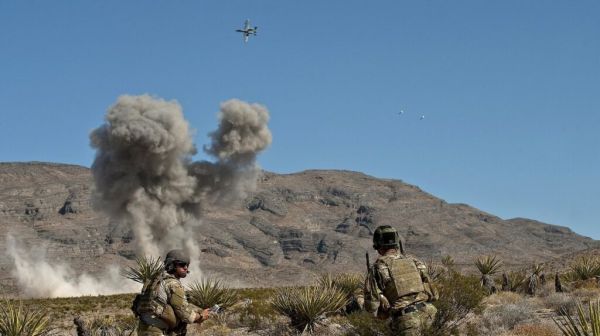
Few places on Earth are as deadly as a weapons test range. They’re usually some variation of sprawling rural salt flat, alpine tundra, or coastline where artillery batteries unleash barrages, jets practice bombing runs, and missile systems prove their accuracy. Once a combined-arms live-fire exercise begins, stopping it is no simple matter. Coordinating aircraft, artillery, armored vehicles, drones, and ground troops requires months of planning; when the rounds start flying, missions typically continue until objectives are met or ammunition is exhausted. Although everyone involved has the right to call “cease fire”, you’d better have a very good reason when the Range Safety Officer storms over to ask why you shut down their range.
Surprisingly, some of these cease fires can have nothing to do with equipment failure or medical emergency, as it’s universally justifiable to do so simply due to seeing an animal. In fact, it’s become increasingly common for a wildlife incursion to be the cited as a range-halting event. At New Mexico’s White Sands Missile Range, one of the world’s largest military testing facilities, the simple presence of the endangered Northern Aplomado Falcon can halt shoots or force exercises to be replanned entirely. Alternatively, if the threatened desert bighorn sheep happens to roam within a set of live range limits, it’s shouts of “unload” and “show clear” all around.
Interestingly, rather than viewing these species as obstacles or obstructions, the U.S. military has taken ownership of their welfare and incorporated their protection into range management. Breeding seasons, migration patterns, and habitat requirements are built into training schedules through temporary pauses, seasonal restrictions, and carefully planned exercises. The result is an unexpected partnership between conservation and national defense: In some of the world’s most heavily militarized landscapes, endangered wildlife have found an unexpected sanctuary.
How the U.S. military drafts the doctrine of wildlife conservation
Protecting endangered species on military land isn’t just a matter of serendipity. Every U.S. military installation complies with environmental legislation, including the Endangered Species Act, and many operate under Integrated Natural Resources Management Plans. These efforts are developed jointly by military environmental offices, the U.S. Fish and Wildlife Service, and state wildlife agencies, balancing military requirements with conservation.
Some efforts are remarkably straightforward. Range orders may designate seasonal exclusion zones, prohibit live-fire exercises during breeding seasons, or require environmental surveys before training begins. If sensitive species are detected in a training area, commanders may delay exercises, relocate activities, or temporarily close sections of a range. These measures often require little more than careful scheduling, but they make an enormous difference for vulnerable wildlife.
Other initiatives involve far closer collaboration. Many large military training areas now employ biologists to routinely monitor endangered plants and animal populations. This provides exercise planners with up-to-date information that allows military activities to proceed without harming critical habitats or active breeding grounds.
The result is an unusual but effective model of stewardship where wildlife benefit from habitats that remain protected from urban expansion, agriculture, mining, and many of the pressures that have driven species decline elsewhere. Today, Department of Defense-owned land supports more federally listed threatened and endangered species than any other federal land management agency, including America’s own national parks — though the latter remain substantially easier to visit thanks to the plethora of mobile apps associated with them..
Wildlife thriving in the killbox across the globe
The results of these conservation efforts have been striking. The U.S. Department of Defense manages around 25 million acres of land, much of it remaining in a wildlife-permissive state. Although explosions, aircraft noise, and armored vehicles may seem incompatible with fragile ecosystems, many species have proven remarkably resilient when military activity is kept to a distant annoyance.
The San Clemente Bell Sparrow on California’s San Clemente Island Training Range, the Louisiana Pine Snake at Fort Johnson, and the Red-cockaded Woodpecker, found across Fort Liberty, Camp Lejeune, and Eglin Air Force Base, have all maintained or recovered populations on military lands that now function as de facto wildlife refuges.
The U.S. military joins other government agencies in this conservation model, as NASA uses satellite imagery to protect animal populations as well. Additionally, other militaries likewise take part; the British Army’s Salisbury Plain Training Area protects one of Europe’s largest remaining expanses of ecologically important chalk grassland. In New Zealand, the Royal New Zealand Air Force routinely pauses activity at Kaipara Bombing Range to support the breeding of the vulnerable Fairy Tern. Even the heavily fortified Korean Demilitarized Zone has become one of Asia’s richest wildlife corridors.
It is a remarkable irony that landscapes designed to prepare for war have become some of the safest places for wildlife. Military training ranges will never lose their primary purpose: They exist to develop combat capabilities and ensure armed forces remain competent and credible. But the same restrictions that exclude humans have also limited human development, allowing biodiversity to flourish beyond the firing line.