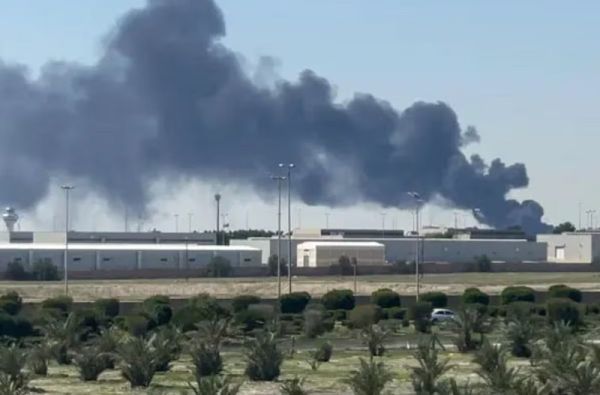
Washington. The ongoing military confrontation between America and Iran has now gone beyond oil wells and military bases and has reached a very dangerous point. The Islamabad Agreement signed between the two countries in June has been completely broken and a fierce war has again broken out in the Strait of Hormuz.
This time, both the sides have made water infrastructure i.e. water supply system their main target to bring each other to their knees. Along with conventional air strikes, there is now a race to destroy water treatment plants, which has directly put the lives of civilians at stake.
-
Read this also Clash over 650 acres of land in Telangana! Farmers opened front against bullet train project
Why is water being made the new battlefield?
The Persian Gulf is one of the few parts of the world where natural drinking water is negligible. In such a situation, water production and its distribution system is the most sensitive vein for the existence of any country.
Attacks on oil refineries or crude oil ships affect global markets and economies. But when the desalination plant that makes the salty sea water potable is destroyed, then the general public faces a direct drinking water crisis.
Iran has launched drone and missile attacks on US bases and its allies in the Persian Gulf. One of the major attacks was on Kuwait’s main power generation and desalination plant. Due to this attack, many power units came to a standstill and a massive fire broke out. The Kuwait government had to implement emergency plans and appeal to citizens to reduce water and electricity use.
Kuwait obtains 90 percent of its drinking water needs by purifying sea water. In such a situation, attacks on these plants can paralyze the entire domestic water supply of the country. The attack shows how vulnerable the Gulf Cooperation Council (GCC) countries are, as most of their large water plants are located on coastlines, which are in direct line of fire from Iranian missiles.
America’s counterattack: Plant destroyed in Bunji village of Iran
Almost simultaneously with the attack on Kuwait, the US military also changed its strategy and started targeting civilian and logistics facilities in addition to military targets. The US carried out an airstrike on a major desalination plant located in Bunji village in Iran’s south-eastern Hormozgan province.
According to Hormozgan Water and Wastewater Company, the entire filtration equipment and pumping system of the plant has been completely destroyed in the American attack. Due to this, around 10,000 people from more than 20 villages have been forced to live without drinking water during this scorching summer season, creating a major humanitarian crisis in the area.
Even before this, Kuwait’s ‘Doha West’ desalination plant was damaged during the war. At the same time, Iran had also accused America of attacking the water plant of ‘Qeshm Island’ on March 8, due to which the water supply to 30 villages was stopped. However, Washington did not confirm this.
Why are Gulf countries so dependent on desalination for water?
According to United Nations (UN) standards, if a country has less than 500 cubic meters of renewable fresh water per capita per year, then it is categorized as ‘absolute water scarcity’. In Gulf (GCC) countries this figure is less than 100 cubic meters.
Despite this lack of natural resources, the region has experienced rapid urbanization, industrial development, and population growth over the past few decades. To keep this glamor alive, a completely artificial water supply network was laid instead of natural sources.
What will happen if these plants stop working?
The closure of an oil refinery only stops business activities, but the closure of a water plant impacts hospitals, emergency services and homes every second. If these plants are closed for a long period of time due to war, the timeline of the crisis could change like this:
Highly dependent countries like Bahrain and Qatar will have to immediately impose strict water limits. Water from industries and commercial areas will be stopped and priority will be given to domestic use only.
If repairs are not made within a week, a large section of the population will be left craving every drop of water. Lack of water in the Gulf’s scorching heat of more than 45°C will lead to widespread dehydration and public health emergencies.
What is the connection between water security and energy?
In Gulf countries, electricity and water plants do not work separately but are interconnected under the ‘cogeneration system’. Thermal desalination plants use hot steam from nearby oil or gas-fired power plants to clean water. At the same time, those power plants depend on this cleaned water to keep their boilers cool and operate safely.
If a water plant’s intake pump or filter is targeted, the power plant may also have to reduce its capacity or shut down to avoid thermal damage. That means an attack on water directly disrupts the power grid.
Modern water plants run on ‘reverse osmosis’ (RO) technology, in which salts are separated through extremely fine polymer membranes. These membranes are very delicate and expensive. If crude oil leaks into the sea due to war and that contaminated water reaches the intake point, these membranes are permanently damaged. It may take months to replace these.
New threat of cyber warfare
In addition to physical missile attacks, the US has warned that Iranian cyber hackers are targeting US water and wastewater systems. For this, FBI, NSA and CISA have issued an alert.
Instead of using a virus or malware, hackers break into the system’s programmable logic controllers, which automatically control pumps and filtration. Hackers use programming tools to hide in the network like normal maintenance staff.
They delete the files that decide when the pump should turn on or off. Additionally, they display false data on the human-machine interface, i.e., the operator’s digital screen, making officials think that everything is going well, when inside, the system has failed. Earlier, a similar attack had taken place on Israel’s water system, where an attempt was made to secretly increase the amount of chlorine in water.
International law and CIA’s old warning
The Pentagon and US security agencies had been aware of this weakness for years. A confidential CIA report in 2010 warned that more than 90% of the Gulf’s water production was concentrated in just 56 sensitive plants. Any major attack on them could bring national emergency in the entire region.
International humanitarian law, under Article 54 (paragraph 2), clearly states that “the destruction, removal or destruction of objects essential to the survival of civilian populations, such as food, agricultural areas… and drinking water facilities and supplies, is strictly prohibited.”
-
Ranking the Former Manchester City Academy Graduates Signed by Chelsea Following Morgan Rogers Deal

-
Near a Record: The Unusual Petition Urging Argentina to Withdraw from the World Cup

-
Mateus Fernandes nets stunning goal on Tottenham Hotspur debut

-
U.S. Customs Confiscate $5.39 Lakh Worth of Luxury Cars Over Fake Sale Documents

-
Porsche Cayenne Electric Matches Speed With the World’s Largest Aircraft in Mojave Test