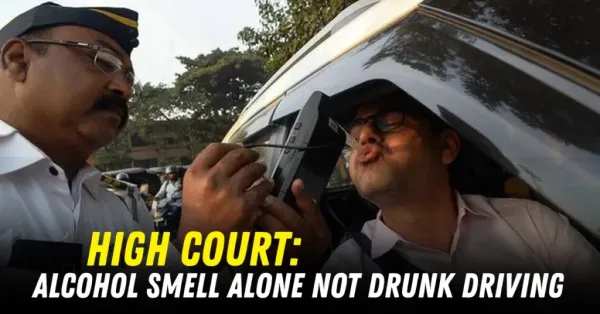
The Uttarakhand High Court has set aside a culpable homicide charge against a driver after finding that the smell of alcohol, without scientific evidence of his blood-alcohol level, was insufficient in the circumstances of the case.
The judgment was delivered on July 8, 2026, in a revision petition filed by Amar Singh. He had been charged under Section 105 of the Bharatiya Nyaya Sanhita, which covers culpable homicide not amounting to murder, following an accident in Chamoli district.
The ruling does not say that a breathalyser or blood test is mandatory in every case before a serious accident charge can be framed. Instead, the court found that the complete body of evidence in this particular case did not support the culpable homicide charge.

Singh was driving a vehicle from Badrinath towards Chamoli when its left-front tyre burst and the vehicle overturned. One passenger died and several others were injured.
The sessions court subsequently framed charges against the driver under BNS Section 105, Section 125(a) and Section 125(b), as well as Section 281.
The prosecution relied partly on a medical report recording that Singh smelled of alcohol. However, no breathalyser test was conducted and no blood sample was taken to determine the concentration of alcohol in his bloodstream.
That absence became important because Section 185 of the Motor Vehicles Act defines the statutory drunk-driving threshold as more than 30 mg of alcohol per 100 ml of blood, detected through the prescribed testing process.
A smell could show that a person had consumed alcohol. It could not establish how much had been consumed or whether the statutory threshold had been crossed.
The court did not examine the missing alcohol test in isolation. Eyewitnesses stated that Singh had been driving normally and steadily during the journey. They did not describe him as visibly intoxicated or incapable of controlling the vehicle.
The technical inspection found that the left-front tyre had burst. It also recorded damage to the brake pipe, while the remaining tyres were found to be in proper condition. The material before the court did not establish that the accident had resulted from rash driving, excessive speed or loss of control caused by intoxication.
Against this background, the High Court found that there was no prima facie material supporting the ingredients required for a culpable homicide charge under Section 105.
The allegation of alcohol consumption remained an investigative clue. It was not, by itself, proof that Singh had been driving above the legal alcohol limit or that he had knowingly engaged in conduct likely to cause death.
The High Court did not discharge Singh from the entire case. It allowed the prosecution to continue under BNS Sections 125(a) and 125(b), which apply when an act endangering human life or personal safety results in hurt or grievous hurt. It also retained the charge under Section 281, covering rash driving or riding on a public way.
The trial court was directed to continue the proceedings expeditiously on those charges.
This distinction is important. Setting aside the culpable homicide charge does not amount to a final finding that the driver committed no offence. It means the available evidence did not justify proceeding under the more serious Section 105 charge.
Accident investigations frequently begin with observations made at the scene: the smell of alcohol, slurred speech, poor balance or unusual behaviour. Such observations may give police reasonable grounds to investigate possible intoxication.
They are not a substitute for measuring the driver’s alcohol level.
A breathalyser reading or laboratory blood test allows a court to compare the result with the statutory limit. It also creates a timed scientific record that is far more reliable than a later recollection of how a person smelled or behaved.
In remote areas, testing equipment or medical facilities may not always be immediately available. But when scientific evidence is not collected, it can substantially weaken any later allegation that intoxication caused the accident.
The Uttarakhand High Court’s order is therefore narrower, but also more precise, than saying that the smell of alcohol can never be considered. Smell may justify suspicion and further testing. Whether it supports a criminal charge depends on the scientific evidence and the other circumstances surrounding the accident.
In Amar Singh’s case, the tyre-burst report, the eyewitness testimony and the absence of a measured blood-alcohol level collectively undermined the culpable homicide charge. The smell of alcohol was evidence of possible consumption. It was not proof of statutory intoxication or culpable homicide.
-
TGCSB warns of fake income tax refund scams

-
Join BJP or you will be in trouble, Dipke claims intimidation by party
-
Delhi Mayor calls for closure of meat shops for Kanwar Yatra
-
2020 Delhi riots: Umar Khalid moves HC for bail in UAPA case

-
Nepal Violence Spreads Beyond Sunsari; Curfews, Army Deployment As Death Toll Rises