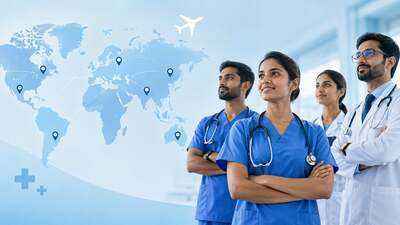
The global healthcare workforce is undergoing a significant transformation. Across many countries, ageing populations, rising healthcare needs, workforce shortages, and expanding healthcare infrastructure are creating sustained demand for qualified healthcare professionals. Nations such as the UK, Australia, Ireland, and New Zealand continue to strengthen international recruitment efforts as they seek to address persistent talent gaps and maintain quality healthcare delivery.
At the same time, healthcare migration is becoming increasingly diversified. While doctors have traditionally represented a significant portion of healthcare mobility, global demand today extends across nursing and allied healthcare professions as well. Healthcare systems are actively seeking nurses, physiotherapists, occupational therapists, radiographers, medical laboratory professionals, and other allied health workers to support growing patient needs.
This evolving landscape presents a major opportunity for India. With one of the world's largest healthcare education ecosystems and a strong reputation for producing skilled healthcare professionals, India is well positioned to play an increasingly important role in addressing global healthcare workforce shortages. However, the scale of emerging demand also raises an important question: Is India's healthcare education ecosystem adequately preparing healthcare professionals for the realities of international practice?
India's Healthcare Education Ecosystem Has a Strong Foundation
India has made significant progress in expanding healthcare education capacity over the past decade. Medical colleges, nursing institutions, and allied healthcare training programmes have grown considerably, creating opportunities for a larger number of students to pursue healthcare careers.
India's healthcare talent pipeline is also geographically diverse. States such as Kerala, Tamil Nadu, Andhra Pradesh, Karnataka, Maharashtra, Telangana, Gujarat, and Punjab have emerged as important contributors to the international healthcare workforce. Kerala, in particular, has long been recognised as a leading source of nursing talent, with estimates suggesting that nearly 25–30% of nursing graduates migrate overseas each year.
However, global healthcare employers today increasingly expect professionals to bring more than academic qualifications and technical expertise into the workplace. Modern healthcare systems are highly collaborative, patient-centred, and technology-enabled. As a result, healthcare employability is increasingly defined by a broader set of competencies that include communication, adaptability, teamwork, professional confidence, and cultural awareness alongside clinical excellence.
The challenge for healthcare education is therefore evolving. The objective is no longer simply to produce healthcare graduates at scale, but to prepare healthcare professionals who can succeed in diverse healthcare environments across the world.
Communication Skills Are Becoming a Critical Employability Requirement
One of the most important shifts taking place globally is the growing recognition of communication as a core clinical competency. Every day, healthcare professionals are required to explain treatment plans, document patient information accurately, coordinate patient handovers, manage sensitive conversations, and collaborate with multidisciplinary teams.
In many situations, communication directly influences patient understanding, treatment adherence, care continuity, and patient safety. As healthcare systems place greater emphasis on patient-centred care, professionals are expected to communicate with clarity, empathy, and confidence.
For healthcare professionals pursuing international careers, communication skills become even more important. Working in multicultural healthcare environments requires the ability to build trust with patients from diverse backgrounds, collaborate effectively with colleagues, and navigate workplace interactions confidently.
Increasingly, language proficiency is not viewed merely as a migration requirement but as an essential component of workplace readiness. Healthcare professionals who can communicate effectively are often better positioned to integrate into healthcare systems and deliver high-quality patient care from the outset.
Preparing for Overseas Careers Involves More Than Qualifications
Despite growing international opportunities, healthcare professionals often encounter several challenges when preparing for overseas careers.
Many professionals must navigate unfamiliar professional registration processes, licensing requirements, workplace expectations, and healthcare delivery models. Adapting to new cultural contexts and communication expectations can also present challenges, even for clinically competent professionals.
In addition, healthcare systems in different countries may place varying levels of emphasis on patient-centred communication, interdisciplinary collaboration, documentation practices, and shared decision-making. Understanding these expectations requires preparation that goes beyond academic learning alone.
This highlights the importance of workforce readiness as a key component of healthcare education and professional development. Professionals benefit from opportunities to develop practical communication skills, workplace confidence, and a deeper understanding of international healthcare environments before entering global practice.
Nursing and Allied Healthcare Professionals Are Driving Mobility Trends
While discussions around healthcare migration often focus on doctors, some of the strongest international demand is emerging within nursing and allied healthcare professions. Nurses continue to represent the largest internationally mobile healthcare workforce globally, supported by established migration pathways and sustained demand across multiple healthcare systems.
Countries such as the UK, Ireland, Australia, New Zealand, Canada, and the United States continue to rely significantly on internationally qualified healthcare professionals, including those trained in India. Even in markets where recruitment patterns fluctuate, India remains one of the most important source countries for healthcare talent globally.
Beyond nursing, opportunities are expanding for physiotherapists, pharmacists, occupational therapists, medical laboratory professionals, radiographers, and other allied healthcare workers as healthcare systems increasingly adopt multidisciplinary models of care. This trend is broadening the scope of international opportunities available to Indian healthcare professionals and creating new pathways for global careers.
India’s Opportunity to Become a Global Healthcare Talent Hub
The global demand for healthcare professionals is unlikely to diminish in the foreseeable future. For India, this presents a significant opportunity to strengthen its position as a trusted contributor to the global healthcare workforce.
The country already possesses many of the foundations required to achieve this, including scale, talent, educational infrastructure, and a growing healthcare workforce. However, the next phase of progress will depend on how effectively healthcare education evolves to meet changing global expectations.
Clinical excellence will remain essential, but it must increasingly be complemented by communication capability, technological awareness, adaptability, collaboration, and patient-centred thinking. By integrating these competencies into healthcare education and workforce preparation, India can move beyond being a producer of healthcare graduates to becoming a leading global hub for healthcare talent.
As countries continue to grapple with workforce shortages, India is increasingly being viewed not only as a source of healthcare talent but as a strategic partner in strengthening global healthcare systems. Sustaining this role will require continued investment in communication skills, workplace readiness, and globally aligned healthcare training. If India can successfully align healthcare education with these evolving workforce expectations, it has the potential to become one of the world's most important healthcare talent hubs in the decades ahead.
(The author is Regional Director, South Asia, OET)
-
Unai Simon says Spain's defence made his job easy during their 2026 World Cup triumph

-
People loot garlic from lorry after accident on Telangana highway

-
Telangana’s Srikar Reddy tipped to be India’s Ambassador to Qatar
-
Top 10 | ABP LIVE Evening Bulletin: Top News Headlines from 21 July 2026 - Evening

-
Argentina criticised for poor sportsmanship and World Cup final conduct after refusing to honour Spain