International Moon Day 2026: International Moon Day is celebrated every year on 20 July. This day reminds of the historic moment when on July 20, 1969, a human being took his first step on the lunar surface.
The United Nations has recognized this day as International Moon Day to honor this day and promote the exploration of the secrets of space. The moon visible from a distance has always been full of curiosity for humans. Sometimes poems and stories were made on the moon, sometimes films and songs and sometimes even scientists tried to understand the moon. In the last few decades, many countries sent their missions to the Moon and gave a new direction to space science.
Apollo 11 had created history
On July 20, 1969, America’s Apollo 11 mission created history. Under this mission, Neil Armstrong and Buzz Aldrin became the first humans to land on the lunar surface, while Michael Collins remained in the command module in lunar orbit. Neil Armstrong’s first step became a memorable moment for the whole world.
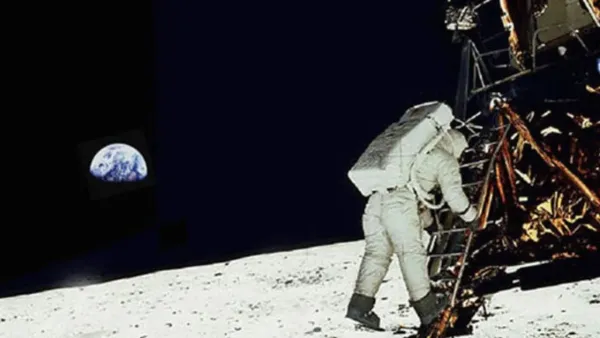
Moon Day (Photo.Social Media)
race to reach the moon
Even after the Apollo missions, many countries of the world continued exploring the Moon. Many countries including the Soviet Union, China, India, Japan and Europe are exploring the lunar surface and the possibilities of presence of water and minerals there through different missions.
India has also made its strong identity through Chandrayaan Mission and preparations are going on for many new missions in future also.
How will the moon look on Moon Day?
This year, on International Moon Day, July 20, the Waxing Crescent will be visible in the sky. During this period, about 39 percent of the Moon will be illuminated by sunlight. This phase comes after the new moon and is part of the moon moving towards the full moon.
What is the purpose of International Moon Day?
This day is not just celebrated to celebrate the success of Apollo 11 but also to increase interest in space science among people. Moon Day is also celebrated to give the message that space exploration should be done in a peaceful manner in the interest of all humanity.
Moon Phase (Photo.Social Media)
8 phases of the moon
The Moon makes one complete revolution around the Earth in about 29.5 days and during this time it appears in eight different phases.
-
Amavasya
In this phase the Moon is between the Earth and the Sun. Therefore, the part of the Moon which is towards the Earth remains completely in darkness and is not visible to us.
-
half moon of shukla paksha
A thin stream of light becomes visible on the right side of the Moon, i.e. in the northern hemisphere.
-
first stage
The right half of the moon shines with light, making it appear like a half moon.
-
rising gibbous
In this state, more than half of the Moon is illuminated, but it is not completely a full moon.
-
full moon
In this phase the entire face of the Moon is illuminated by the Sun and is completely visible.
decreasing gibbous
After the full moon, the moonlight starts decreasing. In the Northern Hemisphere the right side starts getting dark first.
-
last quarter
In this phase the Moon is again visible as half, but now its left side remains illuminated.
dark half moon
In this final phase only a thin streak of light remains on the left side of the Moon. After this it again reaches the new moon stage and the whole cycle starts again.
-
Max Dowman, Estevao, Cavan Sullivan and 20 NXGN Prodigies Poised for Their 2030 World Cup Debuts

-
Tottenham Hotspur Women secure Alice Sombath from Lyon in record-breaking transfer

-
Chhattisgarh: Doc, home guards among 19 held in snakebite compensation 'scam'

-
'We Will Win Medals, But I Don't Expect Gold': Mary Kom Backs India's Commonwealth Games Boxing Team, Questions BFI's Functioning

-
Chinmaya Mission Sets Guinness World Record, 8,277 People Chant Bhagavad Gita Online Together