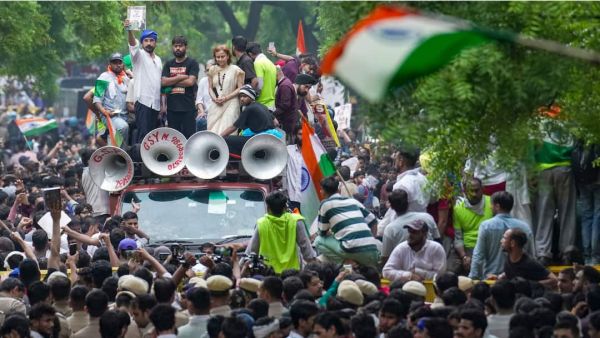
The debate over the legal framework governing public protests has resurfaced after Abhijeet Deepak's Cockroach Janata Party organised a march to Parliament from Jantar Mantar in Delhi on Tuesday without police permission, demanding the resignation of Union Education Minister Dharmendra Pradhan. During the protest, police resorted to a lathi-charge to stop the students.
The incident has once again brought attention to the constitutional provisions and legal requirements governing public demonstrations in India.
What Does The Constitution Say?
The right to protest is rooted in Article 19 of the Constitution, which guarantees citizens the right to peaceful expression and assembly.
Article 19(1)(a) provides for freedom of speech and expression, while Article 19(1)(b) guarantees the right to assemble peacefully in a public place without arms.
The Supreme Court has, in several judgments, held that peaceful protest is an essential part of democracy. However, these rights are subject to reasonable restrictions that the government may impose to maintain public order, national security and law and order.
Who Grants Permission For A Protest?
As law and order is a State subject, the rules governing public demonstrations can differ across states.
To organise a rally or gathering in a public place, organisers are required to obtain a No Objection Certificate (NOC) from the concerned police station or the office of the Deputy Commissioner of Police (DCP).
If the demonstration falls under the jurisdiction of more than one police station, approval must be obtained from the commissionerate. The police issue written permission after considering public safety, traffic management and public convenience.
Documents Required For A Police NOC
Organisers seeking permission must submit a formal application containing their name, address and contact number.
The application must also specify the purpose of the protest, its timing, the expected number of participants, the proposed use of loudspeakers and the location of any temporary tents.
For processions or marches, organisers are required to inform the police about the entire route in advance.
The application must be accompanied by identity proof, residence proof and photographs. Police may also seek affidavits related to crowd management, drinking water, toilet facilities and emergency preparedness.
Can Police Refuse Permission?
Police have the legal authority to deny permission if they believe a protest poses a threat to public safety or peace.
They may also refuse to issue an NOC if they believe the demonstration is likely to cause serious disruption to normal life, trigger violence or significantly affect traffic movement.
-
People loot garlic from lorry after accident on Telangana highway
-
Telangana’s Srikar Reddy tipped to be India’s Ambassador to Qatar

-
Top 10 | ABP LIVE Evening Bulletin: Top News Headlines from 21 July 2026 - Evening

-
Argentina criticised for poor sportsmanship and World Cup final conduct after refusing to honour Spain

-
China narrows AI gap, challenges US influence