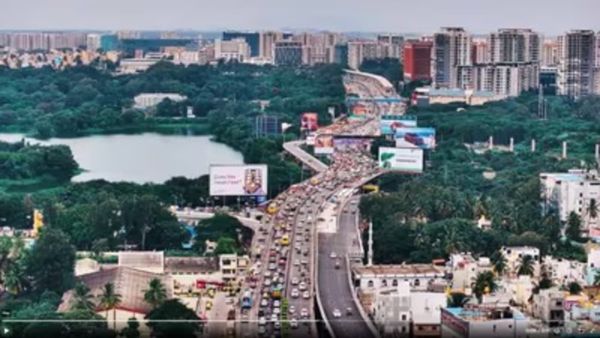
Bengaluru has crossed 25 lakh registered private cars for the first time, highlighting growing dependence on personal vehicles. Experts blame delays in Metro expansion and a shrinking BMTC fleet as the city continues to rank as the world's second-most congested.
Bengaluru's dependence on private vehicles has reached an unprecedented level, with the number of registered private cars in the city crossing the 25 lakh mark for the first time. The milestone highlights the growing reliance on personal vehicles amid persistent concerns over inadequate public transport infrastructure. Urban mobility experts have attributed the surge to delays in the expansion of the Namma Metro network and a shrinking BMTC bus fleet, warning that the trend could further worsen the city's already severe traffic congestion unless public transport is significantly strengthened.
Transport Department Data Shows Steady Rise in Vehicle Registrations
According to the Transport Department, Bengaluru had 25.2 lakh registered private cars as of June 30, 2026. In June alone, 13,519 new private cars were added to the city's roads. In addition, nearly three lakh yellow-board taxis operate across Bengaluru.
Over the past five years, the city has added around five lakh private cars, averaging nearly one lakh new registrations each year. During June 2026, Bengaluru recorded 78,084 new vehicle registrations, making it the third-highest monthly total on record after 86,014 registrations in October 2025 and 78,461 in January 2026.
Bengaluru's Vehicle Count Reaches 1.28 Crore
The rapid increase in vehicle ownership comes as Bengaluru continues to grapple with worsening traffic congestion. According to the TomTom Traffic Index, Bengaluru is the world's second-most congested city after Mexico City, ranking ahead of Dublin.
The report states that travelling just 10 kilometres in Bengaluru takes an average of 36 minutes and 9 seconds. During peak hours in 2025, motorists spent an average of 168 hours stuck in traffic.
The city's total number of registered vehicles has now reached 1.28 crore. Two-wheelers continue to dominate the vehicle population, with around 87 lakh registered, accounting for nearly 70 per cent of all vehicles. Bengaluru also has the highest combined number of registered cars and two-wheelers among Indian cities.
How Bengaluru Compares With Other Major Cities?
New Delhi has more than 1.5 crore registered vehicles but manages traffic more effectively because of its extensive Metro network. During 2025-26, the national capital had around 60 lakh registered two-wheelers and 22 lakh private cars.
Mumbai, meanwhile, has around 15 lakh private cars, as a large proportion of commuters rely on the city's suburban railway network for their daily travel.
In contrast, Bengaluru's Metro expansion has repeatedly missed deadlines. The decision to construct double-decker and underground corridors under Phase 3 and Phase 3A, along with multiple design changes, has contributed to project delays. Furthermore, work on new Metro corridors has not begun in the past four and a half years.
Experts Call for Stronger Public Transport
Urban mobility expert Sathya Arikutharam said the shrinking public transport network is encouraging more people to purchase private vehicles.
"The number of BMTC buses has gone down significantly in the last four years, so naturally, the number of cars and two-wheelers has increased. Today, peak traffic congestion is witnessed at around 10 locations. If public transport continues to decline, this could spread to 20 or more locations," he said.
Chief Minister DK Shivakumar has announced infrastructure projects worth ₹1.5 lakh crore, including tunnel roads, to ease congestion. However, Arikutharam believes such projects may not provide a lasting solution.
"The only permanent solution to Bengaluru's traffic problem is to expand public transport and provide proper footpaths for pedestrians," he said.
Urban Planner Suggests Long-Term Mobility Strategy
V Ravichandar, a member of the government's Brand Bengaluru committee, said one of the city's biggest challenges is the unplanned development of its outskirts without a proper street grid.
"The major challenge is improving connectivity in areas such as Whitefield and Sarjapur, where traffic is funnelled onto a limited number of arterial roads," he said.
According to Ravichandar, projects such as tunnels and elevated corridors do not address the underlying planning issues. Instead, he called for a comprehensive urban mobility strategy that prioritises public transport, makes it more affordable and accessible, and discourages excessive use of private vehicles through stricter parking regulations in key parts of the city.
-
People loot garlic from lorry after accident on Telangana highway
-
Telangana’s Srikar Reddy tipped to be India’s Ambassador to Qatar
-
Top 10 | ABP LIVE Evening Bulletin: Top News Headlines from 21 July 2026 - Evening

-
Argentina criticised for poor sportsmanship and World Cup final conduct after refusing to honour Spain

-
China narrows AI gap, challenges US influence