By: The Obnews Editorial Staff
Congress leaders Rahul Gandhi and Priyanka Gandhi Vadra were detained and taken away in police buses on Tuesday after a protest near Prime Minister Narendra Modi’s official residence in New Delhi. The demonstration centred on alleged examination paper leaks, demands for government accountability and the police action against protesters during a separate march toward Parliament one day earlier.
A major political confrontation unfolded in New Delhi on Tuesday after Congress leaders Rahul Gandhi, Mallikarjun Kharge and Priyanka Gandhi Vadra led a protest near Prime Minister Narendra Modi’s official residence over examination paper leaks and the treatment of student protesters. The demonstration ended with police temporarily detaining Rahul Gandhi, Priyanka Gandhi Vadra and several other opposition leaders.

The Congress leaders gathered outside the residence of party president Mallikarjun Kharge at 10, Rajaji Marg before marching toward 7, Lok Kalyan Marg, the official residence of the Prime Minister. Security personnel stopped the group as it approached the restricted area, after which Congress MPs and workers began a sit in on the road.
Congress said the protest was organized to demand accountability following Monday’s clashes between police and participants in a march connected to the Cockroach Janta Party, a youth driven protest organization. The group has been campaigning over the NEET paper leak, other alleged examination irregularities and broader concerns involving India’s public examination system.
Rahul Gandhi accused the government of failing to adequately address the concerns of students. He called for a discussion in Parliament and demanded political accountability from senior members of the government. Congress leaders also called for the resignation of Union Education Minister Dharmendra Pradhan.
The demonstration took place in one of the most heavily protected areas of the national capital. Delhi Police deployed additional personnel around the Prime Minister’s residence, while BJP leaders accused Congress of creating an avoidable security concern by taking the protest toward such a sensitive location.
Congress representatives maintained that their demonstration was peaceful and said they had approached the Prime Minister’s residence because their attempts to raise the issue in Parliament had not received sufficient attention. Party president Mallikarjun Kharge alleged that opposition leaders were not being provided a proper opportunity to discuss the treatment of protesters or the examination controversy.
The government, however, did not completely dismiss the opposition’s concerns. Union Minister Jitendra Singh, who serves as Minister of State in the Prime Minister’s Office, personally visited the protest site and held a lengthy conversation with Rahul Gandhi. The meeting represented a direct attempt by the government to communicate with the opposition while the demonstration was still underway.
According to Congress MP Syed Naseer Hussain, the government asked the protesters to withdraw but did not accept all their demands. Congress insisted that Education Minister Dharmendra Pradhan should resign and that Parliament should hold a dedicated discussion on examination paper leaks.
Jitendra Singh later offered a different account. He said Rahul Gandhi initially indicated that Congress would end the protest if the government agreed to a parliamentary discussion on NEET and paper leaks. Singh alleged that Gandhi later added the resignation of the Education Minister as another condition after the government showed willingness to discuss the matter.
The government’s account suggested that a possible path toward ending the protest had been available, but that the conditions presented by Congress changed during the discussions. Congress disputed that interpretation and maintained that ministerial accountability had remained part of its broader position.
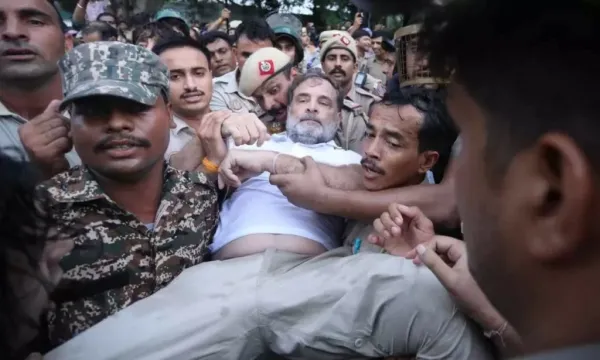
As the demonstration continued into the evening, police began removing participants from the area. Rahul Gandhi remained seated on the road and refused to leave voluntarily. Television footage showed several officers surrounding him before lifting and moving him toward a police vehicle.
Rahul Gandhi was later seen with blood near his nose. Congress representatives accused police of using unnecessary force, although the exact cause of the injury was not immediately established through an official medical or police statement. Gandhi criticized the government’s approach and described the confrontation as evidence of the condition of Indian democracy.
Priyanka Gandhi Vadra and other Congress leaders were also removed from the protest site and taken away in police buses. Rahul Gandhi was transported to Chhatrasal Stadium, while Priyanka Gandhi Vadra was taken to the Mandir Marg Police Station. Sonia Gandhi later visited Priyanka at the station.
Rahul Gandhi and Priyanka Gandhi Vadra were released at approximately 9 p.m. They were temporarily detained as police cleared the restricted area, but they were not formally arrested or charged in connection with the demonstration.
Samajwadi Party president Akhilesh Yadav and senior Nationalist Congress Party leader Supriya Sule also joined the protest. Their presence gave the demonstration support from other opposition parties, although the wider opposition was not entirely united over the Congress strategy.
The Aam Aadmi Party criticized the Congress demonstration and alleged that it shifted public attention away from the original youth protest. The disagreement demonstrated that opposition parties broadly concerned about the paper leak controversy did not necessarily agree on how the issue should be handled politically.
Tuesday’s demonstration followed serious clashes during Monday’s attempted march toward Parliament. Police used tear gas and batons after sections of the crowd attempted to move past security barriers. Protest representatives accused the authorities of using excessive force, while Delhi Police said some participants became aggressive, threw stones and damaged police vehicles.
Delhi Police reported that 118 police and security personnel were injured, including senior officers. Reports also indicated that dozens of protesters were hurt. The different accounts of how the violence began remain disputed, making it important to distinguish between confirmed injuries and the competing political claims about responsibility.
The government has maintained that peaceful concerns can be heard but violence, stone throwing, property damage and attempts to enter restricted areas cannot be accepted. BJP leaders argued that law enforcement personnel had a responsibility to protect Parliament, the Prime Minister’s residence and other sensitive locations.
At the same time, Prime Minister Modi directly addressed the NEET controversy during a meeting of the National Democratic Alliance parliamentary party. According to Parliamentary Affairs Minister Kiren Rijiju, Modi described examination paper leaks as a grave wrongdoing and said preventing them was a national responsibility.
The Prime Minister called for the strictest possible punishment for anyone involved in compromising public examinations. He also emphasized the need to create a more secure and reliable examination system so that students do not suffer because of criminal activity or administrative failures.
The government said it acted immediately after receiving information about the NEET paper leak. According to the official account presented following the NDA meeting, arrests were made and 13 accused were in jail. Investigative agencies have continued examining how the leak occurred and identifying those responsible.
Modi also appealed to opposition parties to participate constructively in Parliament. He said political disagreements should not prevent MPs from working together to protect the future of young people and improve the integrity of India’s examination system.
The government’s decision to send Jitendra Singh to speak directly with Rahul Gandhi, combined with Modi’s public call for strong action, demonstrated that the Centre was not ignoring the controversy. However, Congress argued that investigations and arrests must be accompanied by a full parliamentary debate and political responsibility.
The protest therefore reflected two competing approaches. Congress sought to increase public pressure through a demonstration near the Prime Minister’s residence, while the BJP government emphasized investigations, arrests, institutional reform and maintaining security around protected locations.
-
Modeling Scout Linked to Epstein Found Dead in France
-
Fraudsters Siphon Off Over ₹8 Lakh In Multiple Online Scams Across Bhopal

-
Tai: Western Railway Treating Indore Like 'Orphan'
-
Lock Upp 2: Apoorva Mukhija aka The Rebel Kid joins the reality show; says 'I won't lie, I don't like Shilpa Shinde'
-
Even if there is no pain in the chest, a heart attack can occur, do not ignore these signs even by mistake, otherwise it may prove costly.