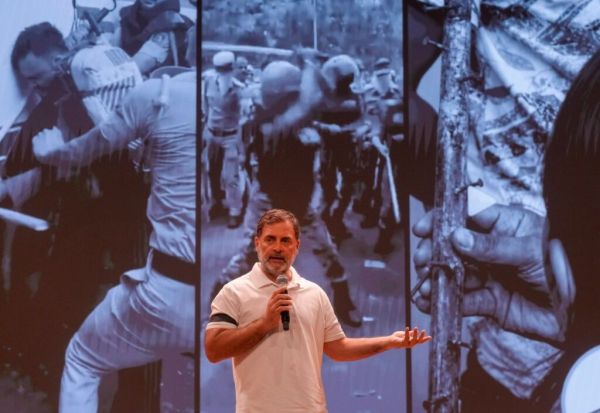
Congress leader Rahul Gandhi’s Wednesday (July 22) press conference may have put the spotlight on examination paper leaks and education reforms rather than his own detention, but the tougher challenge for Congress and the INDIA bloc lies ahead — sustaining this momentum once Parliament session adjourns.
The Federal‘s Political Editor, Puneet Nicholas Yadav, said the real test for the Congress and the INDIA alliance will come only after Parliament wraps up its ongoing monsoon session. He pointed out that while the debates inside Parliament are drawing attention now, keeping the education reforms issue alive in public discourse once the session ends will need a sustained, long-term political push.
Also read: Has CJP protest revealed a chink in BJP’s armour? | Talking Sense With Srini
He said Rahul’s “Chatron Ki Goonj” campaign seems built as an ongoing outreach effort rather than a one-off political exercise. At the same time, he cautioned that the campaign cannot simply repeat the same presentation over and over — it will need to keep evolving if it wants to hold students’ attention across the country.
What Congress spokesperson said
Asked about Rahul’s own treatment during the protests, he said that rather than dwelling on claims that he was assaulted or detained, Rahul kept steering the conversation back to the students’ plight and the need for education reforms. He read this as a deliberate attempt to keep the movement anchored in education issues rather than in his personal run-in with the police. He was speaking in a Capital Beat discussion.
Also read: Blood on Capital streets as doctors, students unite in CJP protests
However, Congress spokesperson Sujata Paul argued that the Congress had consistently supported students protesting against examination irregularities and that Rahul had been speaking about paper leaks through his “Chatron Ki Goonj” campaign in cities including Kota and Dehradun.
Paul maintained that Rahul’s decision not to visit the Cockroach Janta Party’s (CJP) protest site at New Delhi’s Jantar Mantar earlier had been deliberate. According to her, such a visit could have shifted attention away from the students themselves and allowed political opponents to portray the protests as being driven by the Congress rather than by genuine public concerns.
She further claimed that Congress workers, student organisations and legal teams had continued supporting protesters even when Rahul himself remained away from the protest venue.
According to Paul, the central message remained unchanged: the issue was about students, accountability and protecting the future of India’s youth rather than promoting any individual leader.
Police crackdown changes political context
Senior journalist TK Rajalakshmi viewed the press conference through a broader political lens. She said the police crackdown on protesters appeared to have changed the political context, making it important for Rahul to publicly reiterate the Opposition’s position.
Rajalakshmi observed that while Congress had supported the agitation earlier, the violence against protesters created the need for a stronger public intervention.
She also pointed out that Rahul broadened the discussion beyond examination paper leaks to include public sector employment, government jobs, and the broader state of education and employment.
However, Rajalakshmi felt Rahul could have stayed longer at the press conference and answered additional questions, particularly those concerning the future strategy of the Congress and the INDIA bloc.
She argued that, as Leader of the Opposition, Rahul represents not only the Congress but also the wider Opposition alliance, making clarity on future political coordination important.