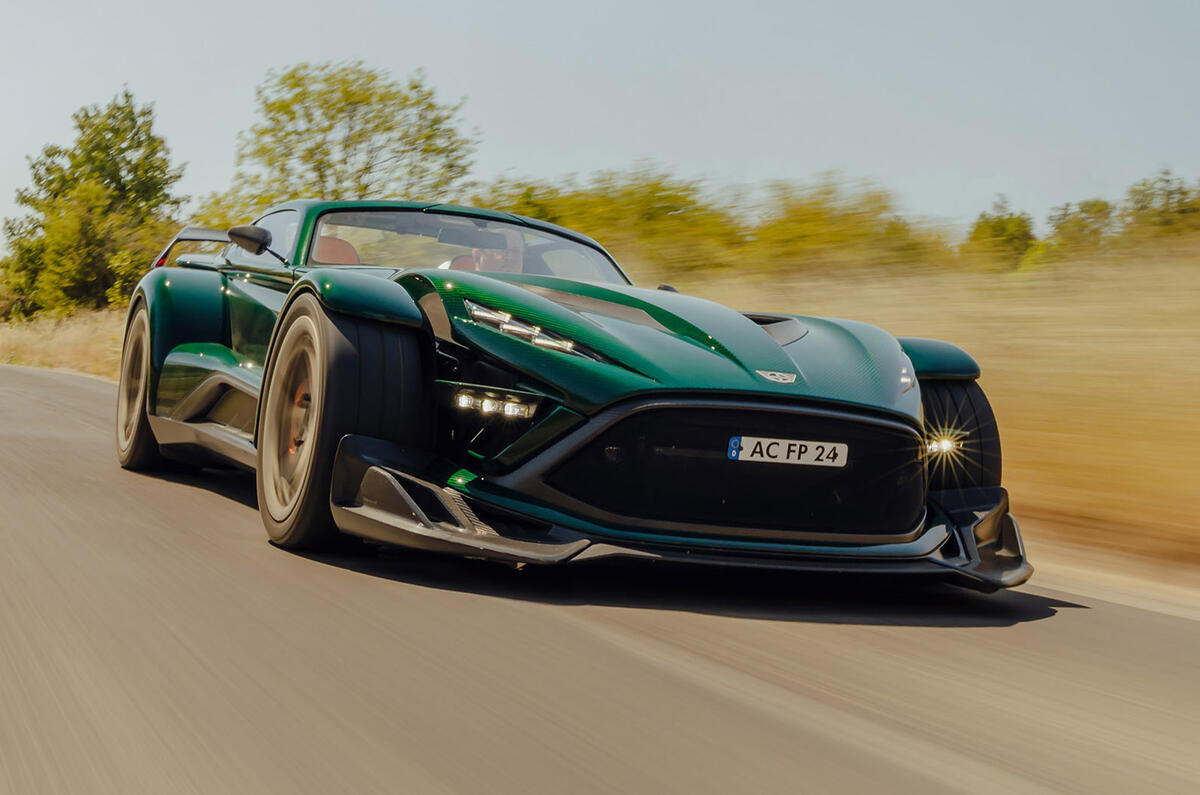
The Dutch automaker Donkervoort, long admired for its unique take on the classic Lotus Seven, is preparing to bring its latest creation – the Donkervoort P24 RS – to the UK. This 592bhp lightweight sports car, featuring right-hand drive for the first time, represents a significant step for the brand as it expands into Britain, the spiritual home of the lightweight sports car.
The Donkervoort P24 RS is a strikingly low-slung and aggressive-looking machine, yet it offers surprising practicality, including a 298-litre boot – a feature that highlights the company’s focus on usability alongside extreme performance. Donkervoort’s founder, Joop Donkervoort, initially began by importing and modifying Lotus Seven kits in the 1970s, eventually creating his own brand after extensive re-engineering to meet Dutch regulations.
Half a century later, Donkervoort’s global reach has come full circle. The firm will deliver its first right-hand-drive model to a UK customer in early 2027. To represent the brand locally, Premier GT of Washington, West Sussex, has been appointed the exclusive UK dealership. Today’s drive offers an early insight into what British enthusiasts can expect from this high-end, ultra-light sports car.
The P24 RS being tested is a left-hand-drive example from the Goodwood Festival of Speed, registered in Germany. Despite that, it provides a clear glimpse into the experience that awaits future UK buyers. The car’s design moves far beyond the minimalist Lotus Seven concept, showcasing a broader, more substantial form while maintaining its lightweight ethos.
The P24 RS is roughly 20% longer and about a foot wider than a Lotus or Caterham Seven. Donkervoort’s evolution from the S8 of 1983 to the D8 GT of 2007 shows how the cars have grown in size – perhaps accommodating the taller average Dutch driver. Nevertheless, the P24 RS remains compact and purposeful, measuring just four metres long.
Technically, the P24 RS builds upon the innovations introduced with the F22 of 2022. It continues to use Donkervoort’s hybrid chassis construction combining alloy spaceframe tubing with carbonfibre sandwich panels made using the company’s own Ex-Core technology. This design offers twice the torsional rigidity of the earlier D8 generation while maintaining a dry weight close to 750kg.
Under the bonnet, the P24 RS departs from the F22’s 2.5-litre turbocharged Audi five-cylinder engine. Instead, it houses a 3.5-litre twin-turbocharged Ford V6, a specially developed version of the engine used in the latest Ford GT. The turbos are supplied by Dutch Formula 1 component specialist Van der Lee. This new powerplant produces 592bhp at 5500rpm and 590lb ft of torque at 4500rpm – a considerable increase from the F22’s 493bhp output. The engine’s longitudinal layout also allows Donkervoort to offer both left- and right-hand-drive configurations for the first time.
In keeping with Donkervoort’s traditionalist philosophy, the car features a Tremec TKX five-speed manual gearbox and a Torsen limited-slip differential. There’s no electronic stability control, although traction control is provided to help manage the near-600bhp output. Anti-lock brakes and electromechanical power steering are optional; this test car includes the latter but not the former.
The P24 RS also introduces semi-active suspension with 35mm of hydraulic ride-height adjustment and six-stage adaptive dampers. Thanks to their sophisticated roll-control function, conventional anti-roll bars are no longer necessary.
Setting off from Charlton village near Goodwood Racecourse on a hot July day, the P24 RS feels surprisingly comfortable and manageable. However, the lack of air-conditioning in this demonstrator quickly becomes apparent, as heat from the carbonfibre cockpit builds up in traffic. Buyers are therefore advised to tick that particular option box.
The cabin itself is impressively accommodating. Despite the car’s compact shape, there’s ample space for taller drivers, with good adjustment in the seat runners and plenty of legroom. The steering wheel can be removed to ease entry through the upward-hinged doors, and the bucket seats strike a fine balance between support and comfort. Only the outboard elbow room feels slightly tight.
On the road, the Donkervoort’s character truly shines. In its ‘High’ ride-height setting, the suspension delivers a surprisingly compliant ride, with the car feeling fluid and communicative, much like a modern Lotus. The steering is light and precise, especially with the optional power assistance, and the overall driving experience feels involving yet approachable.
The five-speed manual gearbox, however, demands a skilled hand. Its short, heavy, and mechanical shift action rewards accurate timing and finesse. The gear ratios are extremely tall – first gear is for driving, not manoeuvring, while second carries the car well beyond urban speeds. Fifth gear corresponds to 6000rpm at the car’s claimed top speed of 186mph. This old-school setup gives the P24 RS a raw, engaging personality rarely found in modern performance cars.
The twin-turbo V6 delivers immense torque and real muscle, though its soundtrack is less exotic than one might expect from a car this wild. It lacks the crispness of a straight-six or the rumble of a V8, but its performance is formidable nonetheless. Acceleration is explosive, and the power delivery feels relentless once the turbos spool up.
When pushed harder on the fast, uneven roads of Salisbury Plain, some areas for refinement appear. In its softer suspension setting, the light steering can feel a touch vague at high speed, while firmer damping improves precision but introduces a harsher ride. The system occasionally struggles to manage sharp vertical inputs when cornering aggressively. These are the kind of dynamic quirks typical of low-volume performance cars—and ones that Donkervoort is likely to fine-tune before UK deliveries begin.
For a car priced at £302,400, potential owners will expect these minor issues to be addressed. Given Donkervoort’s agility as a small manufacturer, further refinement before production seems entirely feasible. The company’s responsiveness to customer feedback has always been one of its strengths.
Ultimately, the Donkervoort P24 RS delivers an intoxicating mix of old-school purity and cutting-edge engineering. It’s raw, mechanical, and deeply engaging – a welcome reminder that the analogue driving experience still has a place in today’s performance car world. As the brand prepares to enter the UK market officially, enthusiasts can look forward to experiencing one of the most distinctive sports cars ever built, now available with the steering wheel on the correct side.
Donkervoort P24 RS – Verdict: Wild-looking and blisteringly fast, yet surprisingly usable. It’s a deeply analogue, involving and evocative machine with a classic roadster spirit at its core.
Specifications:
Model: Donkervoort P24 RS
Price: £302,400
Engine: 3.5-litre twin-turbocharged V6 petrol
Power: 592bhp at 5500rpm
Torque: 590lb ft at 4500rpm
Gearbox: 5-speed manual; rear-wheel drive via Torsen LSD
Kerb Weight: 840kg
Top Speed: 186mph+
Economy: 28.4mpg
Rivals: Ariel Atom 4RR, Noble M500
-
Ines Garcia, partner of Barcelona and Spain star Lamine Yamal, speaks out against online hate following World Cup celebrations

-
Manchester United fans criticise club over strict action on season ticket holders

-
Made a mistake after filing your ITR? Don't worry; this feature can simplify the process for you.

-
Can the government impose an internet shutdown at any time? Here is what the rules and laws say.

-
Best Camera Phones: Capture stunning low-light and zoom photos with these 5 camera phones, now available at discounted prices.