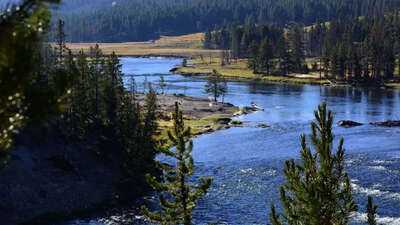
In the 1800s, Americans didn’t usually stop to admire the wilderness. Trees were lumber. Rivers were highways. If you weren’t farming, mining, or hunting, you probably weren’t paying much attention to nature at all. So the idea of setting aside huge swaths of land just to let it stay wild? Pretty radical. But in 1872, something incredible happened: President Ulysses S. Grant signed a law making Yellowstone the world’s first national park . For the first time, a government decided some land was too special to carve up or cash in and should be protected “for the benefit and enjoyment of the people.”
Over 150 years later, Yellowstone is still legendary, not just for its erupting geysers, forests, and herds of animals, but for what it started. The park helped kick off a global movement. Its creation inspired countries all over the world to set aside their own wild places and protect nature for the future. Yellowstone’s real legacy is way bigger than the park itself: it was a simple, bold idea that changed how we think about the planet.
The legendary YellowstoneThe park covers over 2 million acres, stretching across Wyoming, Montana, and Idaho, and packs in everything from steaming hot springs and roaring waterfalls to canyons, forests, and America’s biggest public herd of bison. There are grizzlies, wolves, elk, moose… you name it.
But the place wasn’t “empty” when it became a park. For at least 11,000 years before Yellowstone was even a word, Native American communities lived, hunted, and traveled here. The story of Yellowstone is also the story of those people being moved out, or simply ignored, when the park was created: a legacy historians and park stewards are, only recently, working to acknowledge and repair.
The road to protection really picked up steam in the late 1860s and ‘70s. Government expeditions ventured into the wild region, snapping photographs and painting dramatic scenes of things so strange: from boiling pools and spouting geysers to rainbow-colored streams, that lawmakers back east could hardly believe it. Photographer William Henry Jackson and painter Thomas Moran turned these wonders into images that helped sell the idea of preserving Yellowstone, rather than selling it off.
The legacy that spread everywhereIn 1872, with a stroke of Grant’s pen, Yellowstone was set aside forever. It was a daring experiment. Instead of chopping down the trees or drilling for minerals, the country decided this land simply had to be saved as a gift to everyone, for now and into the future.
That “crazy” idea caught on.
Countries like Canada, Australia, New Zealand, South Africa, and India followed suit, creating their own national parks based on the same principle. These protected places grew from simple sightseeing spots to laboratories for studying nature, preserving endangered species, and teaching people about the world around them.
There are now hundreds of national parks across the planet, protecting deserts, rainforests, coral reefs, and mountains. The notion that governments should look after wild places for everyone’s benefit basically started in Yellowstone.
Why Yellowstone still makes newsThe park’s importance runs far beyond its famous sights. Yellowstone protects one of the last big, healthy ecosystems in North America: a place where wolves, grizzlies, and bison can interact much as they always have. Scientists use the park as a giant outdoor lab, studying everything from predator-prey relationships to climate change and ecological recovery. The 1995 reintroduction of gray wolves stands out as a modern win. Their return changed the balance, letting forests and riverbanks recover after too many elk: a classic case of how top predators can shape entire landscapes.
Yellowstone is also a volcano waiting to go off. It sits on the world’s largest active “supervolcano,” with more than half of Earth’s known geysers. The region is a prime spot to study how the planet works deep underfoot.
Where it stands nowOf course, the way we see the park and the national parks that followed has changed. Growing numbers of scholars, park staff, and tribal nations are working to recognize and address Yellowstone’s complicated past. All the parks’ creation meant loss for many Indigenous people who were forced off their ancestral lands. Today, the Park Service is trying to make space for those stories too.
Still, the birth of Yellowstone changed the world. It showed that nature could be valued not just for what could be taken from it, but for what it gives to everyone: solace, wonder, a place for wild things to be themselves. That thinking has fueled environmental movements, inspired science, and helped protect countless other places.
Yellowstone, after a century and a half, is much more than a postcard. It’s a promise. It tells us that protecting something wild today is an investment for tomorrow. In an age when the natural world feels more threatened than ever, its story matters even more. The idea that started with one law, one park, and a handful of visionaries keeps shaping the way we live on this planet.
-
Abhishek Banerjee urges youth to review support for silent Icons

-
Public Rift Emerges Between Iran's Government And State Broadcaster Over US Talks
-
'Kader Khan would get very angry with Govinda': Shagufta Ali recalls how often the 'Hero No. 1' star was late on set but was always 'a bigger perfectionist than Aamir Khan'

-
Before Ryan Reynolds, Jensen Ackles was considered for 'Deadpool'; 'I wasn't available, so…' reveals 'Supernatural' actor

-
'I heard over a dozen scripts': Chris Evans returns as Captain America for 'Avengers: Doomsday' because of Robert Downey Jr.