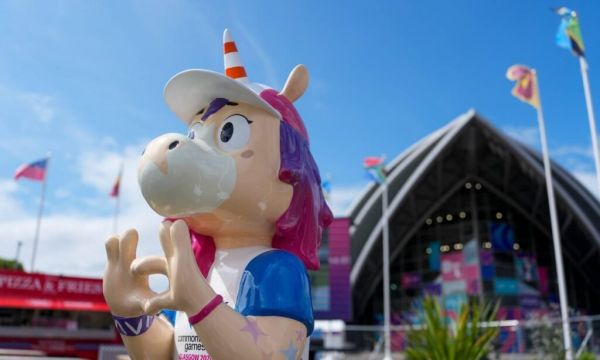
India launched its campaign at the 2026 Commonwealth Games in Glasgow, Scotland on Thursday (July 23) with a 125-member athlete contingent, aiming to make the most of a significantly reduced sporting programme that has altered the country’s traditional medal prospects.
The Games, scheduled from July 23 to August 2, were originally awarded to Victoria in Australia. However, the Australian state withdrew from hosting due to spiralling costs that had pushed the projected budget to nearly Rs 14,500 crore, prompting Glasgow to step in as the replacement host.
Given the limited preparation time and financial constraints, the organisers opted for a scaled-down edition featuring only 10 sports across four venues within an eight-mile radius, down from 19 at the 2022 Birmingham edition. The Games will operate on a budget of around £150 million (approximately Rs 1,750 crore), with £100 million funded by Commonwealth Sport.
Having successfully hosted the 2014 Commonwealth Games, the Scottish city already possessed world-class sporting infrastructure, allowing organisers to reuse existing venues instead of investing in costly new facilities.
Reduced events dent India’s medal hopes
The curtailed schedule is expected to have a significant impact on India’s medal prospects. The biggest challenge before India is the exclusion of several medal-rich disciplines.
The trimmed schedule has forced India to recalibrate its expectations after a memorable outing in Birmingham, where it won 61 medals, including 22 golds.
Sports such as badminton, wrestling, hockey, table tennis, cricket, and squash have been dropped from this edition, collectively accounting for 30 of India’s 61 medals in Birmingham.
Also Read: 2026 Glasgow CWG: To cut costs, only 10 events: hockey, shooting, cricket axed
Shooting, India’s most successful Commonwealth Games discipline with 63 gold medals, has also been omitted. Wrestling, where India has won more than 100 medals overall, including six golds in Birmingham, is another notable absentee. Women’s cricket, which fetched India a silver medal in 2022, has also been excluded.
Despite the reduced programme, India remains optimistic of a competitive campaign and will rely on its strength in the disciplines that have been retained.
Bronze assured for Lovlina Borgohain
India have secured their first medal of the 2026 Commonwealth Games even before the opening ceremony, with Olympic medallist Lovlina Borgohain assured of at least a bronze in the women’s 75 kg boxing event.
The 23rd edition of the Commonwealth Games has handed the Indian boxer a direct passage to the semifinals after she received a bye in a five-member field. Under Commonwealth Games boxing rules, all losing semifinalists are awarded bronze medals, ensuring that Borgohain will finish on the podium regardless of the outcome of her opening bout.
Also Read: Ahmedabad to host 2030 Commonwealth Games, India gets official nod
The Assam boxer benefited from the small draw, where three athletes, including Borgohain, advanced straight to the last four, while the remaining two contested the lone quarterfinal.
Borgohain will begin her campaign on July 31 when she faces Taafaki in the semifinal. Assured of the only major medal missing from her decorated cabinet without even stepping into the ring, Borgohain will now chase Commonwealth Games gold. Even if she falls short in the semifinal, she will return home with a bronze.
High hopes from boxing
Boxing is again expected to contribute a significant share in India’s medal tally.
The sport has yielded 44 Commonwealth Games medals for India so far and another strong showing will be crucial.
As many as eight Indian boxers have received first round byes. The likes of Jaismine Lamboria (57 kg), Priya Ghanghas (60 kg), Preeti Pawar (54 kg) are just one win away from securing medals. The seven-member women’s team, in fact, looks capable of matching or even bettering its return of two golds and a bronze from Birmingham.
Reigning 57 kg world champion Jaismine will be among the biggest medal prospects despite returning from an illness that forced her to miss the recent training camp in the Czech Republic. The Haryana boxer, who won bronze in Birmingham, will be aiming to upgrade the colour of her medal.
All eyes will be on Army boxer Sakshi Chaudhary who has dropped down from 54 kg to 51 kg. She defeated world champions Nikhat Zareen and Minakshi Hooda during the selection trials before underlining her credentials with gold at the Czech Grand Prix.
Asian Games bronze-medallist Preeti (54 kg) and Arundhati (70 kg), fresh from their Asian Championships triumph, further bolster India’s medal prospects.
Head coach Santiago Nieva is hopeful of a better show than four years ago when the women pugilists won two golds and a bronze medal.
The men’s squad, meanwhile, is in transition with plenty of newcomers. Six of the seven selected boxers will make their Commonwealth Games debut, with seasoned Asian Games bronze-medallist Narender Berwal (+90 kg) and Sumit Kundu (70 kg) the only members with significant senior international experience.
Also Read: 2022 Commonwealth Games: 15 interesting facts about India at CWG
Among the newcomers, Jadumani Singh (55 kg) will attract considerable attention.
The Manipuri boxer has moved up from 50 kg to the Olympic 55 kg category, a shift that has freed him from draining and drastic weight-cutting processes and allowed him to focus on performance.
Aditya Pratap Singh (65 kg) and Kapil Pokhariya (90 kg) are also highly-rated prospects, while multiple World Cup-medallist Sachin Siwach (60 kg) being the strongest medal hope among the men.
The young squad may lack experience, but it possesses enough talent to spring a few surprises. India’s finest boxing campaign at the Commonwealth Games came in Gold Coast in 2018, when the team won seven medals, including three gold.
MC Mary Kom became the country’s first woman to win a Commonwealth boxing title, while every Indian male boxer returned home with a medal.
India’s 125-member contingent
India’s contingent comprises 77 men and 48 women competing across eight able-bodied and five para disciplines. Athletics forms the largest contingent with 32 competitors, followed by boxing and judo with 14 athletes each, weightlifting with 12, and swimming with five.
Tokyo Olympic silver medallist Mirabai Chanu will lead the Indian team as the flagbearer at the opening ceremony, while Tokyo Olympic bronze medallist and former world champion boxer Lovlina Borgohain will serve as the baton bearer. The ceremony will begin at 12.30 am IST on Friday (July 24).
The overall Indian delegation includes 190 members, comprising 125 athletes, 51 coaches and support staff, and 14 contingent officials.
Neeraj, Mirabai lead India’s gold hunt
Despite the reduced programme, India retains several strong medal prospects.
Olympic champion Neeraj Chopra returns to the Commonwealth Games after missing the Birmingham edition due to injury. The 2018 champion will renew his much-anticipated rivalry with Pakistan’s reigning Olympic and Commonwealth champion Arshad Nadeem, while Sri Lanka’s world leader Rumesh Pathirage also features in a highly competitive javelin field.
Also Read: Gujarat’s blueprint for 2030 CWG: Land acquisition, new stadiums, mass evictions and infra upgrade
India’s athletics campaign will also be bolstered by long jumper Murali Sreeshankar, high jumper Sarvesh Kushare, sprinter Gurindervir Singh, Animesh Kujur, distance runners Parul Chaudhary and Gulveer Singh, and shot putter Tajinderpal Singh Toor.
In weightlifting, Mirabai Chanu will be chasing her fourth Commonwealth Games medal and a third consecutive gold.
Doping violations
However, in some disappointing news, weightlifter Dilbagh Singh was withdrawn from the Indian contingent after the country’s quota was reduced because of multiple Anti-Doping Rule Violations (ADRVs) during the qualification period. India’s weightlifting quota for the Games has been cut from 16 to 11.
The Indian Weightlifting Federation had named a 12-member squad for the showpiece and said it was told about the reduced quota only on Wednesday. “Since Dilbagh is suffering from a back injury and did not train at all during the preparatory camp in Birmingham, a decision was made to withdraw him,” a well-placed source told PTI.
Also Read: 2026 Glasgow Commonwealth Games: Why Gopichand and Vimal don’t want India to send team
N Ajith (71 kg), Sairaj Pardeshi (88 kg), and Harcharan Singh (110 kg) were banned for doping ahead of the CWG. Woman lifter Vanshita Verma (86 kg) was also sanctioned for an anti-doping rule violation in the qualification period.
Indian judoka Arun Kumar has also been withdrawn from the Glasgow Commonwealth Games after failing an out-of-competition dope test. Arun, who competes in the -73 kg category, had participated in the Qingdao Grand Prix last month.
He has been handed a provisional suspension by the National Anti-Doping Agency (NADA) for testing positive for an anabolic steroid.
India’s first competitive action
India’s contingent officially begins its campaign on Thursday, with the country’s first competitive action coming in lawn bowls. Two lawn bowls matches are scheduled before the opening ceremony later in the day.
With Ahmedabad set to host the centenary Commonwealth Games in 2030, India’s Glasgow campaign carries added significance, offering both an opportunity to add to its medal tally and valuable experience before welcoming the Commonwealth sporting fraternity to home soil.
-
PM Modi announces paper leak bill, Rahul calls video ‘pathetic’
-
Sonam Wangchuk ends 26-day fast, but keeps conditions secret
-
Wangchuk ends hunger strike after govt assures him of meeting his demands

-
PV Sindhu Exits China Open 2026 After Narrow Defeat to Chen Yufei

-
Prosecution Seeks Tougher Sentence for Actor Son Seung-won in Drunk Driving Case