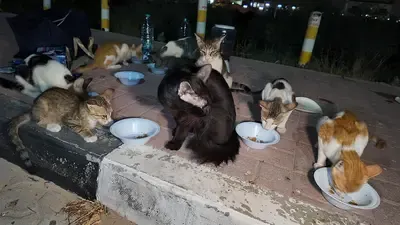
Every morning after Fajr prayers, while most of Dubai sleeps, Ahmed is loading 5kg bag of cat food into his car. He drives to Al Twar Park, where more than 150 stray cats gather each day, relying on him for their next meal.
As he calls out, they emerge from behind trees, bushes and nearby corners, gathering around plastic containers that he fills with food and water. Once they have eaten, he collects the containers, cleans the area spotless, and heads home only to return again later in the day. For the past two years, this has been his daily routine and it costs him at least Dh5,000 monthly on cat food alone.
Surprisingly, Ahmed is not alone. Across Dubai, residents like him are spending thousands of dirhams every month feeding, rescuing, treating and finding homes for stray cats. For some residents, what began as a simple act of kindness has turned into a daily commitment that now shapes their routines and finances.
Stay up to date with the latest news. Follow KT on WhatsApp Channels.
"I have seen cats die because they had no food or were suffering in the heat," said Ahmed. "I couldn't ignore them anymore."
He said he never misses a feeding round. On the rare occasion he cannot make it, someone else steps in to ensure the cats are not left hungry.
From feeding to rescuingFor James, helping stray cats started long before he moved to Dubai. Having always loved cats, he began rescuing them after seeing the challenges many strays face in the hot weather. He and his wife now care for four rescue cats at home, but much of their time is spent helping animals still living on the streets.
"We probably spend close to Dh10,000 a month," said James. "That includes food, rescues and veterinary treatment and more."
Through a network of volunteers, James was introduced to Ahmed while trying to rescue an injured cat in Al Twar. Seeing hundreds of cats gathered around the park convinced him there was much more work to be done.
Over the past five weeks alone, he estimates he and fellow rescuers have helped around six cats, spending nearly Dh24,000 on treatment.
“Rescuing a cat often means much more than taking it to a veterinary clinic,” said James.
Many require blood tests, vaccinations, parasite treatment, neutering and weeks of recovery before they are healthy enough to be adopted.
"Some treatments cost only Dh90. Others can cost Dh500 or Dh700. One rescue recently cost around Dh4,000. Every cat is different depending on the problems they face."
Finding them a homeOne rescue remains especially memorable for James. He recalled a stray cat whose face had severely deteriorated because of illness. The team took it for treatment, nursed it back to health and eventually found it a permanent home.
Another kitten had become trapped high up in a tree. "I had to climb up and rescue it. If it had fallen, it probably wouldn't have survived and the kitten has since been adopted,” said James.
For James, those moments make every dirham worthwhile. "It's not the money that matters. It's the satisfaction in your heart. Once you start helping them, it's impossible to stop."
Community of volunteersAlthough many rescuers know one another, they are not part of any formal organisation. Instead, residents communicate through WhatsApp groups, where someone posts whenever a cat needs urgent medical attention or when additional food is required.
Within a short time, volunteers step forward to help, while others contribute money towards veterinary bills. "These are ordinary people with ordinary jobs. If someone posts about a rescue, people donate because they genuinely care," said James.
He believes many residents develop a stronger connection with stray cats after moving to the UAE. "The weather is tough for them. I think people naturally feel they want to help," said James.
‘Adopt, don't shop’James hopes more residents will consider adopting rescued cats instead of buying pedigree breeds. “Rescuing a stray is often less expensive than buying a cat from a pet shop,” he said.
“Spaying through charity-supported clinics can cost around Dh150, while vaccinations and routine health checks typically bring the total to around Dh600 to Dh700, provided the cat has no major medical issues,” added James.
A pedigree cat can cost several thousand dirhams to purchase. "If you really care about cats, adopt one from the street.”
"It's such a small effort for a human, but for that animal, it's their entire life. Just by doing that one thing, you completely change its future," said James.
He advises prospective adopters to first identify cats that genuinely need homes, rather than removing healthy cats that are already being cared for by volunteers.
Many stray cats living in colonies are regularly fed and monitored, he explained. Those that are sick, injured or unable to survive on their own should be prioritised.
He also urged residents to ensure rescued cats are vaccinated and neutered before adoption. A clipped ear on a stray cat usually indicates it has already been neutered as part of a trap-neuter-return programme.
Despite common misconceptions, James said that the stray cats are generally not aggressive.
"Cats are reactive animals. They are not out looking to attack people. Most scratches or bites happen when you are trying to pick them up for treatment."
For Ahmed the motivation remains simple. Every morning, he returns to Al Twar Park carrying bags of food, knowing hundreds of cats are waiting.
For him, there is no question of stopping. “I will come here every day atleast twice. They are not just stray cats, I feel they are my family,” said Ahmed.
Do clipped ears hurt? Why some stray cats in UAE have them ‘In the UAE, we save every life’: Kittens rescued from inside Sharjah home pillar ‘They never chose this’: UAE rescuers warn of rise in pet abandonment as costs bite-
LPG tanker with 28 Indian crew attacked in Iranian waters, all safe

-
18 Delhi Metro Stations To Remain Closed From Saturday. Here's Why

-
'Thank You Friends': PM Modi's Message For Youth In Late Night Video | WATCH
-
Flipkart, Eight Roads Offload Shadowfax Shares Worth ₹1,654 Cr In Bulk Deal

-
UPI In June: Navi, super.money Gain Ground As PhonePe, Google Pay Slip Slightly