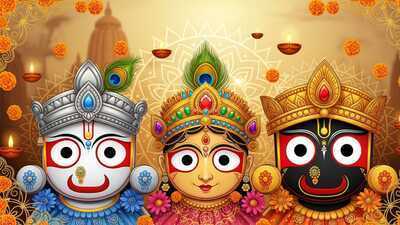
New Delhi: Lord Jagannath, worshipped as a form of Lord Vishnu, holds a special place in Hindu tradition, particularly in Odisha, where millions of devotees gather every year for the grand Rath Yatra. Unlike conventional Hindu idols carved with detailed human features, Lord Jagannath’s wooden idol stands out for its distinctive appearance. The deity has a large round face, wide eyes and an unfinished body with incomplete hands and no visible legs.
Over the centuries, this unusual form has inspired numerous legends and spiritual interpretations. While some beliefs trace its origin to divine intervention during the idol’s creation, others associate it with folklore linked to Lord Ram. Beyond these stories, the idol’s appearance is also understood as a profound spiritual symbol that reflects the limitless and formless nature of the divine.
Legend of VishwakarmaOne of the most widely narrated legends centres on King Indradyumna, a devoted worshipper of Lord Vishnu who wished to establish a temple with an extraordinary idol. According to the legend, Vishnu appeared in the king’s dream and guided him towards the divine form. The celestial architect Vishwakarma agreed to carve the idol on one condition, he would work in complete isolation and no one should interrupt him until the sculpture was finished.
As days passed without any sound from inside the workshop, the queen grew worried and persuaded the king to open the door. When they entered, Vishwakarma had disappeared, leaving behind an unfinished idol. The deity’s face had been completed, while the hands and body remained incomplete. The king accepted the unfinished form as Lord Jagannath’s divine will, and it has continued to be worshipped in the same form ever since.
Folk belief linking idol to Lord RamAnother popular story, passed down through oral tradition, connects Lord Jagannath’s appearance with an episode involving Lord Ram and Bali. According to this belief, Lord Ram acknowledged that killing Bali from concealment was unfair and offered to accept any punishment Bali wished to impose. Bali is said to have declared that Lord Ram’s future form would not have wrists. The tree that sheltered Ram would also become bitter.
According to the same tradition, Lord Ram blessed the tree by promising that it would continue to embody his divine presence despite becoming bitter. Devotees associate this belief with the neem wood traditionally used to carve Lord Jagannath’s idol, which is believed to be fashioned from sacred neem trees known as Daru Brahma.
Although this story is widely narrated in folklore, it does not appear in the major Hindu scriptures and is regarded as a traditional belief rather than a scriptural account.
Spiritual symbolism of Lord Jagannath’s formFor many devotees, the idol’s appearance conveys a deeper spiritual message rather than physical incompleteness.
- Incomplete hands: Symbolise that the divine does not require physical hands to protect, bless or guide devotees, as divine grace reaches everyone.
- Absence of legs: Reflects the belief that God is present everywhere and is not bound by movement or physical limitations.
- Large round eyes: Represent eternal awareness, compassion and the Lord’s constant watchfulness over all living beings.
- Smiling face: Symbolises peace, unconditional acceptance and universal love.
- Rounded wooden form: Reflects the infinite nature of the universe while also signifying simplicity, nature and the impermanence of worldly existence.
Lord Jagannath’s distinctive idol continues to fascinate devotees, scholars and visitors alike. Its unfinished appearance carries a message that transcends physical form. For devotees, the idol serves as a reminder that divinity cannot be measured by outward perfection, but by an eternal presence that extends beyond human imagination and material boundaries.