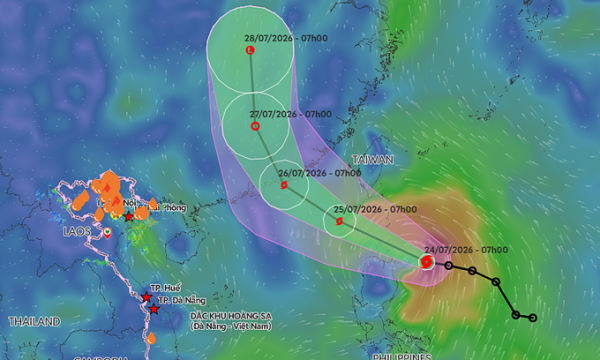
As of 7 a.m. on Friday, the storm lay centered approximately 210 kilometers east of the Philippines’ Luzon Island, according to Vietnam’s National Center for Hydro-Meteorological Forecasting (NCHMF). It is currently moving west-northwest at 25 kph, packing maximum sustained winds of 74 kph with gusts reaching up to 102 kph.
The storm is forecast to enter the northeastern waters of the East Sea by Saturday morning. It is expected to maintain its speed and trajectory while strengthening, with maximum sustained winds reaching 89 kph and gusts up to 133 kph.
|
A predicted trajectory of Storm Noul. Graphic by Vietnam Disaster Monitoring System |
By Sunday morning, Noul should reach the coastal waters of China’s Guangdong Province. Wind speeds are predicted to intensify further, reaching 89-102 kph with gusts up to 149 kph.
The storm will then likely shift north-northwest, making landfall in Guangdong at 15-20 kph before gradually weakening back into a tropical depression.
International forecasting agencies align with Vietnam’s projections. Japan’s Meteorological Agency predicts Noul’s sustained winds could reach 102 kph inside the East Sea, while the Hong Kong Observatory estimates peak winds of 120 kph. All three agencies agree the storm poses no direct threat to the Vietnamese mainland.
However, maritime conditions will deteriorate rapidly. Starting Friday evening, strong winds will develop over the northeastern East Sea, escalating to 75-88 kph and producing waves between 3 and 5 meters.
Conditions will be more severe near the storm’s center, with winds peaking at 117 kph and waves reaching up to 6 meters.
The NCHMF has issued strict warnings for vessels in these waters, citing high risks of thunderstorms, waterspouts, and extreme seas.
Noul will be the second storm in the East Sea this year after Maysak, which struck Vietnam and China in early July, killing 39 people in southern China, most of them after a dam breach inundated the city of Nanning.
Super Typhoon Ba Vi developed over the northwestern Pacific shortly after that. It did not cross into the East Sea but caused damage across mainland China, Taiwan, Japan and triggered heavy rains and landslides that killed at least 23 people in the Philippines.
-
‘I won’t let it be swept under the rug’ - Norway file formal complaint over Donald Trump’s role in Folarin Balogun red card controversy during World Cup

-
Monsoon Gardening Tips: Want a lush garden this monsoon? These 7 fast-growing plants thrive with almost no care

-
Chinese actress Tang Wei gives birth at 47

-
BLACKPINK’s Jennie breaks the internet yet again with latest music release

-
Flies and insects have increased in the house during the rains, so mix these natural things in the mop water.