The tussle between AI and critical thinking: How today's schools are tackling the intellectual conflict
ETimes | July 24, 2026 3:39 PM CST
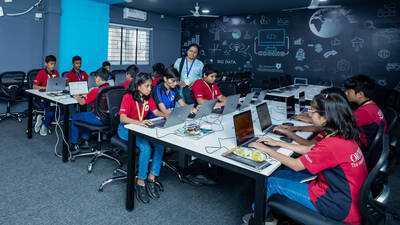
Something curious has happened over the past few years. Social media posts, answer sheets, homework copies: they all look perfect. No spelling slips, no awkward phrasing, no grammatical stumbles. Are students suddenly this precise? Or is something else doing the heavy lifting? The answer, of course, is artificial intelligence (AI).
Ironically, one of the simplest ways to tell human work apart from machine-generated text today is to find mistakes. Their absence has become the biggest giveaway. And that is where things begin. Generative artificial intelligence has been introduced across all levels of education at an accelerated pace over the last two years, prompting many to rethink what the future of student-educator engagement might look like.
According to the 2024 Global Digital Education Council Survey, at least 60% of students reported using generative AI tools on a weekly basis¹. Adoption in India is growing at a similar rate, particularly among secondary and post-secondary students.
While these tools allow for faster access to information, the educator and researcher community has also begun to examine how regular dependence on AI-generated responses might affect the development of critical thinking among students.
When convenience replaces process
For many students, AI has become the fastest route to an answer. The concern is not usage, but dependency.
A 2023 study published by the Stanford Graduate School of Education found that learners who relied on automated solutions were less likely to engage in iterative processes such as considering different perspectives and verifying sources².
This shift points to a broader change in student behaviour: from being driven by process to being driven by results, where the end goal is to arrive at the correct answer as quickly as possible, rather than to understand how that answer is reached.
Why schools are reworking the classroom
Rather than resisting AI, many schools are beginning to redesign how learning happens around it. Classrooms are gradually moving toward discussion-led sessions instead of answer-based teaching, project and viva-based assessments, and in-class problem solving that prioritises method over outcome. The objective is clear: ensure that thinking happens before tools are used, not after.
Some institutions have also introduced early-stage AI literacy , teaching students not just how to use these tools but how to question them. Schools, such as , have begun incorporating structured AI awareness modules alongside classroom learning, with a focus on responsible usage and the critical evaluation of AI-generated content.
Reintroducing the human layer
AI can generate information, but it cannot replicate lived experience, emotional context or ethical judgement in real-world scenarios.
Reports from the World Economic Forum continue to highlight skills like empathy, complex decision-making and collaboration as essential for the future of work³. These are developed through interaction, debate and direct experience, areas where traditional classroom environments still play a critical role.
As a result, schools are placing renewed emphasis on activities that require perspective, not just precision.
Where AI actually works
AI is not universally seen as a disruptive force. A great deal depends on the role it plays: whether it supports a process or replaces the person performing it.
When used to enhance individual effort rather than substitute for it, AI can meaningfully improve both the quality and efficiency of a student’s work. A 2023 McKinsey and Company report noted that students who used AI for brainstorming and editing drafts saw measurable gains in productivity. In that context, AI functions as an enhancement to human effort, not a replacement for it.
The balance schools are trying to build
The conversation around AI in education has shifted. It is no longer about whether these tools should be used, but how.
Too little regulation risks passive learning. Too much restriction ignores the realities of a technology-driven world. The middle ground lies in designing environments where students are encouraged to think first and use AI to refine rather than define their work.
This balance is gradually taking shape in how some institutions, including Orchids The International School , are approaching classroom practices, placing equal emphasis on independent thinking and the responsible use of emerging technologies.
As classrooms continue to evolve, the central question remains unchanged: what does it mean to truly learn?
AI may change how quickly people can find answers, but the lasting value of any educational experience will remain rooted in the ability to ask questions, interpret information and think for oneself.
The real challenge for schools is not limiting access to technology. It is ensuring that even in a world of instant answers, thinking continues to be treated as essential.
To know more about our curriculum, branches and process, visit Orchids The International School.
References:
Ironically, one of the simplest ways to tell human work apart from machine-generated text today is to find mistakes. Their absence has become the biggest giveaway. And that is where things begin. Generative artificial intelligence has been introduced across all levels of education at an accelerated pace over the last two years, prompting many to rethink what the future of student-educator engagement might look like.
According to the 2024 Global Digital Education Council Survey, at least 60% of students reported using generative AI tools on a weekly basis¹. Adoption in India is growing at a similar rate, particularly among secondary and post-secondary students.
While these tools allow for faster access to information, the educator and researcher community has also begun to examine how regular dependence on AI-generated responses might affect the development of critical thinking among students.
When convenience replaces process
For many students, AI has become the fastest route to an answer. The concern is not usage, but dependency.
A 2023 study published by the Stanford Graduate School of Education found that learners who relied on automated solutions were less likely to engage in iterative processes such as considering different perspectives and verifying sources².
This shift points to a broader change in student behaviour: from being driven by process to being driven by results, where the end goal is to arrive at the correct answer as quickly as possible, rather than to understand how that answer is reached.
Why schools are reworking the classroom
Rather than resisting AI, many schools are beginning to redesign how learning happens around it. Classrooms are gradually moving toward discussion-led sessions instead of answer-based teaching, project and viva-based assessments, and in-class problem solving that prioritises method over outcome. The objective is clear: ensure that thinking happens before tools are used, not after.
Some institutions have also introduced early-stage AI literacy , teaching students not just how to use these tools but how to question them. Schools, such as , have begun incorporating structured AI awareness modules alongside classroom learning, with a focus on responsible usage and the critical evaluation of AI-generated content.
Reintroducing the human layer
AI can generate information, but it cannot replicate lived experience, emotional context or ethical judgement in real-world scenarios.
Reports from the World Economic Forum continue to highlight skills like empathy, complex decision-making and collaboration as essential for the future of work³. These are developed through interaction, debate and direct experience, areas where traditional classroom environments still play a critical role.
As a result, schools are placing renewed emphasis on activities that require perspective, not just precision.
Where AI actually works
AI is not universally seen as a disruptive force. A great deal depends on the role it plays: whether it supports a process or replaces the person performing it.
When used to enhance individual effort rather than substitute for it, AI can meaningfully improve both the quality and efficiency of a student’s work. A 2023 McKinsey and Company report noted that students who used AI for brainstorming and editing drafts saw measurable gains in productivity. In that context, AI functions as an enhancement to human effort, not a replacement for it.
The balance schools are trying to build
The conversation around AI in education has shifted. It is no longer about whether these tools should be used, but how.
Too little regulation risks passive learning. Too much restriction ignores the realities of a technology-driven world. The middle ground lies in designing environments where students are encouraged to think first and use AI to refine rather than define their work.
This balance is gradually taking shape in how some institutions, including Orchids The International School , are approaching classroom practices, placing equal emphasis on independent thinking and the responsible use of emerging technologies.
As classrooms continue to evolve, the central question remains unchanged: what does it mean to truly learn?
AI may change how quickly people can find answers, but the lasting value of any educational experience will remain rooted in the ability to ask questions, interpret information and think for oneself.
The real challenge for schools is not limiting access to technology. It is ensuring that even in a world of instant answers, thinking continues to be treated as essential.
To know more about our curriculum, branches and process, visit Orchids The International School.
References:
READ NEXT
-
HCLTech Announces $1.5 Bn Investment To Build Maiden AI Data Centre In Odisha

-
Fractal, Meesho Slide Over 6% Each After Q1 Results

-
New Bill Aims to Protect 'Vande Mataram' from Disrespect

-
New Delhi Metro Station Temporarily Closed Amid Security Measures

-
Gold Price Today: Good news, finally a break in the rise in gold prices, know what is the price of gold on July 24