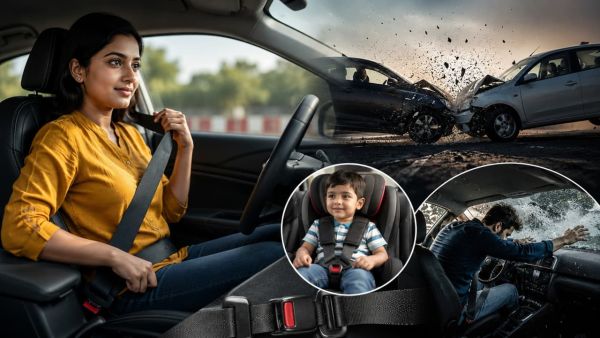
Importance of Seat Belt: Know why seat belt is important in a car, how it saves life in an accident, how to wear it properly, history and interesting facts.
Seat Belt Benefits: Wearing a seat belt as soon as you sit in a car is a small habit, but it is one of the biggest measures that can save your life during a road accident. Many people think that seat belts are necessary only for long journeys or on the highway, whereas the truth is that most road accidents can happen in cities and even during short distance journeys. Let us know why seat belt is important? How does it work?
What is a seat belt?
A seat belt is a safety device designed to keep the occupant safe in the vehicle seat. If the car stops suddenly or has an accident, the seat belt prevents the body from jumping forward rapidly.
How do seat belts save lives?
When a car is moving at a high speed and there is a sudden collision, then according to Newton's first law of motion (Law of Inertia) the body wants to maintain its speed. That means the car stops, but the body continues to move forward. This is where the seat belt comes in handy. It keeps the body anchored to the seat and distributes the shock of impact over the stronger parts of the body like shoulders, chest and hips. This significantly reduces the risk of serious injury to the head, neck and spine. For example, your car is running at a speed of 50 km/hr and suddenly brakes. If your seat belt is not on, your body could hit the dashboard, steering, or windshield. This risk is significantly reduced when seat belts are worn.
Why is seat belt necessary?
1. The risk of serious injury remains low
Seat belt keeps the body safe inside the vehicle during an accident, which reduces the risk of serious injuries to the head and chest.
2. Prevents being thrown out of the car
In a serious accident, the risk of passengers being thrown out of the vehicle without seat belts increases manifold. Seat belts reduce this risk to a great extent.
3. Provides better security when combined with airbags
Airbags and seat belts are supportive of each other. Airbags work most effectively when the occupant is wearing a seat belt. It is not safe to rely only on airbags.
4. Required on both front and rear seats
Many people believe that only those sitting in the front should wear seat belts. But seat belt is equally important for the people sitting behind. A rear passenger without a seat belt can get seriously injured in an accident and can also become a danger to the people sitting in front.
How to wear seat belt correctly?
- Place the belt across the middle of the shoulder and across the chest.
- The waist part should not be on the stomach, but above the hips.
- Do not keep the belt loose.
- Use a child restraint system or car seat for the child according to his age and weight.
When were seat belts introduced?
- In 1885, the first seat belt-like safety belt was patented in America. Its use was not thought to be for cars, but to keep horse carriages and other passengers safe.
- In 1903 French engineer Gustave-Désiré Leveau patented the first seat belts for automobiles.
When did seat belts come into cars?
- In 1949, the American company Nash Motors first introduced seat belts as a factory-fitted option in its cars.
- Early seat belts were only 2-point (lap belts), which held only the waist.
Read this also- The narrowest street in the world, where only one person can pass at a time
Who created the latest 3-point seat belt?
- In 1959, Swedish engineer Nils Bohlin developed the latest 3-point seat belt. At that time he was working in Volvo Cars.
Which car got hit first?
- The 1959 Volvo PV544 and Volvo Amazon were the first cars to be equipped with modern 3-point seat belts from the factory.
Why did Volvo free the patent?
Volvo kept the patent of this technology, but allowed other vehicle manufacturers to use it for free, so that more and more lives could be saved. This is considered one of the biggest safety decisions in automobile history.
Read this also- What is doping test? Why are A and B samples of players taken?
Some data related to seat belt
- According to WHO, wearing a seat belt can reduce the risk of death for the front occupants of the car by about 45–50% and the risk of serious injury by about 50%.
- According to the US National Highway Traffic Safety Administration (NHTSA), seat belts help save thousands of lives every year.
- WHO estimates that every year around 11.9 lakh people die in road accidents across the world.
- According to research, a rear passenger without a seat belt can also increase the risk of injury to the people sitting in front during a collision.
Content Source: World Health Organization (WHO), National Highway Traffic Safety Administration (NHTSA)-USA, Ministry of Road Transport and Highways (MoRTH)-Government of India, Global Road Safety Partnership (GRSP), Society of Indian Automobile Manufacturers (SIAM).
-
EPFO: Mutual Fund or PF? EPFO reveals which is the more beneficial choice..

-
Big Opportunity for IGNOU Students and Alumni: Placement Drive Set to Begin

-
CBSE Practical Exam Guidelines: Class 12 Supplementary Practical Exams to Begin on July 29; Board Issues New Guidelines
-
Are AI chatbots secretly using personal data? Here’s how to protect your data from AI..

-
Bihar Education News: Bihar Assembly passes the Private University Amendment Bill; know the key changes and why the Opposition is protesting.