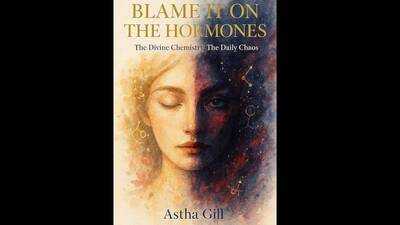
The AutHer Awards 2026 at Taj Palace, New Delhi, on March 22 celebrated India's finest women writers across categories. But one award stood apart from all the others that evening. The Popular Choice Award is not decided by a jury. It is not given by a panel of experts or a committee of literary professionals. It is decided by readers, real people who read, loved, and voted for the book they believed deserved to win. And this year, thousands of those readers chose one book above all others.
Blame It on the Hormones : The Divine Chemistry, The Daily Chaos by Astha Gill , the award-winning singer, performer, and now author, won the Popular Choice Award at the seventh edition of the AutHer Awards, a joint initiative by JK Paper and The Times of India. The vote count told its own story. This was not a close result. This was a community of readers speaking loudly, clearly, and with complete conviction.
The book that feels like a conversation you have been waiting to have
Astha Gill is best known as a performer and a voice that has filled dance floors and Bollywood playlists across India. But in Blame It on the Hormones, she brings something entirely different to the table. A voice that is raw, honest, deeply personal, and completely unafraid. The book explores what happens inside a woman's body and mind, the hormonal shifts, the emotional waves, the days when everything feels too much, and the days when nothing makes sense at all. But it does so not with clinical distance or medical jargon.
It does so with warmth, humour, self-awareness, and a disarming honesty that readers described as feeling like overhearing thoughts people rarely admit out loud. Astha's writing is raw, honest, and refreshingly fearless. Her message that it is okay to feel deeply, mess up, laugh at yourself, and still keep going hits hard. That, in many ways, is the heart of this book. Not a manual. Not a self-help guide with numbered steps and tidy solutions. But a companion. A voice that sits beside you and says, I feel it too, and here is what I have learned.
Why this book resonated with so many
What makes Blame It on the Hormones so powerful is not just what it says but also what it gives back to its readers. The book helped readers understand their emotions not as overreactions, but as signals worth listening to. It gave language to feelings they had long carried without clarity and reminded them that growth is rarely neat. For Indian women especially, this matters enormously. We grow up in a culture that does not always give us the vocabulary for what we feel and that often tells us we are too much, too emotional, or too sensitive. Astha Gill's book pushes back against every one of those dismissals and does it with grace, honesty, and the kind of humour that makes difficult truths easier to hold.
Instead of urging control, it offered compassion. Readers walked away more patient with themselves, more accepting of their changes, and deeply reassured that evolving does not mean something is wrong. You are not too much of anything. You are in motion. That line alone is worth the entire book.
A book that earned every single vote
The Popular Choice Award at the AutHer Awards is perhaps the most honest award in the literary world. It cannot be lobbied for. It cannot be influenced by prestige or connections. It is given by readers who were genuinely moved. And the fact that thousands of readers chose this book, above every other title in the running, says something important. It says that Astha Gill wrote something that people did not just enjoy. They needed it. They recognised themselves in it. And they wanted to make sure the world knew it existed.
Blame It on the Hormones: The Divine Chemistry, The Daily Chaos is not just a book about hormones. It is a book about being human, about feeling everything, about the messy, magnificent, sometimes maddening experience of living in a woman's body and mind, and choosing to embrace it anyway.
-
Saudi Arabia tops MENA in digital government services

-
RAF probes ‘excessive force’ used by personnel against students

-
Parliament remains deadlocked over NEET paper leak controversy
-
Bill in Rajya Sabha to criminalise insult to ‘Vande Mataram’
-
Pakistan’s first Netflix original drama premiere details out