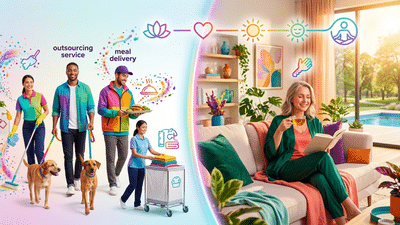
International Self-Care Day always gets people talking about baths, journaling and eight hours of sleep. But there's a quieter version of self-care that rarely makes the list: not having to scrub your bathroom after a ten-hour workday. Or hunting for a cleaner who can actually show up on a Sunday. That's the space Aayush Agarwal has been building for years now.
As Founder and CEO of Snabbit , Agarwal has watched wellness stop meaning just gyms and green juice, and start meaning something closer to home, literally. Urban India is spending more hours inside its own four walls than it used to, juggling hybrid work, long commutes and whatever's left of a social life. And somewhere in that shift, a clean, organised, functioning home stopped being a nice-to-have and started feeling like a basic requirement for sanity.
So on a day meant for slowing down and checking in with yourself, we sat down with Agarwal to talk about why younger consumers are paying for help with things their parents handled solo, how social media fits into all this, and why he thinks convenience isn't an indulgence anymore. It's a productivity tool. And for a lot of people, it might be the most practical form of self-care there is.
Is the rise of wellness culture changing the way people think about their homes, from simply being a place to live to becoming a space that affects their mental and emotional health?
Aayush Agarwal: The definition of wellness has expanded significantly over the last few years. It is no longer limited to fitness or nutrition; increasingly, people are paying attention to the environments they spend the most time in. For urban consumers who often work, socialise and unwind from home, the quality and upkeep of that space has become part of their overall lifestyle.
We see consumers prioritising homes that feel organised, functional and easy to maintain, not because a perfectly maintained home guarantees well-being, but because reducing everyday friction allows people to spend more time on what matters to them, whether that's family, work, hobbies or rest. Convenience, in that sense, is becoming an enabler of better everyday living rather than a luxury.
Why are younger urban consumers willing to spend more on professional cleaning , home organisation , grooming and maintenance services that previous generations often handled themselves?
Aayush Agarwal: Every generation makes different trade-offs based on how they value time. Today's urban consumers are balancing demanding careers, hybrid work schedules, long commutes and increasingly dynamic lifestyles. People are choosing to outsource routine tasks so they can reclaim time for work, family, fitness or simply taking a break.
Equally important is flexibility. Traditional household help often operates on fixed schedules, whereas modern urban life rarely does. Consumers today expect services that fit their calendars and not the other way around. Whether it's a cleaning session before guests arrive, a quick grooming appointment between meetings, or home maintenance over the weekend, people increasingly value the ability to access professional help when they need it, not just at a pre-agreed daily hour.
We are also seeing a broader mindset shift: convenience is no longer viewed as an indulgence. It is becoming a productivity tool. Consumers are increasingly willing to pay for predictability, quality and flexibility because they recognise that the most valuable resource, they have is time.
How much of this shift is driven by social media, changing lifestyles and the desire to create homes that look and feel 'put together'?
Aayush Agarwal: Social media has certainly influenced aspirations by exposing people to new ideas around home aesthetics, organisation and self-care. However, we believe it is only one part of a much larger shift.
The more fundamental drivers are changing lifestyles. Urban consumers are spending more time at home than they did a decade ago, balancing work, relationships and personal commitments within the same space. As a result, expectations around how that space functions have evolved. People increasingly want homes that are clean, organised and ready for everyday living, not simply because they look good in a photograph, but because they make daily life easier and more enjoyable.
Ultimately, convenience services are responding to this broader behavioural change by helping people maintain their homes without adding another task to an already busy day.
Self-care doesn't always look like a spa day. Sometimes it's just a home that runs smoothly enough to think straight in. Agarwal's take makes one thing clear: as urban life gets busier, convenience isn't about laziness anymore. It's about protecting the little time we actually get for ourselves.
-
Saudi Arabia tops MENA in digital government services

-
RAF probes ‘excessive force’ used by personnel against students

-
Parliament remains deadlocked over NEET paper leak controversy

-
Bill in Rajya Sabha to criminalise insult to ‘Vande Mataram’

-
Pakistan’s first Netflix original drama premiere details out