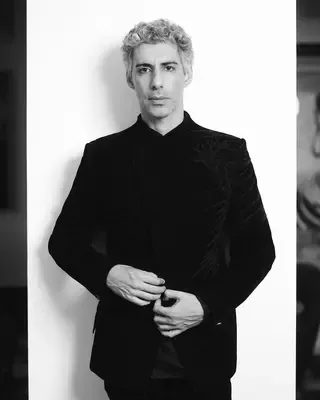
Few actors in contemporary Indian cinema possess the range and fearlessness of Jim Sarbh. Most recently seen as Xerxes Desai in Made in India: A Titan Story on Prime Video, he continues to reinvent himself with every role. Across films and streaming projects alike, Sarbh has displayed an uncanny ability to slip into characters both within and far outside his own world with the ease of a true master.
Whether as the chilling hijacker Khalil in his breakout debut Neerja, Alauddin Khilji's trusted general Malik Kafur in Padmaavat, the calculating Zubin Mistry in Sanju, the empathetic journalist Hamid Fezi in Gangubai Kathiawadi, the flamboyant Adil Khanna in Made in Heaven, or pioneering nuclear physicist Dr Homi J. Bhabha in Rocket Boys, he has delivered one memorable performance after another. Khaleej Times caught up with the critically acclaimed performer for a conversation about the craft and the characters that continue to challenge him.
When two good actors, well-trained in theatre, become co-stars on screen, how is the magic different compared to working with actors who have only worked on screen?
Film actors can be brilliant. Theatre actors can be brilliant. Film actors can be a pain to work with. Theatre actors can be a pain to work with. Training doesn’t necessarily make someone a great co-actor. I have acted in plays with highly trained actors, including those who teach, and wished I was in any other room. Very possibly, they felt the same about me.
If you're asking me specifically about Naseer, then it was an absolute pleasure. I would enjoy working with him on stage or on screen, not just because he is talented and in complete command of his voice and body, not just because he is fully prepared with his lines and motivations, not just because he is acutely aware of the camera and the power generated through shot-taking alone, but because he is fun to act with.
He listens to how you deliver a line. He notices your body language. He is alive to the moment and plays the scene moment by moment. He feeds off your impulse and gives you something to gnaw on in return. He can take a small mistake and turn it into a moment, as he should. Life is full of mistakes. I'm sure his training has helped him, but he is a kind of magic. And the kind of magic he is inevitably seeks out the appropriate training. Chicken or egg?
Do you see a change in the roles you're offered today compared to the ones you were offered when you first started out?
Yeah… time has passed. People have seen me do a variety of things. My commercial viability has increased. Naturally, the roles I'm offered have changed.
Do you see yourself taking on more roles in Indian regional cinema? Are there any non-Hindi Indian films you've particularly enjoyed, and why?
Yes, I have very much enjoyed a variety of Indian regional cinema. So much so that I had the opportunity to help bring two lovely projects to life. I was executive producer on Baksho Bondi by Tanushree Das and Saumyananda Sahi, a heart-rending Bengali film starring the exceptional Tillotama Shome. I was also co-producer on Sabar Bonda by Rohan Kanawade, a tender Marathi film starring Bhushaan Manoj and Suraaj Sharma, which won the World Cinema Grand Jury Prize at Sundance last year. Sabar Bonda (Cactus Pears) is available on Netflix, please do watch it.
Photo credit: Vansh Virmani
Later this year, I'll be acting in an Assamese film, and I'm quite excited to learn more about my role and to shoot in Assam. I have a particular soft spot for the Malayalam film industry because I enjoy how culturally specific its films are, as well as how good they are at setting things up. They take their time and don't seem to worry about "the formula", that by 20 minutes you must have this, the third act must be that, or there has to be a cliffhanger every two minutes. I think this country has incredible diversity and is just bursting with stories. I hope many more regional voices continue to emerge.
You've played several Parsi characters over the years. Does portraying someone from your own community come with a certain comfort, or do you still find yourself discovering new nuances with each role?
I'm not entirely certain. I suppose that because I feel comfortable, I can concentrate on the person and who he is. That allows me to discover the nuance, as you say.
If I'm uncomfortable with the language, or if I feel I haven't had enough time with the text — very late scripts being all too common in my industry — I spend all my energy trying to make the lines flow as though they are my own thoughts. That becomes my sole objective. I'm then stuck in what I prepared. I can't tread lightly. That focus might blunt the nuance, or my ability to play freely in the scene. To try new things and to explore, you have to feel comfortable.
To quote an article: 'Robert De Niro did not speak Italian growing up. To play young Vito Corleone in The Godfather Part II, he spent four months learning the specific Sicilian dialect. He studied at a language school, worked with a linguist, and lived in Sicily to perfect his accent.' I would happily put in the same amount of work. However, sometimes I'm handed the final script on the very day I'm supposed to fly to the shoot. Perhaps those projects end up lacking some nuance.
Do the characters you play leave a lasting impression on your life, or do you find it easy to leave them behind once filming ends? Do traces of them stay with you?
I shed all my characters quite easily. I become so intensely focused on the part while I'm working on it that, as soon as the project is over, I'm very happy to free up all that mental space, for myself and the people around me. My favourite day is the day I'm cast. My next favourite day is the last day of shooting. Everything in between is a kind of pleasurable torture. Hopefully, some of the lessons my characters teach me stay deep inside, and, hopefully, they'll find their way out.
Do you write as well? And do you see yourself producing or directing films, or perhaps even a play, in the future?
I have already produced, and I've already directed quite a few plays. I hope to continue down both those avenues. As for writing and directing films, they scare me. They really scare me. And so, I suppose I should do them.
When portraying real-life figures such as Xerxes Desai, Homi J. Bhabha and Charles Sobhraj, how do you strike the balance between staying true to the person and bringing something of yourself to the performance?
Well, no character in a biopic is the person. They are a version of them. There are many factors at play... the screenwriter's perspective, the producer's intent, the director's vision, and, eventually, the actor's melding of themselves with all of those forces.
I find it's good to do your research. Look up how the person speaks and moves. If that isn't available, then look at how they write. And if that isn't available, see how other people write about them. Those things give you little clues to add to your performance.
But eventually, I come back to the same approach I use for a fictional character. What do they need to do in the context of this particular production? This particular scene? This particular moment? How do I represent the spirit of the person within these very specific contexts?
Do you think cinema needs to be progressive-minded and carry a sense of social responsibility, or does it not necessarily matter?
All stories should be allowed to be told. The audience can decide whether they wish to watch them or not. Films will always be used as propaganda. There is no escaping that, anywhere. When censorship and propaganda join hands to allow only a certain kind of film to be made or released, that's when everything becomes very shaky.
'Fail again. Fail bigger. Fail better.' How do you interpret those words, both as an artist and as a person?
It is absolutely integral. If I feel comfortable enough to get a scene entirely wrong on set because I was being ambitious, trying something new, or pushing the boundaries of my character, then that is a good problem to have. Discovery only comes when you stretch the imagined limits of "the character". So what if things don't quite work? Perhaps the director catches a glimpse of something he or she can expand on, or polish until the scene does work. And it is more complicated now as a consequence. It is not just a wash of one colour. There are many colours intertwined. It is richer for failure.
Exclusive: Bhumi Pednekar on 'Daldal', imposter syndrome and why she’s done being hard on herself Arshad Warsi on his new crime thriller 'Bhagwat', life in Dubai, and why he chooses real stories-
LPG tanker with 28 Indian crew attacked in Iranian waters, all safe

-
18 Delhi Metro Stations To Remain Closed From Saturday. Here's Why

-
'Thank You Friends': PM Modi's Message For Youth In Late Night Video | WATCH
-
Flipkart, Eight Roads Offload Shadowfax Shares Worth ₹1,654 Cr In Bulk Deal

-
UPI In June: Navi, super.money Gain Ground As PhonePe, Google Pay Slip Slightly