More than 35% of Swiggy’s transacting users used multiple offerings on its platform during the financial year 2025-26 (FY26), as the foodtech major expanded its presence across food delivery, quick commerce, dining out and newer hyperlocal services.
Swiggy, in its annual report, said engagement across multiple services helped improve user retention, wallet share and the utilisation of its restaurant, merchant, dark-store and delivery networks.
However, the company’s overall platform frequency declined to 4.07 orders per user per month in FY26 from 4.43 in the previous year. It stood at 4.48 in FY24.
The decline indicates that the sharp addition of new users did not translate into a corresponding increase in average ordering frequency during the year.
Swiggy’s average monthly transacting users rose 33.1% YoY to 23.5 Mn in FY26, while its business-to-consumer orders increased 23.6% to 1.14 Bn.
“This cross-pollination effect continues to expand our user base while improving utilisation across restaurants, merchants, dark stores and delivery networks,” Swiggy said in its annual report.
The company’s average monthly transacting restaurant partners stood at 2.66 Lakh during the year, while average monthly transacting delivery partners increased to 6.49 Lakh.
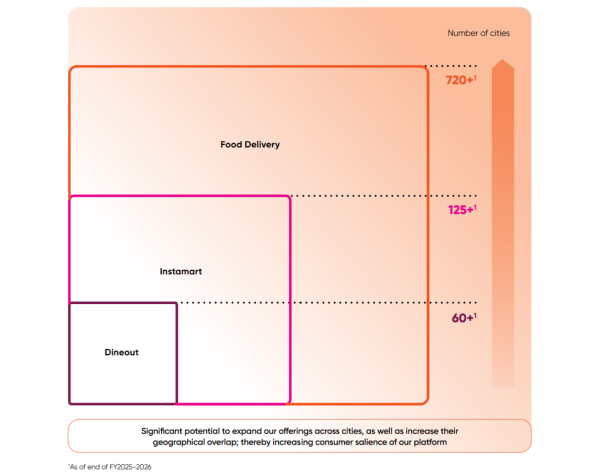 Swiggy Shows User Overlap
Swiggy, whose two largest businesses are food delivery and quick commerce platform Instamart, expanded its offerings during FY26 through multiple new experiments.
These included affordability-focused food delivery platform Toing, 10-minute food delivery offering Bolt, concierge service Crew and clean-label private brand Noice. The company also shut professional services marketplace Pyng and quick food delivery app Snacc within months of their launches.
“Crew was also introduced as part of our effort to explore newer convenience-led services. Not every experiment will scale at the same pace, but each helps us understand where our technology stack, fulfilment capability and consumer relationship can create future opportunities,” the company said.
Swiggy’s consolidated net loss widened 33% to ₹4,154 Cr in FY26 from ₹3,117 Cr in the previous fiscal year. Meanwhile, its operating revenue jumped about 51% to ₹23,053 Cr from ₹15,227 Cr in FY25.
Here is how the company reshaped its quick commerce and food delivery businesses during the year.
Instamart Network Can Support Over 2X Current GOVDuring FY26, Swiggy adopted a more calibrated approach towards expanding Instamart’s network, adding 122 dark stores to take its total active dark-store count to 1,143.
The company said its existing infrastructure could support more than twice Instamart’s current GOV, allowing it to focus on improving store utilisation and expanding selectively for coverage and debottlenecking.
Swiggy said it increasingly prioritised assortment depth, throughput and hyperlocal density rather than aggressive footprint expansion alone.
“Our existing network today has the capacity to support more than 2x the current order base, enabling greater focus on sweating assets, improving utilisation and selectively expanding where required,” the company said.
In comparison, quick commerce market leader Blinkit added 942 stores during the same period.
Instamart’s active dark-store area increased to 4.8 Mn square feet during the year. The company also scaled larger-format dark stores and megapods to offer a wider assortment and support higher throughput.
Swiggy is relying on this assortment expansion and automatic discounting feature Maxxsaver to increase basket sizes, improve wallet share and reduce its dependence on unsustainable incentives.
Quick commerce discounting has emerged as a recurring point of discussion in the sector. Days earlier, Eternal’s quick commerce CEO Albinder Dhindsa said the industry had reached peak competitive intensity and argued that there was limited room for rivals to deepen subsidies without worsening their losses.
The comments come as ecommerce majors Amazon and Flipkart expand their quick commerce operations and increase investments in the segment.
Instamart’s revenue from operations jumped 81% YoY to ₹3,859 Cr during FY26. Its loss widened 62% to ₹3,063 Cr.
Swiggy’s Bid To Become An IOCCThe annual report was released a day after Swiggy’s board approved capping aggregate foreign ownership in the company at 49.5%, an important step towards becoming an Indian-owned and controlled company (IOCC).
The status could allow Swiggy to shift Instamart from a marketplace model to an inventory-led structure under India’s foreign investment regulations. In such a model, Instamart could directly procure and sell products rather than operating solely as a marketplace connecting consumers and sellers.
However, Swiggy’s earlier attempt to amend its Articles of Association failed to secure the required shareholder approval. The proposal received 72.36% of the votes against the 75% threshold.
The renewed push comes ahead of Swiggy’s Q1 FY27 financial results on July 30, as the company faces pressure to improve Instamart’s economics amid intensifying competition in quick commerce.
Edited by Vinaykumar Rai
The post Over 35% Of Swiggy Users Try Multiple Services, But Order Frequency Slips appeared first on Inc42 Media.
-
Flipkart, Eight Roads Offload Shadowfax Shares Worth ₹1,654 Cr In Bulk Deal

-
UPI In June: Navi, super.money Gain Ground As PhonePe, Google Pay Slip Slightly
-
Jennifer Lopez Embraces Her 'Single Era' as She Celebrates 57th Birthday

-
Challengers' Cup 2026: A New Era for Ice Hockey in Ladakh

-
Rodri Set for Back Surgery as Manchester City Welcomes New Coach Enzo Maresca