
Swiggy slumped over 9%, while BlueStone surged nearly 29% in a weak week for new-age tech stocks.
Earnings-driven volatility and geopolitical tensions kept investors cautious, dragging most new-age tech stocks lower.
Only 16 of the 59 new-age tech stocks tracked by Inc42 ended the week higher, with the sector’s combined market capitalisation falling to $138.25 Bn.
It was a bearish week for India’s new-age tech stocks as renewed geopolitical tensions and a broad-based market selloff weighed on investor sentiment.
Of the 59 new-age tech stocks under Inc42’s coverage, only 16 ended the week in the green, gaining between 0.15% to nearly 29%. Meanwhile, the remaining 43 stocks closed lower, declining anywhere between 0.03% to over 9%.
Swiggy emerged as the week’s biggest loser, tumbling 9.19% to ₹251.40, while Fractal also declined more than 9% to end at ₹787.20.
We have added AI cloud service provider E2E Networks to our weekly new-age tech stocks coverage from this week.
Quarterly earnings remained the biggest stock-specific trigger during the week, with investors rewarding strong performers while punishing weaker results and cautious outlooks.
Go Digit, for instance, declined 8.95% to ₹256.50 after reporting a sharp fall in its Q1 FY27 net profit. Investor sentiment around Paytm, Eternal, Turtlemint (Q4 FY26) and IndiaMART Intermesh also remained largely dictated by their respective quarterly disclosures.
Here’s a look at the key headline numbers from the Q1 earnings season this week:
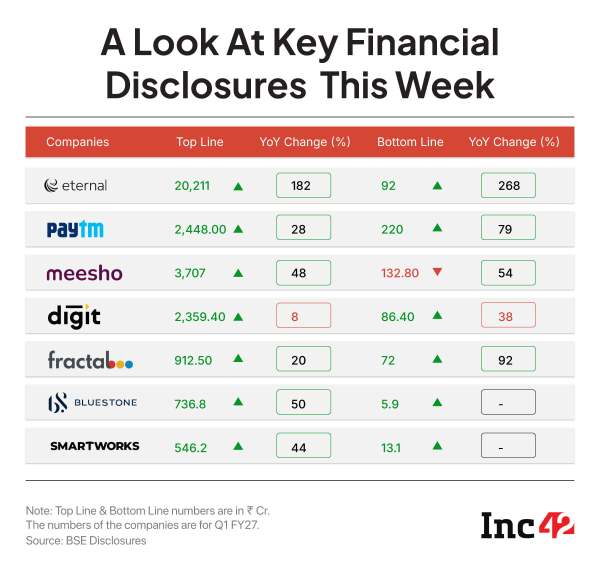
At the other end of the spectrum, strong quarterly performances fuelled sharp rallies in BlueStone and E2E Networks. BlueStone surged 28.9% to end the week at ₹772.90, while E2E Networks climbed to a fresh all-time high of ₹516.95.
The combined market capitalisation of the 59 new-age tech companies stood at $138.25 Bn at the end of the week, down from $142.41 Bn commanded by 58 companies a week earlier.
With that, here’s a look at some of the biggest developments from the week.
Key Updates Of The Week
- Flipkart Sells Stake In Shadowfax: Shadowfax investors Flipkart and Eight Roads Ventures offloaded shares worth as much as ₹1,654.4 Cr through multiple block deals shortly after the lock-in period expired for the recently listed logistics company.
- Paytm Drops Bonus Issue Plan: A week after the company floated the proposal, Paytm’s board decided against undertaking its maiden bonus issue, saying the company should instead focus on compounding growth and profitability to maximise shareholder value.
- Ather Energy Closes QIP: The EV maker raised about ₹1,300 Cr through its qualified institutional placement, allotting 1.08 Cr equity shares at ₹1,202 apiece. The QIP forms part of Ather’s broader ₹2,500 Cr capital raise aimed at funding debt repayment, research and development, and marketing.
- Klassroom To List Next: The edtech startup’s SME IPO will open on July 31. The public issue, comprising a fresh issue of up to 19.89 Lakh shares and an offer for sale of up to 4.66 Lakh shares, is priced at ₹151-159 per share and aims to raise ₹39 Cr.
- Meesho Faces Fresh Allegations: Proxy advisory firm InGovern urged SEBI to inspect Meesho’s logistics arm Valmo over alleged GST underpayment and inadequate tax disclosures. Meesho rejected the allegations, maintaining that its tax positions are fully compliant with applicable laws and disclosure norms.
- InMobi Braces For IPO: The SoftBank-backed adtech unicorn has appointed JPMorgan Chase, Jefferies, Kotak Mahindra Capital and Axis Capital to manage its proposed $1 Bn IPO. The company is expected to formally kick off the listing process shortly, though the final issue size and structure are still being finalised.
- Zaggle Continues Acquisition Spree: The fintech SaaS company approved the acquisition of a 19.9% stake in cross-border payments startup Unobanc for ₹7.97 Cr. The investment is expected to strengthen Zaggle’s cross-border payments, forex and remittance offerings.
- Zappfresh Claims Strong Growth In Q1: The SME-listed meat delivery startup said its revenue jumped 58% year-on-year to ₹74 Cr in Q1 FY27, driven by expansion across retail stores and quick commerce channels. The company is targeting ₹600 Cr in revenue by FY28.
- TAC Infosec Enters Consumer Cybersecurity: The cybersecurity company plans to acquire Israel-based Safehouse Technologies, marking its entry into the consumer cybersecurity segment. Safehouse’s flagship app, which has crossed 1 Mn downloads, will operate under a new entity called TAC Safehouse Technologies.
With that, let’s take a look at broader market trends.
Markets Succumb To Rising Geopolitical & Crude Oil Risks
Indian equity markets ended the week on a weak note as benchmark indices extended their losing streak, weighed down by a sharp spike in crude oil prices, escalating tensions in West Asia and persistent foreign institutional investor (FII) outflows.
Investor sentiment deteriorated as Brent crude breached the $100-per-barrel mark following the escalation of the US-Iran conflict and disruptions in the Strait of Hormuz, raising concerns over imported inflation and pressure on corporate margins.
Consequently, the Sensex fell 2.68% to close at 76,059.77, while the Nifty declined 2.33% to settle at 23,767.45.
Despite the broader risk-off environment, domestic macroeconomic indicators offered some relief. Private sector activity remained in expansion territory, with the composite PMI coming in at 54.3, while India’s foreign exchange reserves rose to $675.16 Bn.
Stock-specific buying also emerged in the auto and FMCG sectors, with Bajaj Auto and TVS Motor outperforming following strong quarterly earnings.
From a technical standpoint, the Nifty has broken below its 23,800-24,400 consolidation range and is now trading below key moving averages, with immediate support placed near the 23,600 level.
Going ahead, investors will closely track the US Federal Reserve’s policy decision, movements in crude oil prices, domestic macroeconomic data, including June IIP and fiscal deficit numbers, and the ongoing Q1 FY27 earnings season.
Now, let’s take a closer look at this week’s biggest gainer and biggest loser.
BlueStone Stock Rallies On Strong Performance
BlueStone emerged as the week’s standout performer, with its shares rallying nearly 29%. The omnichannel jewellery brand started the week trading around the ₹600-610 mark before witnessing sustained buying interest, eventually touching a high of ₹792.30 and closing the week at ₹772.40.
Investors cheered the company’s strong Q1 FY27 performance. BlueStone remained profitable during the quarter, reporting a consolidated net profit of ₹5.9 Cr against a loss of ₹34.7 Cr a year earlier. Operating revenue also surged 50% YoY and 8% sequentially to ₹736.8 Cr.
Management commentary pointing to robust domestic demand, continued retail expansion and healthy same-store sales growth further boosted investor confidence.
Strong momentum in gold and diamond jewellery sales, coupled with improving margin profiles, also provided fundamental support for the stock’s sharp rerating.
Another Bad Week For Swiggy
Swiggy ended as the week’s worst-performing new-age tech stock, with its shares declining 9.19% to ₹251.40.
The selloff came after the foodtech major approved a proposal to cap foreign ownership at 49.5% in a bid to qualify as an Indian-owned and controlled company (IOCC).
While strategically important for the company, the move sparked concerns that Swiggy could be excluded from global benchmark indices such as the MSCI Standard Index and FTSE, potentially triggering sizable passive fund outflows.
According to Nuvama Alternative & Quantitative Research, Swiggy could see passive outflows of nearly $460 Mn if its foreign ownership limit is reduced to 49.5%, resulting in its removal from major global indices.
Investor sentiment was further dented by Flipkart’s plan to foray into the food delivery business, intensifying competition in a market currently dominated by Swiggy and Eternal-owned Zomato. Continued concerns around margin pressure in Swiggy’s quick commerce business, Instamart, also weighed on the stock.
Edited by Vinaykumar Rai
-
Intent of infiltrators hasn’t changed since 1999 conflict, says Rajnath in Dras

-
Arsenal may launch Vinicius Junior bid as Real Madrid forward's contract saga continues

-
I don''t give much focus on what''s happening outside: Ishan Kishan

-
Drone capabilities display, Shaurya Sandhya: Army hosts anniversary events to honour Kargil heroes

-
5-year-old tigress found with infested injuries in Pilibhit Tiger Reserve, being treated