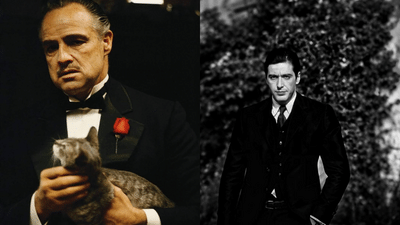
Picture this: Robert Redford squaring off in a dim, cigar-smoke study, playing not a golden-boy con artist but a hardened Sicilian don.
Or Ernest Borgnine, gruff and thick-necked, sitting behind Vito Corleone's desk instead of Marlon Brando.
It sounds like fan fiction, the kind of alternate-universe scenario film buffs dream up on a slow Tuesday night.
Except it very nearly happened. Fifty-plus years on, The Godfather feels less like a movie and more like a fixed point in cinema history, one of those rare works where every face on screen seems inevitable, almost predestined.
But behind that seamless final cut sat months of boardroom warfare, actors nobody asked for, and a director who fought Paramount Pictures nearly every step of the way.
Start with Brando, the man who is the Godfather in the popular imagination nowParamount didn't want him. Not even a little. By the early seventies, Brando had cooled off considerably from his ‘Streetcar’ and ‘Waterfront’ heyday, and studio executives saw him as an aging, unpredictable star whose box-office pull had all but evaporated.
According to Mark Seal, who chronicled the film's chaotic production in his book “Leave the Gun, Take the Cannoli: The Epic Story of Making Godfather”, the studio brass would have happily cast almost anyone else as reported by NPR.
Names tossed around included Ernest Borgnine and Carlo Ponti, the husband of Sophia Loren. Even Danny Thomas, the television star, reportedly floated the idea of buying the rights outright just so he could star as Vito himself.
The wish list for the role didn't stop there. Charles Bronson, Burt Lancaster, and even Orson Welles were all whispered about at various points, with Welles apparently convinced he was born to play the aging patriarch.
Laurence Olivier's name came up too, though age and health concerns eventually pushed him out of contention. Coppola, however, had tunnel vision. He was adamant in believing that only Brando could deliver the quiet menace the role demanded, and so did novelist Mario Puzo, who had personally written to Brando insisting he was the only actor capable of capturing that restrained, simmering power.
Getting Brando approved wasn't a matter of persuasion alone. Paramount attached brutal conditions: a reduced salary, personal liability if the production ran over budget, and a screen test, an indignity for an actor of his stature. Brando agreed anyway, and what followed became one of Hollywood's most famous auditions.
He stuffed tissue paper into his cheeks to mimic jowls, slicked his hair back with shoe polish, and experimented with a rasping, half-broken voice, imagining that his character had once taken a bullet to the throat.
"You see him roll up his hair in a bun and blacken it with shoe polish, talking all the time about what he’s doing. You see him rolling up Kleenex and stuffing it into his mouth. He’d decided that the Godfather had been shot in the throat at one time, so he starts to speak funny', told Coppola as reported by Collider.
When Coppola finally screened the footage for Gulf and Western chairman Charlie Bluhdorn, the skepticism melted away almost instantly. Once Bluhdorn came around, the rest of the studio followed his lead, and Brando had his role.
Casting Michael Corleone proved even messier
Coppola wanted Al Pacino from the very start, a decision that baffled nearly everyone around him.
Pacino was a respected New York stage actor with a Tony Award to his name, but on film he was practically a stranger to audiences, having appeared in only one prior movie.
Worse, at five-foot-six, he was shorter than Diane Keaton, the actress eventually cast as his love interest. Paramount production chief Robert Evans reportedly dismissed him outright, insisting a "runt" couldn't carry the role.
Meanwhile, the studio's casting shortlist for Michael read like a who's-who of early-1970s leading men: Dustin Hoffman, Robert Redford, Warren Beatty, Ryan O'Neal, Jack Nicholson, even Martin Sheen and Frank Langella. James Caan, originally in the running to play Michael himself, later joked that Paramount spent roughly $400,000 on screen tests in New York and Los Angeles, enough, he quipped, to have bought the perfect cast outright for the price of a few sandwiches.
Coppola refused to budge. Paramount eventually offered a compromise: Pacino could play Michael only if Caan agreed to take the role of Sonny instead. Coppola, still holding firm that authenticity mattered, pushed back hard, arguing that Caan simply wasn't right for the role he'd originally been eyed for. The standoff reportedly ended with Evans and Coppola in a heated face-off, a slammed door, and a reluctant agreement that finally locked the cast into place.
Diane Keaton wasn't a shoo-in either
Paramount worried she read as too unconventional for Kay Adams and pushed alternatives including Karen Black, Tuesday Weld, Blythe Danner, and Michelle Phillips.
What makes this backstory so compelling isn't just the "what if." It's the way Pacino's own rise mirrored Michael Corleone's arc on screen, an unknown quietly stepping out of the shadows into overwhelming power.
Pacino later admitted the transformation left him disoriented, saying the film handed him a new identity he wasn't fully prepared to carry.
"I was thinking that this is a character that could be very effective if he comes out of nowhere. That was my vision for it”, he told The New York Times as reported by Collider.
In hindsight, that unfamiliarity was the point. A more famous face as Michael might have robbed the story of its central shock, the sense of an ordinary man quietly becoming something monstrous.
Hollywood almost got a very different Godfather: older, more conventional, safer. Instead, Coppola's stubbornness gave audiences the one they know by heart.
-
July 27 Horoscope: Who will have to control expenses? Who is getting good signs? Whose unfinished work will be done?

-
Weekend Trip: Skip the rush of Shimla-Manali, plan this trip on a low budget
-
Parents struggle to keep kids entertained by day 10 of summer holidays

-
8 Tequila Brands Owned By The World’s Biggest Celebrities

-
Meghalaya, the ‘house of clouds’ gives a paradise like feel during the monsoon season, enjoy the greenery and valleys.