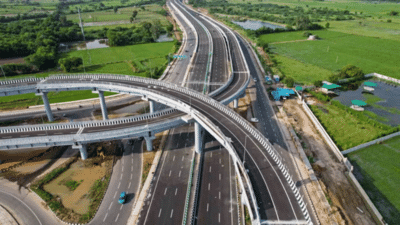
New Delhi: If you’ve ever missed a flight because of the Mahipalpur bottleneck, or watched your airport cab crawl through bumper-to-bumper traffic despite leaving “well in advance”, you’re not alone. For thousands of commuters travelling daily between Delhi, Gurugram and Indira Gandhi International (IGI) Airport, stretches like NH-48, Mahipalpur Chowk, Rangpuri and the Vasant Kunj approach have become synonymous with long traffic snarls, especially during office hours and weekends. Even a short distance can easily stretch into a 30- to 60-minute ordeal.
In a bid to tackle these chronic choke points, the Centre has cleared a nearly ₹7,000-crore access-controlled corridor featuring a twin-tube tunnel beneath Delhi’s Southern Ridge – an ambitious project that promises to make airport and inter-city travel faster, smoother and far more predictable.
Mega tunnel project set to rewrite NCR commutesAt the heart of the project is a state-of-the-art underground tunnel beneath Delhi’s ecologically sensitive Southern Ridge, designed to bypass some of the city’s most congested stretches without disturbing the protected forest above. Officials believe the new corridor will not only reduce travel time significantly but also decongest arterial roads that have remained under immense pressure for years.
The Centre has approved the construction of an 8.1-km, six-lane access-controlled corridor at an estimated cost of ₹6,969.67 crore. The National Highways Authority of India (NHAI) will execute the project as part of its efforts to improve connectivity across Delhi-NCR.
The corridor will link:
- Shiv Murti Interchange on the Dwarka Expressway
- Nelson Mandela Marg near Vasant Kunj in South Delhi
The project has been designed to provide seamless movement for traffic travelling between Gurugram, Dwarka, IGI Airport, West Delhi and South Delhi, significantly reducing dependence on already congested surface roads.
One of the project’s biggest engineering highlights is its 3.14-km underground twin-tube tunnel, of which nearly 1.98 km will pass beneath the Southern Ridge forest.
Instead of cutting through the protected Ridge ecosystem, engineers will tunnel underneath it, minimising surface disruption while preserving one of Delhi’s largest green spaces. The underground design also helps avoid major land acquisition and reduces the environmental footprint of the project.
The corridor isn’t limited to an underground stretch. The project also includes several supporting infrastructure upgrades aimed at ensuring uninterrupted traffic flow:
- A 3.56-km elevated road
- A flyover
- An elevated U-turn near the Mahipalpur–Chhatarpur corridor
- Grade-separated interchanges and access-controlled connectivity
Together, these components are expected to eliminate several traffic conflict points that currently slow down vehicles travelling between South Delhi, Dwarka and Gurugram.
How will it benefit travellersThe biggest beneficiaries are expected to be travellers heading to or from Indira Gandhi International Airport, especially those commuting from Gurugram, Dwarka and western parts of Delhi.
Currently, airport-bound traffic often gets caught in congestion around Mahipalpur, NH-48, Rao Tula Ram Marg and adjoining junctions. The new signal-free corridor is expected to provide a much smoother route, cutting travel delays and improving journey reliability during peak hours. While authorities have indicated that travel times will reduce substantially, no official estimate for end-to-end savings has been released.
Apart from airport connectivity, the project is expected to ease traffic pressure on several key roads, including:
- NH-48 (Delhi–Gurugram Expressway)
- Mahipalpur junction
- Rao Tula Ram Marg
- Nelson Mandela Marg
- Inner Ring Road approaches connected to South Delhi
With a significant portion of through traffic shifting to the new access-controlled corridor, authorities expect reduced congestion on these stretches, improving overall traffic movement across southern and western parts of the capital.
Part of larger Delhi mobility planThe tunnel corridor complements a broader set of infrastructure initiatives aimed at modernising Delhi’s transport network. NHAI is also working on a proposed elevated corridor between AIIMS and Mahipalpur, which, together with the new tunnel, is expected to create faster east-west and north-south connectivity across the city.
The project also strengthens integration with major road infrastructure such as:
- Dwarka Expressway
- Urban Extension Road-II (UER-II)
- Delhi-Gurugram Expressway
- South Delhi road network
Together, these projects aim to create a more efficient and resilient transport network for the rapidly expanding NCR.
Delhi-NCR continues to witness rapid growth in population, commercial activity and airport passenger traffic. With Gurugram emerging as one of India’s largest business hubs and IGI Airport handling millions of passengers annually, the demand for faster and more reliable connectivity has never been greater.
-
July 27 Horoscope: Who will have to control expenses? Who is getting good signs? Whose unfinished work will be done?

-
Weekend Trip: Skip the rush of Shimla-Manali, plan this trip on a low budget

-
Parents struggle to keep kids entertained by day 10 of summer holidays

-
8 Tequila Brands Owned By The World’s Biggest Celebrities

-
Meghalaya, the ‘house of clouds’ gives a paradise like feel during the monsoon season, enjoy the greenery and valleys.